RORY (00:00)
here’s something that I’ve been changing my mind on lately, which is the value of consistency in terms of your posting. if you’re trying to build a large following and you’re trying to be an online marketer and you’re trying to really grow that aspect of your business, consistency is really key. It’s really important. If you’re a small, small,
Business, and if you are sort of a micro influencer who’s gonna make a lot of money from a small audience.
I actually don’t know that you should be spending all your time cranking content consistently. And the reason why is because the algorithms are no longer just rewarding you for cranking out a whole bunch of content.
AJ (00:42)
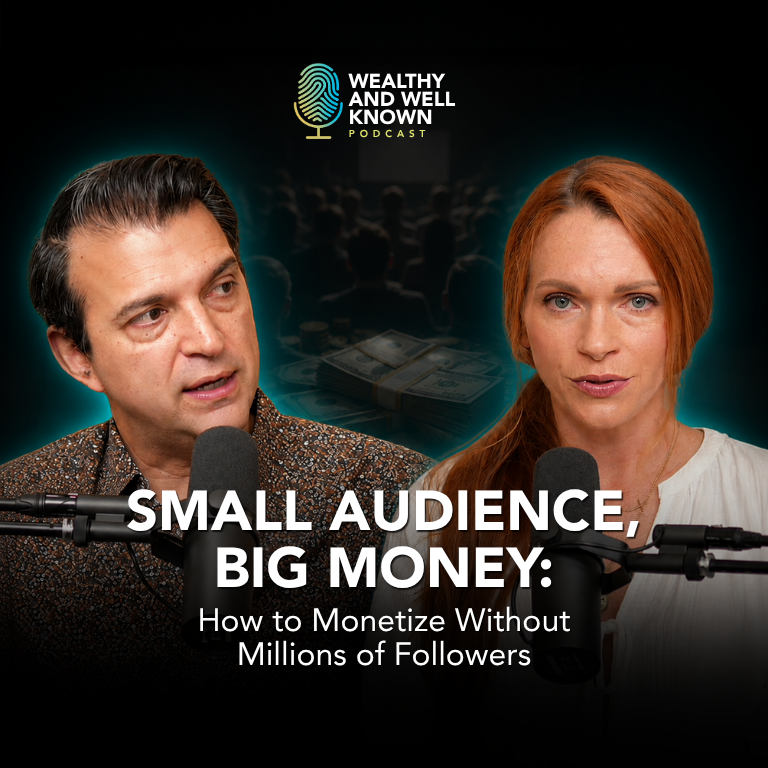
In a world where everyone thinks that bigger is better, today we’re gonna talk about the power of a small audience. And I think this is a good reminder for all of us, including me. So maybe today is just for me that bigger isn’t always better. And that a small audience can actually generate just as much, if not more, revenue than a big audience. Would you believe that a smaller audience can actually be
More powerful in generating revenue from your business than a huge audience. And would you believe that some of the highest paid experts in the world actually have an embarrassingly small audience? And so that’s what we’re gonna talk about today is how do you monetize a small audience and that it’s never too late to get started, and that it’s most powerful to serve the audience that’s right in front of you. And you can do that whether you have 10 followers or 10 million followers. So, Rory.
Here’s my first question of today. All right. All right. If you were to narrow it down to some of the best monetization models.
That would help someone go, I don’t have a big audience. Actually, I have a relatively small audience. We’ll say below 5,000. Below 5,000 followers online. We’ll say email us and all of that. But if you have you have a small audience, what are some of the best monetization models that you can use to actually generate revenue and create a business with a small audience?
RORY (02:09)
Yeah, so it comes down to one word, I would say really is like intimacy or access. When you have a small audience, what people are gonna pay you for is more access. Right. When you have a big audience, they they they don’t get close to you. But when you have a small audience, you can serve people in a very close way and they will pay money for that access. So I think, you know, my brain immediately goes to coaching and consulting as the actual business model to.
Make a lot of money from a small audience. Why? Because those are the most intimate environments from a business model where you go, I’m really getting to know people. I’m I’m working closely with them and their team. I’m probably walking with them over some period of time. And so they get access to me. And then also to the extent that I can do more done-for-you services, that is going to be the primary, those are the primary levers that I’m pulling: access and execution.
To go, hey, we we can get a lot of money from a very small audience. Even one customer, you know, two customers, five customers, ⁓ you know, you can make a lot of money serving people. And when we say you make a lot of money serving people in a deep way, that’s what we mean. You’re up close with them and you’re walking, we’re walking with them to the point of executing exactly what you have to share.
AJ (03:34)
So for clarity’s sake, can we just define what is coaching versus consulting?
RORY (03:39)
Yeah,
that’s a great question. ⁓ I want to hear your answer to this too. Okay, so basically
the the the simplest delineation in my mind between coaching and consulting is I think of coaching as B2C business to consumer. I’m working with an individual person. ⁓ I think of consulting as you know B2B business to business. I’m working with a group of people or a company. And even if I’m I can be coaching as a subset of consulting, but it’s like I’m consulting an organization and as part of that package
I’m coaching individuals. So I think that’s the main delineation that I have, but it’s it’s still they both sit inside the vein of: I have a framework, I have a methodology, I have unique intellectual property, I have a unique method, something we would call your modular content method, and I’m deploying my method.
to an organization or an individual to help them apply that to resolve a problem and achieve a payoff. And it’s just am I doing that at the organizational level or am I doing it at the individual level? That’s it.
AJ (04:47)
Yeah, I’d I’d say my definition’s pretty dang close to that. ⁓ it’s just a a one to one versus a one to many. It’s like when I think about a coaching relationship, it is a one to one relationship. When I think about consulting, it’s what am I institutionalizing that is one to many. ⁓ it’s for the people who are here today, but also for the people who will be there in the future. I’m putting systems and processes in place that allow people to run on a track. ⁓ so it’s more systems and process driven. It’s more
are what I would say corporate.
RORY (05:22)
Give give give us some tangible examples because ⁓ so here’s something that I don’t think not everybody knows about you because you know today you’re the CEO of brand builders group and we do what we do. ⁓ in our former business, among other things, you ran a consulting division that was a multi-seven figure division inside of the whole company, and you were doing a lot of this B2B. What when you say installing systems, giving people a track to run on, taking a methodology and applying it one.
to many. What are examples of the kinds of systems? What are the ways you’re institutionalizing your expertise in an organization at scale that allow you to charge high fees and and more importantly, bring high value worth high fees?
AJ (06:07)
Yeah, I think one of the biggest opportunities for people who want to be consultants or who are consultants and who are maybe even asking this question of like, well, how do I better monetize what I’m doing in my consulting business with a really small audience? And the beautiful thing about consulting is you don’t need a big audience. you couldn’t handle a dozen projects if you wanted to. Like if I had three projects running at the same time, I was like
trying to breathe air through a straw in the middle of a tsunami. Like more than three or four projects. I couldn’t handle more than that. But that has a lot to do with how do you define consulting, right? And it is the institutionalizing of systems and processes. So here’s one tip to ⁓ actually help monetize a consulting business is I started every consulting project with a research phase. And I think a lot of people don’t do that. In fact, I know a lot of people don’t do that because we have hired many a consultant
that never offered that. Or at least we considered hiring them. But I think that’s a really big part of like I was like, I can’t even tell you what you need. I can’t even offer my services to you because I have no idea what you have in place. So if you really want to consider this, what I will sell you where we start everyone was a flat consulting package that was just a research package. Now, this isn’t a research study. This is hands and feet
Hitting the pavement and being like, I’m coming in and I’m secret shopping. Right. I spent three months as a somewhat undercover retail operations person for a client that I cannot name publicly here because I don’t think that would be fair and right, but it’s like I had the uniform.
Right. I was working in the retail stores, ⁓ doing research. That was a part of what I was being paid to do. Why? I needed to go. Did the systems and operations that they had as a company actually make it to deployment in the stores? Were they actually using the scripts? Did leaders actually do what they were taught to do? Right. So it’s one thing to have systems and processes. It’s another thing for your people to actually use them. We know that even internally at our small company. So a research phase is going, hey.
If you really want to see movement and success in your organization, then I first have to assess where you’re at. I can’t help you get to where you want to be if I don’t know where we’re starting from. ⁓ Also, that’s a part of the adoption process. It’s going, I have to be able to culturally align whatever I’m doing to something that’s going to fit in your organization. And that’s why I charge a premium. Everything I’m doing, even though there are systems and processes, I’m going to adapt them. I’m going to mold them. I’m going to customize them to fit within your culture.
Cultural parameters based on something that I think your people would actually do, that they would actually adopt. And I can’t tell you how to do that if I don’t know your people. So I would be reviewing scripts. I’d listen to sales calls. I’d sent in call centers for hours and hours at a time, listening to how people answered the call, had the conversations, ended the call. I would ask them how they documented stuff. They thought I was there often being onboarded as a new employee. So it wasn’t deceptive. I just didn’t share a whole lot. And I was introduced as hey.
She’s here shadowing today. And it’s amazing how many people never asked. What are you shadowing for?
RORY (09:26)
And so you
you would actually companies would actually pay you to basically just go listening. Just listen, read, watch what they’re doing. You’re not actually teaching them anything. You’re not doing anything for them. You’re just learning effectively. You’re learning their organization and how they do what they would do.
AJ (09:33)
What’s happened?
Absolutely. And then at the end, I provide my feedback analysis and recommendations. And at that point, my part of the process could be done. And I was like, you can take this research report. because this is hands-on research of what’s happening at the frontline level, at the mid-level manager, at the executive level. This is what’s being used. This is what’s not being used. Here’s why it’s not being used. Here’s what’s working. And here are my recommendations of what need to be improved. And on a consulting basis, most people
Are going, hey, we’re trying to increase increase top line revenue. ⁓ 99.9% of the time, it was something to do with revenue generation or revenue retention. ⁓ and then I would say, here’s the real problem: there is no consistent sales training. There is no sales training, there are no scripts, there are no processes to follow. You don’t even have regular meetings, there’s no chain of communication, there’s no
No, whatever. The point is, is that is one way for anything that you’re doing as an actual consultant to be implemented and to get real results, is that before you go and deliver, which we often hop to, it’s go, hey, first I have to assess. And it didn’t matter how small the company was. I did this for companies that were as small as twenty or thirty people. And I did this for corporations that had hundreds of thousands of employees.
RORY (11:08)
And to so to tie this back to monetizing, if you have a small audience, right? You can’t provide that level of service to clients and have hundreds of clients to go spend four hours watching their videos, watching their people, going through their website, secret shopping them, reviewing their internal training materials, interviewing their leaders, interviewing their frontline. And you go, that is a massive value add. And it’s exactly what we’re talking about when we say it’s more access to you.
It’s a more intimate experience. And the end of that first project is just telling people what to do. So you learn and assess and then you tell them what to do, but you don’t tell them how to do it. That’s what they hire you for on the ongoing basis. But so that would again a few clients, a big big big
AJ (11:57)
There’s a great ways to a great way to increase monetization if you’re a consultant. And then coaching was always just a part of what we included in the next phase. That’s like part of what you need is you need coaching. Like these people need help. They need support. They need guidance. so I would just say like that is one way to monetize a very small audience because you can only handle a very small amount of people doing that level of intense work. So you don’t need huge audiences for one-on-one coaching or for consulting.
And again, it doesn’t matter the organization size. ⁓ It’s like, you know, you’re paying a premium because you are paying me to do something that is completely custom for you. It’s this isn’t a course. This is like I am in your uniform, in your call center, following your people, going on sales meetings. And so you can charge a premium for that because it’s so custom and it’s so tailored.
RORY (12:50)
Yeah. And it I think when you think about monetizing a small audience, I think about this as like David and Goliath, right? It’s like if you’re Goliath, you’re big. You’ve got a big audience and that gives you certain advantages. But most people who have a big audience monetize it by selling lower price products to a lot of people because they built a big audience by sort of generally applying at a sort more surface level to a lot of people. If you have a small audience, that’s like David, right? You’re more nimble. ⁓ and
You go, I can serve a small number of people, but in a much deeper way, a much more intimate way, and a much more customized way, which I think is a big word that you use there. And people will pay for that premium. They’re not paying you a lot of money because you have a lot of followers. Nobody pays you a lot of money because you have a lot of followers. People pay for a result. They pay for you to solve a problem. They pay for you to be helpful and to be customized and unique to their situation. And that doesn’t have anything to do with how many followers you have.
have and you could actually argue that the smaller the audience you have, the smaller the team you have, the more time you have available to be with clients because there’s less time you’re having to do to like manage your team and your media company and and do all of those things.
AJ (14:03)
Thanks.
So here’s what I would say is if you’re because the question really to go back to this is what are the top monetization models that you can use with someone who has a ⁓ smaller following, under 5,000 people? And we’re saying it’s one-on-one coaching or it’s consulting. Now, I think something that’s really valuable to add on to that if you’re, you know, sit in that coach or consultant category is to go, well, how do I get started in that? Right? Like if what if this is ⁓ a business model that I’m new to? Like, how do I introduce myself as a
coach or consultant. And here’s where I would say that true expertise is your biggest advantage. And this is where I would also say that our what I think is one of our most powerful quotes out of our book, ⁓ which is about the person you serve. And what we say all the time is what, Rory?
RORY (14:51)
You’re most powerfully positioned to serve the person you once were.
AJ (14:55)
Okay, so pause right there. You’re most powerfully positioned to serve the person you once were. This is the fastest way to activate a coaching or a consulting business. I’ll give you a couple of ⁓ nuanced micro examples that are varied just to help you have a little understanding of like what
I don’t know. It’s like I I’ve been in roofing sales for the last 20 years. Like, how would I do that? So we have a client at Brand Builders Group. Who is that person? He was a top 1% in the nation salesman for a nationwide roofing company.
Okay, they went through a merger acquisition, something. And anyways, his office got closed and he found himself ⁓ without a job. he was getting recruited left and right to join all these other roofing companies in his local area in Florida. But he didn’t want to do that. He goes, I actually want to build my personal brand. I want to get out of being an employee for another company. And I I at this point doing this for I think he had been doing 30 years, he goes, I want to build my
personal brand. How do I do that? And I’m like all these companies that are recruiting you to come and be their top performing salesperson, just saying you’re not for hire, but you are available as a consultant.
Right. True expertise, true results was the pathway for him to building his coaching and consulting business. He didn’t even have to go find these people. He just had to take these recruiting calls and turn them into sales calls. So that’s one way, right? So let’s just say you found yourself being laid off or there was a merger and an acquisition or whatever, but you’ve got real expertise and a real reputation in your industry. That’s why building a personal brand, ⁓ even as a corporate employee, even as a frontline
Salesperson for someone else matters a lot because he had a reputation and decades of real results and experience where people started calling. They were blowing him up. And all we talked about is take those recruiting calls and turn them into sales calls. You’re not available for hire, but you are available as a consultant.
RORY (16:59)
And an easy line to say there is to say you’d have to pay me so much money to be an employee, you could not ever afford it, but you can fractionalize that and I can not only d you know help your team, I can install the principles that makes everyone on your team do in exactly what I did. And that’s because you had the results to prove
AJ (17:19)
That’s right. So that’s the first example. The second example is how do you make this transition? So let’s say you are trying to make the transition out of corporate. And one, let me just say this as a caveat. I do not think everyone should leave corporate. I do not think everyone should own own their own business. I do not think everyone should be a coach or consultant. That does not serve everyone really well. I think it is great and amazing for some of us to be nine to five employee jobs. That is like what we were built and suited for. And companies need you. Companies need it. So like let me just say that. Like not everyone should do
RORY (17:48)
It’s
also not as easy as glamorous to be an entrepreneur.
AJ (17:51)
Like first,
I’m not saying everyone should just like bail or threaten their employers. Cause if my team says, ⁓ listen to that podcast, I’m gonna have like a full on like meltdown and be like, delete that podcast, right? That’s not what I’m saying. ⁓ but I do think this is important. ⁓ if and when the time comes where you’re like, hey, like, I do have a calling on my life and I do know I need to go do this other thing. Like a great transition out is to contact your current employer and be like, hey, I’ve got to go do this other thing. Like, I feel called to do it. I can’t be a full time
I’m employee anymore, but would you ever consider retaining me as a consultant?
So that could also be another path to transition. ⁓ not allowed for our team members, of course, because you want to be full-time employees here at VVD, but for other companies, that is a really good transition that I have actually had lots of people at Brand Builder’s Group go, hey, because I was so valuable, because there was so much trust equity in the decades and decades that I had been there, this was a good, healthy transition for me and for them. Instead of leaving the organization, I became a consultant on retainer as I started.
building out this other business and it was a win-win for both entities. That doesn’t work all the time. It does it’s not a good fit for every situation. But one is to turn recruiting calls into sales calls. the second thing is to make your current employer your first client as you’re making this transition out of corporate. So those are two things. The third thing that I
RORY (19:14)
Just on
one thing on that. So and often what happens is the the company’s gonna pay you less money. So one, you had to get great results when you’re there.
You had to kill it. And then what happens is they go, Okay, I can actually pay less money to hire someone else to do your job. You’re gonna train them to do that as a and then and now I’m your customer and you have to take care of me as getting one customer to go off into the into the future. So but that does happen, ⁓ that that that can be a good way where you’re saying it is a win for everybody and sort of like a springboard for somebody.
AJ (19:45)
Yeah,
it’s a it’s a healthy transition path for both parties. because losing top talent is hard for any organization and starting your own business is especially hard for any individual.
RORY (19:55)
But as a consultant, you have to think that way. You go and I’m I’m trying to replace myself. People are paying me a lot of money, but not forever. They’re paying for me to install a system and a process that other people can step into. And that’s what you’re doing. And when you’re not serving a lot of customers, you’re not having to cater to a large audience, then you can do that kind of deep work.
AJ (20:19)
And then the third thing I would just encourage is I think the third way that you could kind of start up in this is really where you’re actually, and I I really do strongly believe this, is that you are a local presence. Like I really do believe that most people’s initial coaching business and initial consulting business comes up with local clients, local prospects, because you are a local presence. That means that you’re a part of different associations and networking groups in the town. You are an active member of your church.
You serve on nonprofit boards, you are a well-known community member. And I think that’s really important in an era where it’s really easy to sit behind a screen all day long. And I just remember this, ⁓ I heard this a long time ago, is like be with people before paper, people before paper, people before paper. and this never rings more true is that when you’re actually trying to start your own thing as a coach or a consultant or even your own business, is that you already have an established community.
community presence. And people are coming out of the woodworks to go, how can I help? Who can I introduce you to? Because you are an established person in that local community. Because I bet most of your first clients will come in your local community.
RORY (21:33)
Mm-hmm. Yep, I agree with that. I mean it’s gonna be referrals, it’s gonna be word of mouth. Th and you know, crush it where you’re at, right? The best way to get your the next thing is to be awesome at your current
AJ (21:44)
Exactly where you’re at.
RORY (21:45)
And
when we say the the best marketing in the world is a changed life is going, you need one customer who has an amazing experience with you who’s gonna introduce you to their people. That’s right. And if that’s not happening, that means they didn’t have an amazing experience, which means you need to go back and work on your product a little bit. So there’s a question ⁓ here, what role does content consistent consistency play in small audience monetization?
we hear a lot of people feeling like they’re po posting into the void. How do you keep going when the numbers don’t feel like they’re reflecting the effort? That’s good. So here’s something that I’ve been changing my mind on lately, which is the value of consistency in terms of your posting. ⁓ if you’re trying to build a large following and you’re trying to be an online marketer and you’re trying to really grow that aspect of your business, consistency is really key. It’s really important. If you’re a small, small,
Business, and if you are sort of a micro influencer who’s gonna make a lot of money from a small audience.
I actually don’t know that you should be spending all your time cranking content consistently. And the reason why is because the algorithms are no longer just rewarding you for cranking out a whole bunch of content. ⁓ And as a small business owner, as a micro influencer, the way that I think most of you are going to make money from social media is not that media is generating leads. It’s that it’s the new website. It’s that when you’re at your local chamber of commerce and someone hears your name.
They’re gonna go look you up on LinkedIn. They’re gonna go look at your Instagram profile before they talk to you or before they agree to a meeting or just in their decision-making process. And what I think matters more is having
A few pieces of really quality content that people see on your feed, they’re not gonna buy from you because you post every day at 9 a.m. But they are gonna buy from you when they look at your last 10 videos and they go, my gosh, all 10 of these videos are killer. I got 10 tips in 10 minutes that blew my mind that were more valuable in their free content and more beautiful and presented well than what I paid my last consultant in their monthly retainer, right?
That’s how I think the future of making money from a small audience connects to social media. And I’m, I think I’m gonna stop encouraging the people with the really micro audiences to just be like, you just gotta keep creating content and create content and create content and post thousands of times a day. I don’t see that, I don’t see that small creators are making a lot of money that way. I think if you wanna build up, be a micro influencer and you get to 10,000 followers, you’re gonna get some brand deals, but that’s not how you’re gonna get rich. And I think the consulting and the coaching, you make a lot of
of money by having a few pieces of really quality content and you make sure every one of your prospects sees them and you you feed it to them in your email nurture sequence like you know send them an email with a link to your best performing YouTube video. I think that’s what it really is about because the algorithm there’s too much noise and the algorithm is just not rewarding volume. ⁓ and AI is, you know, people are produce producing so much garbage.
AJ (24:54)
So
I would ⁓ so I think this is a worthy content topic to go, okay, so posting every day might not be all that fruitful for someone with a small audience, but what’s the frequency that you need to hit at minimum?
RORY (25:08)
You need to not look like you’re a ghost, right? You need to not be like, I posted I posted in 2023 a picture with my cat. That’s not that ain’t it.
AJ (25:16)
Yeah. So but even if it’s good quality content, and I can just tell you, like as somebody who is vetting vendors and employees, like if you haven’t posted something in the last 30 days, I skip over you. Like if I’m going and looking LinkedIn profiles would be a great example. It’s like, because that’s where we do a lot of our business recruiting and or vendor vetting. And it’s like if it’s not a complete profile, i.e., there’s not even a picture, or the last time you posted anything was months ago, I literally I’m like
Like I’m a
RORY (25:47)
They’re an inconsistent person. They look like an inconsistent person.
We were literally texting about this this morning. A vendor we’re evaluating that is one third the cost of other vendors that we’re looking at, but but their their content is very inconsistent and the service they’re selling us doesn’t at all match up with the content that they have posted. And it’s like, yeah, they’re cheap, but it it looks like that’s why they’re cheap, is it it doesn’t match up what we need. And it’s like, ⁓ I don’t know, like we have to we have to discuss this and figure it out. But that’s a great example.
AJ (26:19)
Well, and I would
just say, like, even as an employer who’s recruiting, right? And it’s like the first thing I do, literally, I think this is good for us all to think of like where do personal brands really matter, right? And it’s like the first thing I do before I go through your resume is I go to your LinkedIn profile.
I come back to your resume to verify, but I’m going there to go like, are you engaging? I want to be like, what what did you have to say online? Have you gotten endorsements? It’s amazing how no one has recommendations. And I’m like, huh.
Like, are you not asking for them? Do they post? What are they posting about? What are their interests in? Your resume is the static thing that you fill out and you forget it. It’s a set and forget thing that people are only updating once they’re looking for a job. ⁓ that’s not a
RORY (27:08)
Public. It’s
also not public. So you don’t have the corroboration of
AJ (27:12)
It’s not an
indicator of a good candidate or not, in my opinion, anymore in today’s time. It’s, you know, you update it only when you’re looking for a job. It’s like, it’s not something you keep up to date. It doesn’t give me anything cultural for me to go, like, are you really a values alignment? So I go to your LinkedIn and it’s amazing because we’re in the middle of hiring somebody for our finance team and it’s like
There’s no pictures. There’s incomplete profiles and it’s like their resume looks amazing. And I’m like, you don’t even have a picture. You don’t even have a complete profile. Like I I no. Moving on.
And so again, even in a finance and accounting world, I don’t expect you to be some content creator or ⁓ you know, some finance, you know, influencer. But I’m going like, this is a public facing representation of who you are. And there’s nothing there. There’s no recommendations. There’s no interests. There’s an incomplete profile. There’s not even a picture. And the last last job that’s mentioned is one that you had five years ago. I have a problem with that.
As a business owner in today’s time, when I’m going like, hey, I have to know more than just what it says on a piece of paper that can’t be corroborated.
RORY (28:21)
So one of the things that we’ve been doing recently that’s been awesome is we take members of our actual paying community at Brand Builders Group and they ask us questions and the other members vote up the topics. And those are the questions that we choose to answer here on the show. So this one comes from Trevor. Trevor says, I’m a business consultant with 12 years of corporate experience, and I know I have real value to offer, but
But I only have about 1400 LinkedIn connections and barely any social presence. Everyone I see succeeding online seems to have hundreds of thousands of followers. Is it too late for me to build something real or am I starting from too far behind?
AJ (29:03)
No, it’s not too late. No, you’re not starting too far behind. Remove the word only before 1400 and the perception you have is not accurate. So let’s dissect this question a little bit. Like one, you have 1400 followers on LinkedIn. That’s amazing. You only
Again, it’s like again, this is I think is really important. You’re a business consultant. We just talked about this. Like this whole episode is for you. Trevor, I really I’m gonna figure out who you are and I’m gonna send this episode to you because this is really important. Like you don’t even need 1400 to have more business than you can handle. You are a business consultant. That’s what you do. We just said if you had more than three or four clients, you’d be so inundated you couldn’t breathe. ⁓ so again, it’s it’s reframing what we what we really need to focus on, which is how many clients do I need? How many of my
What new ones am I trying to get this year and reverse engineer that? So one, remove only. You have 1,400 people who have invested into your content. That’s amazing. How can you go better serve those 1,400 people? How can you better outreach to them, but build better relationships with them, give them the content that would generate your next 10 clients? So one, congratulations, you have 14. It’s not only you have 1400 connections on LinkedIn. Amazing. ⁓ Number two, it’s never too late. ⁓
clients in our community who are in their late seventies. Like they’re crushing life. They’re crushing it. It’s never too late. that is something that we tell ourselves when we feel like giving up.
When we look around and we compare our step one to someone else’s step ten thousand and go, everyone else seems to be, you know, doing this or this. And it’s like, one, that’s comparison, and you just can’t compare. Right? ⁓ perhaps they’re not business consultants. Perhaps they need that volume. ⁓ we cannot compare. So I would just encourage put some blinders on when it comes to that, because you cannot compare things that aren’t comparable. It’s like, you know, do I like this Kiwi or do I like
Rice. It’s like they’re not even the same thing, not even in the same category. We cannot compare those two things. and then it’s like, are you starting from too far behind? No, you’re not behind. I don’t know why you think that. Like, who has told you that you were behind? You are not behind. You’re exactly where you should be. You have 1400 LinkedIn connections. You’re a business consultant. You can’t have 1,400 clients. You probably could only have 14 clients. You are not too far behind.
RORY (31:30)
I think a big thing people need to understand in here is that the number of followers that you have is not a demonstration of the level of value you can provide. And in many ways, the larger the audience you have, the more obligated you are to serve them and to be available to like nurture that community, which means the the less available you are to work with any small number of those people in a very deep way. When we hire people to do various services for us personally.
For the business. We don’t look at how many followers does this person have at all. It’s not even in our consideration of do we hire them. We do look at: is it relevant? Is it up to date? And is their content worthwhile? Is it useful? Is it valuable? Are they demonstrating that they are an expert at the thing that we are considering hiring them for? And I just want to ask All of your clients are doing the same thing.
AJ (32:28)
And I want to add two other things to that to what we said because we’re not talking about hiring people. We’re talking about hiring vendors. ⁓ the two number one things that we also vet is were they referred to us?
Did someone else recommend them who has used them and can vouch for them? ⁓ and then two, it’s like, do they have a list of testimonials that prove that they’re really good at the thing they say they can do? Right. And it’s like, one, can I go and validate those testimonials? Are these real humans with a first and last name? Like are they videos? and it’s like I weird, we’re just living in an an era right now where Amanda P says, I’m like, Who’s Amanda P? Like, is she a real person? Like, I I I need to know. I need to see her picture. I wanna know her last name is, I wanna know where she works.
I need to go validate this because that is an like if you weren’t referred to me, it’s like this is how I’m proving that you’re trustworthy. Is I’m basing the experience of someone else who’s hired you. And if it’s just partial human, it’s like I it’s not enough for me. Right? It’s not enough. So I think those two things in addition to everything you said are also really important when we’re looking at these things. It is not follower count though. That’s not even a piece of consideration.
RORY (33:33)
And and and to me, testimonials, what we’re really looking for is sample work. Yeah. We want to see a sample of what you’ve done and a testimonial, depending on what trait you’re in. Like, you know, if you’re a videographer or photographer, I should just be able to see a portfolio. When you’re a consultant, it’s a little bit tougher to see your sample work. And so testimonials is the closest thing to that. But we’re trying to go, can you create the thing that I’m considering hiring you for? Point blank. That is that is the question. But it’s not about how many followers you have. The only
Person who’s concerned about that is you. And that is a fear living in your own head. It’s false evidence appearing real. It’s a figment of your imagination. Do not let you do not let it hold you back. Doesn’t mean you shouldn’t create quality content and demonstrate your expertise, but do not let the number of followers be the reason why you can’t grow your personal brand and turn your reputation into a massive pile of revenue. That’s right. All right.
AJ (34:26)
Preach it.
RORY (34:28)
So, if you have a small audience and you want to make a big amount of money from a small audience, which by the way, arguably we are some of the best in the world at making a lot of money from a smaller audience. We don’t have a huge audience, and much of our audience has only grown here in the last couple of years, really. ⁓ so if you are that person or if you know somebody who has a real expertise and a real passion for helping people and a real mission-driven, ⁓ you know, sort of purpose and stance in life, make sure you share this episode with them and then let them.
know they can request a call with us at freebrandcall.com forward slash podcast and we’ll do the first call for free to understand where they’re at. We’ll show you our entire four phase journey and we’ll create a custom plan for exactly what steps you need to take next, whether you work with us or you don’t.
⁓ and for the rest of you, please ⁓ thank you for tuning in to the podcast. Please rate and review this show wherever you listen or watch. Make sure you hit subscribe, follow, ⁓ and share. And we’ll catch you next time on the wealthy and well-known podcast.
Now, before you go binge watch all the rest of our episodes, we want you to know we’re committed to serving you as an individual in a much deeper way.
AJ (35:43)
And we actually mean that. We don’t have to make these episodes. This is something we want to do to serve the person who’s really listening. And the first way that you can do that is to actually subscribe, to tune in and to learn more on every episode that goes live.