AJ: [00:00:00] Welcome to our show. I am so excited to have you on the show today. It’s rare that I get to have an actual real life human friend, but also I actually got to spend the last almost eight hours with you today. So also getting to see you shine in what you do best, and I’m so excited to help the world get to know about what you do.
But before we get into that, ’cause I could spend the next hour just asking you questions. I would love for our audience to get to know you a little bit better, right? You’re the CEO and founder of Book Thinkers. You started this company, what? What year is it? Almost eight years ago. In 2017 with two friends.
Tell us what is Book Thinkers? Why did you start it? And what do you do?
NIck: We’ll actually start the story back in 2015, so two years before I started Book Thinkers, and I think this will be interesting to your audience. Prior to 2015, I was not much of a reader at all, even though it’s my [00:01:00] entire personality today when I was growing up, I was more of the athlete stereotype, not really much of the academic.
So I mean, you couldn’t have paid me to read a book back then. But in 2015, I took an internship going into my senior year of college at a local software company, and it was a sales internship. And my boss, Kyle, he’s a little bit of a pain in the neck, but the one thing that rubbed off on me in a positive way was personal development.
He loved personal development content, specifically podcasts. Now, at the time, I had never listened to a podcast in my life, but I was commuting almost an hour each way. Day, five days a week to that internship. So 10 hours a week in the car, and Kyle said, that’s a book said to me, that’s a week, Nick. It was, well, but first he said podcasts.
So he said, on your way to and on your way from work, you can listen to the world’s greatest entrepreneurs. Talk about how they became successful for free. Mm.
And
NIck: I was like, that sounds amazing. And Kyle was a cool guy and he was recommending it. So I gave it a [00:02:00] shot. And very quickly within the first couple of weeks, I realized that most of the successful people that I wanted to be like, because all of these people were superstars, I.
They were all giving at least some credit for their success to the books that they had read. Mm. And here I was too cool to read a book. Not willing to read because of my reputation. I thought I was the cool guy on campus, but I was entirely wrong. I went to my local, Barnes and Noble. I grabbed about 10 books from the shelves.
AJ: Right. Hold on. What books did you grab? Do you remember?
NIck: Oh yeah, of course I do. And I wish I, I actually reached out to Barnes and Noble for the receipt, but they didn’t have it because I wanted to like frame that thing. Mm. I didn’t know it was about to change my life. So Rich Dad, poor Dad. Mm-hmm. By Robert Kiyosaki and the Cashflow Quadrant were the first two books that I read as an adult.
I also read The Total Money Makeover by Dave Ramsey, think and Grow Rich by Napoleon Hill, the Richest Man in Babylon by George s Clayson. A lot of money books here, the Seven Habits of Highly Effective People. But that’s the funny thing is like. You are most powerfully positioned to serve the [00:03:00] person you once were.
Mm-hmm. And I think that books, they solve problems. Amen. Just like people solve problems. So at the time I’m a business school student. I don’t know anything about money. I get super insecure in the classroom when kids start bringing up like how much they’re gonna make outta college. And all of these complicated, like kids are managing money with the school’s money.
It, it was all over my head. I. So I’m like, I was naturally drawn to books that promised to solve my financial literacy issues. Hmm. And that’s why I think when I first started getting into these books in 2015 and they started solving my problems and building the skills that I was looking to build, I just became hooked.
And money was that first thing.
AJ: Okay. So lots of people read books. Very few people are so moved by them. They then go, I gotta turn this into a business. I’ve gotta like do something more with this. Lots of people read. What was it that made you go, okay, this is beyond just reading books and personal development.
This is, this is a business.
NIck: The [00:04:00] original idea for book thinkers was a little funny because I was reading so many books, but I was having a hard time retaining anything from them. And I had a friend at college, his name is Alec. And Alec and I were always trying to find a new business to start. We didn’t really know what, but we were looking for opportunities and we heard that entrepreneurs solve.
Problems. Well, I had started forgetting so much of the content that I was reading, that it was becoming a problem. And one weekend we were sitting in, I went to the University of New Hampshire. We were sitting in a little room with the whiteboards, just drawing out all the problems that we face that week.
And I said, I can’t remember anything from the books I’m reading. I need a place to document my favorite takeaways from each book. Yeah. Around the same time, a hometown friend who I had gotten coffee with Derek, he said, let’s put all of those takeaways on a website. So we all got together, we called it Book Thinkers, and the very first iteration of Book Thinkers was simply a website where I would put my favorite takeaways from every one of the books that I was reading so that I could go back and reread those [00:05:00] notes.
Hmm. This was before an Instagram account or before any author services. It was just a way for me to retain content. And obviously it’s evolved since then, but that was the need that I was trying to solve in my own life.
AJ: Yeah, I mean, lots of people read lots of books and apply. None of it. Is that kind of the thing?
It’s like how much are we reading, how much are we retaining, and then how much are we actually applying?
NIck: Yeah. My, one of my mentors Kevin Horsley, who’s a grandma of memory, and we could talk about what that means in a minute. He has this great Ted Talk. He, he starts by saying to the audience. How many of you have read the legendary book, the Seven Habits of Highly Effective People, and every Hand in the room goes up, and then he says, now put your hands up again.
If I can call on you and you can name the seven habits and no hands go up. And then he delivered this line that the first time I heard it, it hit me like a punch to the gut. He said, what is the use of reading or learning anything? If you can’t recall
AJ: what
NIck: you know,
AJ: that’s good.
NIck: The minute that information [00:06:00] disappears, so does its value.
AJ: Mm-hmm.
NIck: And so we spent all of this time consuming content in the same way that people look at social media and they want the likes and the shares and the vanity metrics. People also read books just to cross ’em off a list, add them to the big stack of books that they’ve read, put it on their Zoom background.
And that frustrates me because these books like yours have the power to change lives. Yeah. But people aren’t using them that way.
AJ: Mm. I love that. And that’s so true. You know, I didn’t read a lot growing up. I read a lot of fiction, but not nonfiction, not like personal development. It wasn’t until my early twenties, but I really got onto that train.
But then when I had kids, I just honestly gave myself the excuse. I don’t have time for this. Right. It’s like I am to the max. And I can tell you when I stopped doing personal development, when I stopped listening to books or con going to conferences and stopped reading, like I really fell into like a pretty, I’m not gonna say like a full on depression, but I was in a pretty severe [00:07:00] state, like not a good, healthy mental state.
And I remember like Rory, my husband as you know, having like a, a serious come to Jesus meeting with me, he’s like. Hmm. You have got to snap out of this. Like, what is going on? Like something is up. Like, do you need counseling? Do you need therapy? Like, what? What is happening? And I wouldn’t do it. And so somebody recommended a book to me.
They said, Hey, you’re really struggling with your transition in life right now. I recommend a book. It’s an easy first step. Nothing to prove by Jenny Allen and that book. It changed my life. It set me back on a trajectory of rediscovering purpose. Mm-hmm. Personal value, my connection to God. Like it literally set me on a new trajectory.
And that was what, roughly five years ago. And ever since then, it’s like back on the book train, back on the learning train. But it’s like when you say books have the power to change a life, that book nothing to Prove by Jenny Allen changed my life. [00:08:00]
NIck: I love that story and it’s a testament to my entire personal brand at this point.
I mean, I, I believe the right book at the right time when properly implemented, like we’re alluding to, will change your life. These books condense decades of somebody else’s greatest life experience in today’s and for $20, or in your case for free. You can read the book, you can implement the lessons, you can overcome the problem or build the skill.
You can diversify your perspective, live up to your potential. Like there’s so many reasons that books are a great medium for learning content, and so I’m so happy to hear that. And like my life has been changed and I can’t tell you literally thousands of dms since we started the company with people saying, Hey, you recommended this book.
I decided to read it and it changed my life. Mm. Like my entire life is different. Books change lives. They really do. When you
AJ: think about it. For 25 bucks, you can get some of the best business coaching, financial coaching, marriage coaching, life coaching, whatever it is in the world. So the whole idea of, I can’t afford it, [00:09:00] or it’s like go to the library, get a library card, it’s like it is accessible for the cheapest amount of money humanly possible.
It is right there. And you kind of have dedicated your whole business model to helping books. Be known. Right. So tell us how Book Thinkers has evolved from just helping you remember the books to helping other people know what books are out there.
NIck: So I started sharing the content that I was reading on social media, and as my audience started to grow, as I started to reach more people, I would have authors reach out to me in my dms and they’d say, Hey Nick, I love your content.
I’ve been following along for, for a long time, and I think your audience would get at a kick of, I think your audience would get a kick out of. My book, how much do you ca, or how much do you charge to promote it? At the time I was reading for free, right? This was just a passion of mine and so the idea of getting paid to do something that I was already doing for free was like a dream come true.
So, and I looked [00:10:00] this up recently, the first author that I ever did business with. I charged him $50 for a review, so he sent me a copy of his book. He sent me $50. I read it cover to cover, and I just talked about my favorite takeaways on social media, and the light bulb went off if there’s natural inbound momentum mm-hmm.
For this service, I bet if I started to reach out to other people. That they would be interested in it too. And not only just random authors looking to sell a couple of books, but some of my favorite authors, big time authors looking for additional promotion. And so that’s how the flywheel started. As we started to work with more authors and I would get involved in their businesses, I realized that a lot of times these books in the nonfiction business or personal development space, they’re not standalone products, but they’re a lead mechanism or a credibility builder or a business card.
For some type of higher ticket complimentary product or service. Mm-hmm. You know, coaching, consulting, speaking, all of the things that the BBG clients love to build [00:11:00] on the back end of their books. And so that’s when I thought, I bet I could help them sell books. But also coaching, consulting, speaking, whatever their business was.
And that’s when we really started to sort of hit the gas and, and take off.
AJ: And when was that?
NIck: It took a couple of years. Book Thinkers was very much a side hustle from 20 17, 20 18, 20 19. I started to take it more seriously. There’s about six figures in just book promotion income at that point. And so I started to take it more seriously, like I bet this could be my full-time job.
Hmm. At some point.
AJ: So one of the things that I love, um, ’cause I think I’m, I’m a lover of books ’cause I know the value that there is and, and quite honestly how much time and preparation goes into it. If you think about the amount of time that we prepped for this podcast, just being honest, I probably spent 15 minutes on an outline, called it a day.
That’s about what I would do for a blog. When you write a book, it’s years. It is [00:12:00] years and so much time, energy, money, and resources, it’s not even comparable. So when you think about that, not spending the time to promote the book is just nonsense, right? But as authors, we spend so much time writing the book, creating the content, getting it out there.
Then it’s like we’re kind of just tired. And it’s like, well, really, that’s when the work really begins. So what I would love for you to share with everyone who is listening is. What are some of the biggest misconceptions that you see when it comes to book marketing that actually helps authors get their book out into the world?
NIck: Robert Kiyosaki said it best. It’s not New York Times best written, right? It’s best selling. Selling is a verb. It’s an action. It’s something that you need to participate in. I think gone are the days because the barrier is so low to get a book out there that you can just put together some content. It’s uploaded to Amazon and all of a sudden you’ll sell a million copies.
It’s very unlikely that that’s going to happen. I think the sales [00:13:00] process that you teach at BBG through the bestseller launch plan is great because you do all of this work leading up to the launch for the better part of a year. That’s how much time it takes to prepare for the launch, and that entire time you’re working on your messaging, you’re putting together these bulk order packages, you are selling your book, putting together a launch team, and then your launch happens, but you need to continue to pour more fuel on the fire, which we could talk about in a few minutes.
The misconception is that the book will sell itself. Hmm. It won’t. Yes, of course, word of mouth can happen. If you change a life over time, people will start to share your book, but that’s slow. You want it to happen faster, right? You wanna change more lives, which means you need to put more effort into promoting and marketing your book.
It will not sell itself.
AJ: So why don’t people do that? Like, why don’t people promote market and sell their book?
NIck: I think that it’s uncomfortable. People are scared, they’re uncertain. They don’t know how to navigate this new age of marketing, which is social media and personal branding and podcast [00:14:00] guesting, and speaking on stages, traditional advertising, like putting your book up on a billboard in Times Square or something like that.
So a bunch of random tours can see it. It’s not gonna sell books. I even had a client tell me once that she was on Good Morning America. And sold zero books. Zero, zero.
AJ: We were on Good Morning America and sold zero books.
NIck: Now I know two people that that’s happened with, and so that traditional advertising of pr, public relations type stuff, little three minute clip here and there on a big talk show.
Doesn’t sell books, it’s boots on the ground. Consistent building trust, winning over, providing value to your target customer over a long period of time. That’s what sells books. And so it’s just different. It’s new. And so that’s what Book Thinkers exist for is we help people navigate that. You know, they’re again, spending decades of their life learning something really unique years of their life, putting it together.
And then they’ll knock on our door three months [00:15:00] after launch and they’ll say, nobody bought my book. Can you please help me pick up the pieces? And that is sad because these people are special. Their book has the potential to change lives, and that’s what they set out to do. But. They never invested in the marketing side of things.
AJ: Hmm. So what would you, ’cause I agree with all that and we’ve seen it and studied it and been a victim of it in some cases. Um, what would you say are the best things, the best mediums, the best vehicles that you have seen that actually helps authors sell books today?
NIck: I think that trust can be built in one minute increments through short form thought leadership, video content, which we can unpack in a minute.
It can be built over a 30 to 60 minute podcast interview, or over an hour on stage when you’re presenting. Those are my three favorite formats, and in a lot of ways, you can retain and consistently promote to those people if you can collect their email as well. Mm-hmm. In any one of those formats. So through short form video content, I love Instagram [00:16:00] and I love LinkedIn as mature content platforms where you can actually sell through to an audience.
Mm-hmm. They might have slightly less viral potential than maybe TikTok does, but it’s easier to retain that person consistently, provide them value when their trust over time and sell to them. So I love Instagram and LinkedIn as more mature platforms, especially for the. Personal development and business type content that we love.
Mm-hmm. Fiction is a little bit different. I think you could sell a lot of fiction books on TikTok, not so much nonfiction. I think with podcasting, who sells better than the author? Mm. And so, well actually, the person whose life has changed from the book might sell better than the author. That’s fair.
Right. But I think if the author has a chance to show up for 30 to 60 minutes on a podcast, tell their backstory. Build a relationship with the audio listener or the video listener, share some background stories, like really build it up. Then talk about why it matters so much and who they’re best positioned to serve.
It’s a great platform [00:17:00] to sell books. And then I think the last piece is that in-person presentation, which BBG knows all about.
AJ: Yeah. Well I love that too. And I think people really underestimate the power of the podcast medium, and they forego that for more traditional, you know, larger. Larger scale media such as national TV and radio.
What is it about the podcast niche that you guys have seen work so well At Book Thinkers?
NIck: I think you can get hyper niche. I think you can serve your target client and I think that, uh, what’s nice about podcasting is you can get really targeted like that.
Yeah. So
NIck: we were talking about this earlier today with you and with Rory that.
Impact and virality. Oftentimes they sit on opposite ends of the social media or podcasting spectrum. So content that reaches more people by definition, has to be slightly more general than niche content, which has higher sell through. And so couple of years ago when I launched a book, I put this to the test myself, and I went [00:18:00] on a lot of smaller niche podcasts, and I had amazing experiences selling through at a much higher rate.
Not only because the podcaster was more. I’d say enthusiastic about the content because it was solving a problem that their audience had. Mm-hmm. They were really proud to have me on the show. Um, off. I think if you can be a big guest for a small podcast, they also put in a lot more effort in their preparation.
AJ: Oh, that’s good. Yeah. Everybody needs to write that down.
NIck: They do. Yeah. There’s this misconception that you have to go on the biggest podcast possible.
That’s so true. Yeah,
NIck: those, those podcasts oftentimes do the least amount of prep work. They have the most shallow conversations, and then they do the least to promote the episode.
They don’t collaborate with you on their Instagram posts. They’re not out there posting 10 or 15 times about your podcast on every platform. But the smaller shows, they really hustle like they’re so happy to have you on.
AJ: Oh, that’s a really good, I’d like to just stick there for a second because I think that’s really good because.
I think so many of us think back to, it’s like, oh, I have to be [00:19:00] on Good Morning America, or I have to be on, you know, the top 10 or top 50 biggest podcasts in the world if this is gonna work. Mm-hmm. And the truth is, is that’s not true. That’s, that’s inaccurate, and you’re probably even better suited to be on more small, medium sized podcasts.
What that old saying is like, well, do you wanna be a big fish in a small pond or a small fish in a big pond? Like which one is better for what season of life you’re in? But I love what you said also is the more niche the podcast is, the more targeted the audience, which. That helps the sell through rate, right?
The bigger the audience, the wider and more general it is by nature. Mm-hmm. So if you don’t have a super general, you know, topic appeal, then it’s gonna be surface level.
NIck: Yes. And you can also stand out as a guest on that podcast and disrupt the listeners. Normal tendencies to just press play and then kind of zone out.
If you [00:20:00] are a dynamic presenter, if you are leagues above everybody else that’s been on that podcast. There’s a Malcolm Gladwell book that I’m thinking about for the first time and connecting it to this, and I don’t remember if it was out, I think it was Outliers where he talked about this idea of big fish, small pond, small fish, big pond, that in the world of athletics, if you are a superior athlete, you’re much better staying at a small school.
And standing head and shoulders above everybody else as a way to stand out compared to going to a bigger school where now everybody’s competing on the same level and you don’t stand out as much. Mm-hmm. So you have a, a far better success rate to be an outlier, to be a standout if you are that big fish.
In a small pond. And so if you go on some of these really big podcasts, you’re competing with the largest personal brands on the planet. People who have spent decades of their life learning how to present their content with all this amazing enthusiasm. It’s tough to stand out, but if you go after the smaller or medium sized shows in your [00:21:00] niche and you’re great at what you do, it’s a lot easier just to, I think.
Have the host help you present, you know, have the host help you promote the content because they’re just so proud of what they did with you.
AJ: So how do you find these? Like what are some like best practices for the listeners that they’re going? Yes, Nick, that’s what I needed to hear. I need to find these other podcasts.
Where do we go find them?
NIck: You should hire book thinkers. What I will do though, is I wasn’t the
AJ: tee yet for you.
NIck: I’ll give you some of the strategies that we use for free, and if you want help implementing them, we are happy to do that. So back in 2020, it was my goal to start a podcast. I realized in 2020 that I now had access to all of my favorite authors.
And so within the first 10 episodes, and I won’t name any names, but we had a lot of author celebrities on the show. As a result of that hot start we had. 15 to 20 inbound inquiries from my show every single week from PR companies and independent publishers, publishers, self-publishing services companies or independent [00:22:00] authors wanting to feature their content.
And every pitch looked exactly the same. It was done via email. It was 15 paragraphs long of background, credentials and book summary info. It all sounded the same and it was generic. Hey, podcaster, you should interview X, Y, Z author. It didn’t matter if you were the best thing since sliced bread. I was deleting the email.
It was too much for me to consume. I was too busy. You got lost in the noise. Just submitting an email inquiry to me and. After a few months of like literally a hundred of these same exact cookie cutter templated emails to me, I just became shocked at how transactional the industry was. And I reached out to a bunch of our book promotion clients and I said, how many of you are paying for services like this?
And a lot of them were. And there were three things that they all had in common. One, there was no guaranteed deliverable. So with our service, we provide a guaranteed deliverable. If you buy four shows, you’ll get four shows. If you buy 25 shows, you’ll get 25 shows [00:23:00]
AJ: versus a monthly retainer or mm-hmm.
NIck: Number two was, uh. They were getting placed outside of their niche. So again, they weren’t presenting to their target customer. So their message might have been great, but it was falling on deaf ears because they weren’t presenting to the
AJ: people. Because it’s not about how big the show is, it’s who has my audience.
NIck: Exactly. And the last piece, which I think a lot of people were very unhappy about was they were in these fixed contracts where they had to work with that agency for six months or 12 months. So at Book Thinkers, no fixed contract month to month. We have to win you back every single month by putting you in front of the right audience.
And delivering value. So here’s a little bit about our process, and feel free to steal this if you’re an author or anybody really listening that wants to be on more podcasts, instead of sending a pitch via DM or email offer to get on a call, that’s a big differentiator, novel idea. Yeah. I’ve been pitched talk to someone since 2020.
I’ve been pitched. Hunt 500 a thousand times for authors to be on my [00:24:00] show. Nobody’s ever offered to get on a call. Learn more about why I started the podcast, what my interests are, make their pitch, confirm that it’s a good fit, and then introduce me, not a single person. So that’s our secret. We reach out to podcasters.
Hey, aj, we just brought on a brand new author. He or she would be an amazing fit for your show. Can I jump on a quick 15 minute call? Tell you more about him or her. That’s it. By the time we’re on the show, we learn the backstory. Why’d you start the podcast? Who are your best guests so far? Who are your dream guests?
What subjects are you just so passionate about? We confirm it’s a good fit for our client, which is part of the due diligence that we make an educated pitch. The likelihood that you say yes, and then we’ll take our clients consistently goes through the roof.
AJ: You mean you’re actually having real life conversations?
NIck: Yes. Believe it or not,
AJ: I mean, I think this is a really important moment. I. For everyone who’s listening to just like, stop whatever you’re doing and [00:25:00] listen to the importance of what’s being said, which is this whole like, rinse and repeat, copy paste. Uh, just work the numbers. Like there’s a, there’s a time for that and there’s also a time to go.
I need to do my research. I need to pick up the phone. I need to have a real life conversation. I need to build a relationship. I need to make a sales pitch, not just blanket market as many people as humanly possible and see what sticks.
NIck: Yeah, and there are so many AI tools coming out, and I get pitched on all of them because I am an author.
Hey, you should check out our new AI software for pitching you on podcasts. It’s the same problem. They’re just spam emailing podcasters who somehow they bought their information, like, I’m never going to take one of those spam emails and have that person on my podcast. I’m looking for direct referrals.
Rory, in the last couple of weeks introduced me to Ryan Leak and Dr. Benjamin Hardy. They’re coming on the Book Thinkers podcast because Rory made a direct introduction. Mm-hmm. Or somebody on your team did that introduction [00:26:00] means something because I know Rory. Yeah. And I know you. And when you say I Great.
Understand your podcast Nick. This is a great guest. I’m willing to make the intro. I’ll say yes, but if you just spam me via email every week with a list of new people, I’m never gonna take them. So that’s our secret. We get on calls, we get to know the podcasters, we get to know the authors. We only make an introduction if it makes sense.
AJ: I love that. And you’re putting together actual. Relational pieces that fit for both parties. Yes. Which I think really makes a difference. I can tell you similar to you, it’s like we get cold pitched daily of guests on this. I bet. Out of the seven years since this podcast has been live, we’ve accepted two in seven years of a cold pitch.
That’s it. Very, very rarely. But if somebody personally says, Hey aj, I got a great guest for you, 50 50. It’s 50 50, they’re coming on the show, assuming they’re a right fit. But again, it’s [00:27:00] back to, it’s a trusted relationship. It’s that transfer of trust and it’s a real actual conversation, not just a blanket email.
So I think that that was significant enough to talk about that for a minute. Um, now the other thing you said is presentations. Why do presentations sell books?
NIck: I’m still in the process of learning more about this. I’m stepping into the world of public speaking as we know it, just because I see so much value in it.
I think a couple of things. Number one. That presentation in person, you can retain so much more of it. That’s my belief. I mean, 80% of the 80% of the information that flows into our brain is visual, and so getting in front of another human being where they can experience you in your entirety, they get to see how you move, see how you feel, see how you talk.
I think that it just builds such a deeper relationship. Now, obviously there are speakers that sell books in the back of the room. But then there are also speakers [00:28:00] that negotiate those books into their fee. And so that’s the brilliant way of doing it is instead of selling one-to-one, you’re selling one to many by doing the speaking engagement.
I always think of 80 20 selling what 20% of people can sell 80% of your books. It’s event planners and conference hosts. And so that’s something that I learned from you and uh, I’m stepping into a lot more.
AJ: Well, I’ll tell you one other thing that I would add to that, that is. Not strategic whatsoever, but just a bonus ad for everybody.
Think about the last time you went to any sort of event. Like just yesterday, I came home from going to an Atlanta Braves game. I also came home with a suitcase full of stuff IE souvenirs, right? There is a human tendency when you have seen someone speak live. When you have been to an event, you want a memento.
You want a souvenir, especially if it’s a signed one, right? It’s a signature piece of me being present and live in attendance at this [00:29:00] thing. Saw that Speaker live, got my book signed. Gonna put it on the shelf. What we have found is just as many people buy these books at events, speaking in events for souvenirs from mementos as they do to actually read them.
Now, of course. We want them to read them, but however, I would just encourage anyone who’s listening, it doesn’t even matter if you’re getting paid to go and speak, go speak for the sake of actual branding awareness, marketing awareness, because people will wanna copy just because they were in the audience.
NIck: Yeah. The first time an event host told me, Hey, I have 200 people in the audience and I want 200 copies of your book. What kind of deal can you give me? I’m like, I just sold 200 books in one conversation.
AJ: Amen.
NIck: One conversation. Yeah. Power. So it’s amazing power.
AJ: I mean, it’s being power of proximity, right?
It’s being in the room.
NIck: And also what’s fun about Books as a business card as a souvenir, is that people don’t throw away books. People donate books sometimes, but people don’t throw them away. There’s something weird about a book.
I agree. Like too much
NIck: effort went into it. You can’t throw it [00:30:00] away.
Yeah.
NIck: Right. Even though it’s just paper, like the Amazon cardboard box that your book came in, you can’t throw it away. And so it will exist in your environment forever. And that person who brought your book home will always be thinking in the back of their head about you. Now if they read the book, which would be amazing, then it also exists as a trophy in their environment, reminding them of the amazing thing that they learned, which is also really cool.
AJ: I love that. That’s so good. Okay. I have just a few other things I wanna talk about before I let you escape ’cause you’ve been with me all day. Um, so this whole concept of all this work we have to do as authors to get to the launch day, to get the book out into the world, it’s a lot of work. You just talked about the marketing and being on podcasts and speaking and.
How disappointing it is for some authors to get all the way to that and then nothing sells and then they call you three, six, nine months later ’cause they didn’t know you existed and they’re like, oh, I think there’s some really important wisdom in this whole concept of going, we do all this work up until the book launches.
What [00:31:00] needs to continue to happen after the book launches? ’cause this isn’t just about launch day, right? There’s a lot that leads up to that. But we want the book to keep selling. Yes, we do. So how do do that? We
NIck: do. We have to wake up every single day and ask ourselves, how do I sell another book? Today. Mm.
Because selling books leads to changing lives, and that’s why we all get into this. And the best form of marketing is a changed life. And so if you want more business as a result of your book, you need to continue to change lives. I think one of the greatest books for getting this into somebody’s head is The Compound Effect by Darren Hardy.
I’ve read that book so many times, and it says that small steps in the right direction when repeated over a very long period of time will lead to disproportionately. Positive outcomes, the same content. That I was producing back in 2017 that only reached a hundred people is the same content that I produced today that reaches tens of thousands of people.
You need to stay in the game long enough to make [00:32:00] a difference. And so yes, your book launch is an excuse to talk about the book a lot. It’s fun, it’s new, it’s sprint hot off the press, and people will share the content. They’ll be excited about the content, but it’s your responsibility as the author to continue that excitement for as long as you can see.
Sustain it, and I think that’s for at least a couple of years, if not forever. I think the longer a book shows success and the more people that it positively impacts, the better chance that it does kind of catch that forever momentum. Totally. You know, whatever they say, 10,000 books. If you can get over that mark, your book will sell forever, and I believe that.
If you have 10,000 little soldiers out there changing lives and people just can’t stop talking about it, you’ll sell books forever. So stay in the game as long as possible. What do you need for that? I believe you need content. I believe you need content that was filmed when you were excited about the book, that you can then distribute forever and continue to repurpose, which is another service that we offer at Book Thinkers.
AJ: Yeah, but you also do [00:33:00] it in a very specific way. So let’s talk about the ki, the kind of content that actually converts. And this is, again, we’re talking specific for books and book content and thought leadership, but the way you do it is very specific. So what are some of the things that make the way that you produce content for authors and books that’s really unique?
NIck: Yeah. We love to build content that follows the following formula. Kind of each video should start with a hook. That hook pulls your target customer, that niche that you serve pulls your target customer into the video and rejects anybody that’s not a good fit. Mm-hmm. You don’t want monotony or mediocrity.
You don’t want people who don’t agree with you or aren’t going to pay you money. Consuming your content because you made it too general pulls your target customer in, rejects anybody that’s not a good fit for you. You might credentialize yourself quickly, but you move into providing value as fast as possible.
The value that we typically pull out of the book is the value that serves your [00:34:00] target customer as an author. And so it’s your goal to start to share that content. Give your target customer a preview for what they might be able to learn inside of that book. Demonstrate your value, demonstrate that you can solve that problem or help them build that skill.
And then right as you hit that sweet spot, right as you start to prove that to your potential customer, you move into a call to action. Tell them where they should go next. Should they get a free copy of your audio book? Should they buy a physical copy of your book? Should they follow you on social media or share the video with somebody that it might be able to positively impact?
There are a lot of great options for that call to action, but that’s the formula. Hook your target customer, provide value, and then tell them where to go if they would like to continue that learning.
AJ: Okay, I have three follow up questions for you. Hit me since I’ve spent, you spent eight hours with you doing this.
Number one. Length is important. So what’s the ideal duration and why?
NIck: Of the entire video or the hook?
AJ: I Or both. The whole video or both? Yeah, both. [00:35:00] Give us all you got.
NIck: What’s beautiful about today is that all of the major social media platforms love the same kind of content, which is short form video, short form, meaning less than 60 seconds, ideally and vertically cut.
So that same video that you film is good for LinkedIn. It’s good for Instagram, it’s good for Facebook. It’s good for TikTok. It’s good for YouTube. It’s good for X. It’s good for everything. Five years ago, you would’ve to create that same video in five different formats with five different dimensions in order to satisfy all the social platforms Today, that same video is good for everything.
Can
AJ: we talk about just for one second, why? Why, why is that? Like what changed?
NIck: Well, unfortunately, I think that social media companies realized that. Variability increases dopamine, so the more often you can get somebody to the next piece of content, the shorter the content is, the longer you can retain them in the platform.
So all of the platforms over time have just gotten to [00:36:00] this short form video content, like what’s the smallest amount of time that we can hook your attention and then move on.
AJ: Oh, interesting.
NIck: Yeah. Hmm. And I hope that over time there’s this reversion back to longer form content that’s maybe a little bit more meaningful.
But you can still deliver a ton of value in a short form video.
AJ: But it’s hard.
NIck: It is hard.
AJ: It’s hard. So I think that’s one of the things, that’s why I asked the duration question, because I think we all underestimate. Oh, that’s so short, right? Uh, brevity is the essence of wisdom. And it’s so hard, right?
It’s so easy to talk for five minutes. It’s so difficult to get it all in in 30 to 60 seconds. What’s your best tip on how to do that
NIck: editing film a three minute video, edit it down to 30 seconds later by removing anything that’s not necessary.
AJ: And that’s, uh, the hard cold truth, right. Or spend more
NIck: time scripting.
So there’s that. I forget who said it, but it’s like, oh, I apologize for the length of this letter. If I had more time, I [00:37:00] would’ve written a shorter one.
Mm-hmm.
NIck: So it’s this idea that it takes time. To create a short, concise message. Oh yeah. I love the analogy that a surgeon, while performing surgery doesn’t make extra cuts ’cause it’s not necessary.
And a salesperson, we’re all selling. A salesperson shouldn’t use extra language when selling, and it takes a lot of time to condense your message. That’s why a book takes years to write. Mm-hmm. Rather than you could get the same amount of content in an hour on a podcast. But if you want to get the right message, the juiciest content, it takes time.
AJ: So true. Like, again, back to just even the podcast, like to fill 45 minutes. No problem. If you wanted me to fit this all in 15 minutes, I’m gonna need to strategically outline plan. You know, do a, if you wanted to be in seven minutes, I need weeks to be thinking right? Planning, editing, reviewing. Tightening.
It’s like the shorter it is, the more planning or the more editing, uh, which is the easier option of [00:38:00] the do. Uh, but I think that’s really important, right? It’s like don’t worry about how long it is. Make sure you have a good editing team.
NIck: Yeah. Yeah. Shorter content does typically perform better in terms of view count, but I think we’re noticing a shift right now, and we’re talking about this today, which is that view count doesn’t indicate sell through.
AJ: That’s right.
NIck: Right. So impact and virality are on opposite ends of the spectrum, and so in the thought leadership space, I think shorter is not always better. I think if you can use that full 30 to 60 seconds, sometimes a 62nd video might sell five times more than the 32nd video that got more views, so, mm-hmm.
Yeah, we’re still. Collecting data and analyzing this. But that’s a trend that I’m starting to see.
AJ: And it changes, right? And it changes. And it changes,
NIck: which is why a lot of big publishing companies and then the big book PR companies don’t touch social media is because it changes all the time. All the
AJ: time.
NIck: Yeah.
AJ: Now, let’s talk about the call to action because we had a brief conversation earlier today about how many authors you work [00:39:00] with who refuse to give any sort of call to action at the end of their videos to sell their own book. Why
NIck: you would think if they believed their book had the power to change lives, they wouldn’t be able to stop talking about it.
But I think most people, they don’t wanna come across as salesy. There is still this idea that the used car salesman is jamming something down your throat. They don’t wanna be perceived that way. Oftentimes the business professionals that we work with, they’ve spent decades in an executive type role, C-level, big company.
They wear a suit and tie every day. They have to be very careful about how they communicate. They wanna be perceived as opulent or articulate, and they don’t wanna come across as salesy and enthusiastic and just jamming the message down your throat. But that’s the, that’s something that we’re overcoming with them, is the idea that if you genuinely believe your book has the power to change somebody’s life, you shouldn’t be able to stop talking about it.
AJ: Hmm. You know, I had two thoughts [00:40:00] when you were talking. One is something that, um, a good friend of mine, Hillary Billings always says is that when you get emotional, you get, you get promotional, right? Mm-hmm. And I love that concept of like, if you really believe in the concept of this, right, you’ve gotta get emotional.
And when you do, you get promotional, which is what your reader readers will do if they actually make it through the book, right? In theory. Hopefully that’s the plan. And then the second thing that you had me thinking about is this. It’s a sales issue of, Hey, I don’t wanna be perceived as salesy, or somehow selling is a bad thing.
Uh, like, what do you think we’re doing here? Right? It’s like, I need you to pull out your money and buy the book, and if you do, I will give you value, right? Like there’s like this weird fear based or perception based thing of, hey, sales is a bad thing, or it’s a slimy thing. And so I’m just curious, have you seen anything that really helps authors get over that?[00:41:00]
Because I know, ’cause we work with a ton of authors at both our publishing and print as well as at Brand Builders Group where we know that unless they get over that ain’t know books being sold, ain’t no list being hit and ain’t no lives being changed. So I would just love to see like, have you seen anything that really helps authors overcome this?
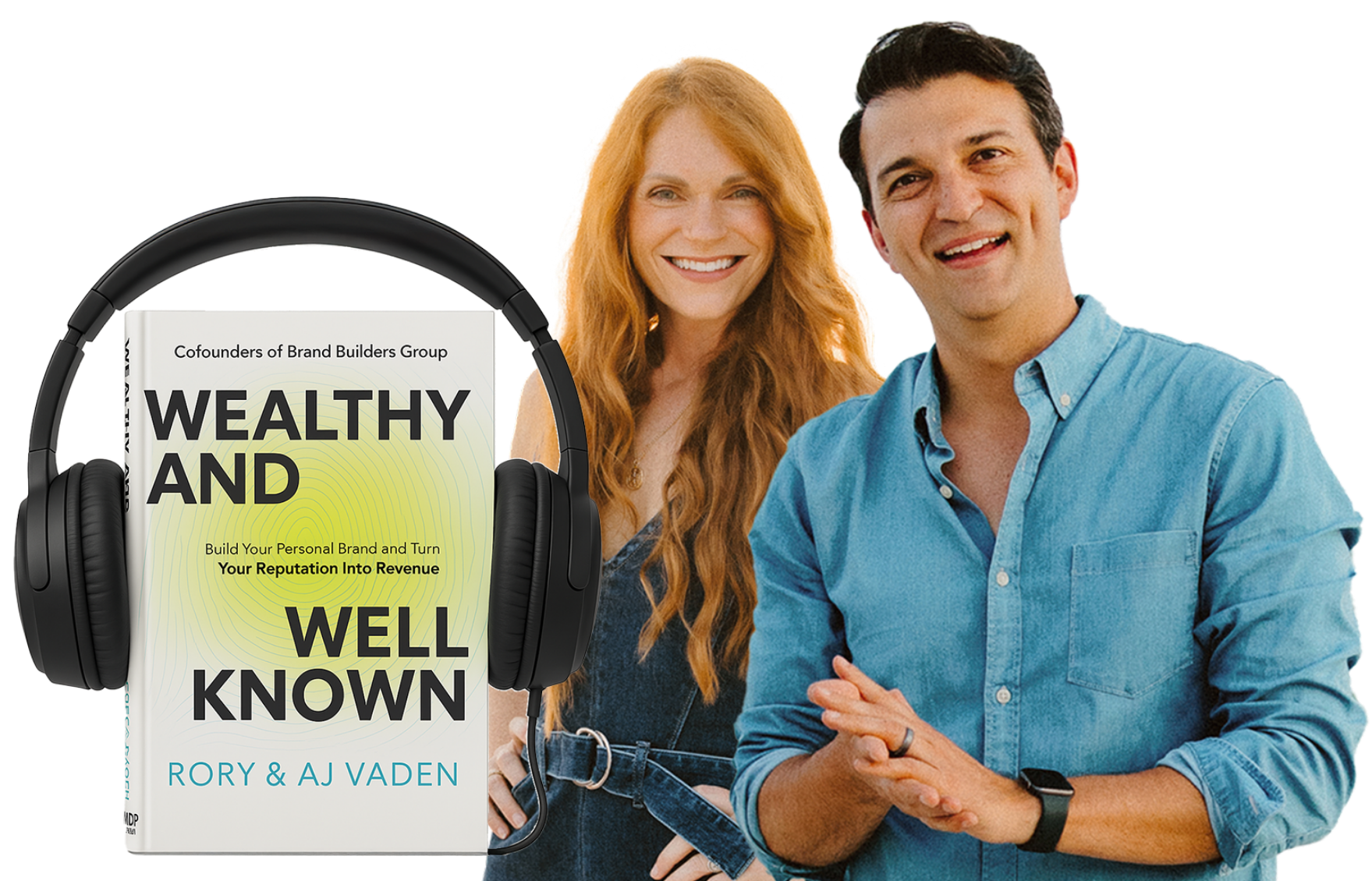
NIck: I’ll give a great example from today. I. Because I watched you and Rory both do this really well. Instead of selling the book in every single video, you’re giving away the audio book for free. Mm. And so for anybody listening or watching the podcast today, I think you should spend some time learning a little bit more about what Rory and AJ did for Wealthy and Well-known.
This is Credit to Brand Builders Group and Mission-Driven Press for this idea of giving the audiobook away for free. Upselling the physical book. And that’s because the book is a business card for your businesses. Mm-hmm. Which is beautiful. You can’t feel guilty giving away an audio book for free, can you?
I mean, that’s not sales. That’s [00:42:00] just like, please hear, I’m being of free value. So that’s genius.
AJ: Well, you know, and it’s interesting as one of the reasons that we did that is because what we wanted is for everyone else to have that same no pressure feel to promote the book. Mm. Right. It’s like it was easier for us, right.
To go, hey. Can we provide your audience with a free value, a free audio book versus, Hey friend, would you please promote my book to every single person on your list? Would you mind doing a live about this? And those are big asks, especially when a lot of people have been curating their audiences for years.
It’s a big ask, but to go, Hey, we have something for free. Added value, no cost for your audience. Can we give it to them? It was a much easier ask. So again, it was like our own, how do we overcome our own slight sales resistance? Um, we don’t really have sales resistance. Like we are happily shoving this down.
All the throats all around us. Yeah.
NIck: You said you even reached out to your friends and family. Like beware. Yeah. Beware for the [00:43:00] next six months. Yeah. This is
AJ: all you’re gonna hear about. Um, but, but also back to what you said, it’s because we deeply believe and are truly convicted that if you read this book and you actually apply it.
It will change your life. Mm-hmm. It will change your business. It will make a significant difference. We actually believe that. So to not share it is a disservice. Right,
NIck: right. Yeah. So many authors undersell to their own audience because people aren’t aware of the book. I think here, here’s a another funny thing that we do sometimes, which is we will have an author film, a Call to action, and then we’ll attach it to their other videos.
So they’ll only do it one time. Ah. ’cause they feel so uncomfortable doing. It’s like, come on, just try it one time and then we’ll attach it. Once they see that it works and that it’s not that icky. The other thing, the other beautiful thing about short form video content that’s attracting your target customer.
Providing value. And then you say, the call to action is, you’re not selling to anybody that’s not a good fit.
Mm.
NIck: They have to make it to the end of the video, which is [00:44:00] very specific. Mm-hmm. About your content in order to hear the pitch.
AJ: That’s good. Yeah. That’s a good reminder to everyone. It’s like they’ve already made it through the filter.
They wanna hear what you have next, make sure you give them something. Right. And I would just also encourage, as someone who had to do this like at least 30 times today, it’s like building a muscle. Right. And the more times that you give the CTA, the easier it gets, the better it gets, and the funner it gets.
NIck: Yeah. You started to have a lot of fun with vocal variety and you were focusing on different words, and you said it, so you had a lot of fun with it.
AJ: But it didn’t start that way. I was like, blah, blah, blah, blah, blah, blah. Like in the beginning, right? And it’s like, I do this for a living, and it’s like, wait, what am I trying to say?
What am I trying to do? That’s the power of having a good coach, right? Mm-hmm. Right. I think for all of us, it’s like. Getting your book out into the world is not just about the writing. You said that earlier. Right. Robert Kiyosaki says, it’s not the best written book. Right. It’s the best selling book. That is a discipline.
It’s a skillset. Mm-hmm. [00:45:00] And it’s one that you guys really help with at Book Thinkers. Now the CTA, just one last quick question about this. What are good CTAs to help someone buy your book?
NIck: I think asking people to share the video with somebody that it might be a good fit for. So they’re, they’re not buying it themselves, but they feel comfortable like, Hey, this message could really help a few people that come to mind.
So that’s a good call to action. I think your call to action today was great, which is comment the word audio and we’ll send you a free copy of the audio book. You’re integrating your social media accounts with many chats. Mm-hmm. So the. DM with the audio book link will automatically go through. I love inviting people to comment and share their thoughts below.
Mm-hmm. And then you can engage them in a conversation between before you pitch them on your book. Yeah. So if you’re just selling the book directly, it’s like, comment down below, let me know what you think. If you wanna move the conversation to dms, I’m happy to have it. Mm. If you’re talking about something that’s intellectually controversial.
Which can make for great content. That way you’re not asking somebody [00:46:00] to marry you on the first date, but you’re having a conversation with them about the book before you ask them to buy it. And if you have a team to help you support that, that can be really helpful too.
AJ: I love that. Um, all right, one last question about book marketing and then I have a list of some hot questions, um, that I’m just super curious about, and I’m sure our audience will gain some benefit from this.
So, okay, we’re 2025, right? The landscape has changed drastically over the last five years, uh, when it comes to book publishing, right? Mm-hmm. As you mentioned this earlier, the barrier to entry to have a published book is basically none, right? For very little money. You could have a book out into the world.
That doesn’t mean it’s a great book, doesn’t mean it’s well published or well edited, but you could have a book, right? So with this emerging trend of the last time I checked, it was like. Tens of thousands of new titles are published every year. Think about that for a second, tens of thousands. [00:47:00] What would you recommend people do to break through the noise?
Like that’s so much.
NIck: So many different ways I could answer this question, but the first thing that came to mind was invite your existing community into the book writing process with you. You did a great job. Rory did a great job at this. I think it was popularized a few years ago when James Clear took a blog.
Mm-hmm. Where he collected a lot of data and then decided to put that into a. Book. Mark Manson did the same thing. And there are more and more examples of people using their social media to invite their audience into the book process, whether it’s split testing titles or cover designs, or just sharing him writing today.
And here’s the. Here’s the question that I have for my audience, and I’d invite you to give me some feedback on it. Or, you know, like releasing content through social media in micro videos or in blog formats, or on podcasts and just testing the waters. It’s like doing a minimally viable product before you release a finished product.
Good to [00:48:00] confirm product market fit, and. I also had this realization, I mean, I talked a lot about the book I released a year and a half ago on social media in advance of the launch, and I got feedback. But something funny happened when I started to do a lot of podcasts on the subject, which is that.
People started asking me questions that were a na, a natural progression of my thinking and my teaching and my strategies that I didn’t write about in the book that I wish I did. Hmm. So another thing is, as you are sharing the book content and collecting feedback throughout the journey, which will make your launch more successful because people are more bought in, they feel like they were part of the process.
Of course they want to talk more about the book. Like, I help contribute to that even in a small way. Yeah, that’s good. The other thing is. Test the content in a live format on podcasts and see what people are asking about as you start to share these stories and strategies, because there will be things you missed.
There will be things that you wish you wrote about. Hmm. And those podcasts, Hey, I’m writing a book and. [00:49:00] It’s coming out a year from now, but I wanna start to test some of the theories that I have in the book. Do you mind if I send you some sample copy? We could chat about it on your podcast. It also gives you an existing audience to tap back into when it’s time to launch the book so you can go back on, have a second impression with the same audience.
Now it’s time to have your call to action to actually pre-order the book or give it away for free. And so it’s just involving like your existing community in the book process a little bit more.
AJ: I love that. Let’s have ’em come along for the ride.
NIck: Yes.
AJ: Now, before I ask you these last couple of questions, if people wanna learn more about what you do at Book Thinkers, where should they go?
NIck: They can go to book thinkers.com and there’s a contact form there.
AJ: All right, so book thinkers.com. Click the contact form, learn more if people just wanna follow you. Like where, what social media platform should they go to? What’s your handle?
NIck: Instagram is our largest social media following, and I think it’s our most vibrant community as well.
So if you want to be around a lot of [00:50:00] other nonfiction, business and personal development, book lovers and authors, check us out on Instagram at Book Thinkers as well
AJ: at Book thinkers, and we’ll put both of those links in the show notes, which is a great segue to my rapid fire questions. Now, you’ve already mentioned a few of these, so cannot be one you’ve already mentioned.
Right. What’s one nonfiction book that has changed your life?
NIck: The Four Hour Work Week by Tim Ferriss.
AJ: Why
NIck: that book took me from a cubicle to a remote job traveling the world. Hmm. And then I eventually used the principles in that book to build book thinkers, and I became detached from my business in a lot of ways by automating, delegating, or eliminating low impact activities and replacing them with high impact activities.
I owe so much to Tim Ferriss. A lot of times I say he’s my spirit animal. He doesn’t know who I am, but the four hour work week changed my life.
AJ: I love that. And that’s so good. And it’s a great book, right? It is a
NIck: great book.
AJ: You’re gonna work for more than four hours, but it’s a great [00:51:00] book. Most underrated marketing channel for authors.
NIck: Ooh, small podcasts. We talked a little bit about this, but again, podcasting people have this idea they have to go after the big show, small to medium niche podcasts where you can over perform and the host can fall in love with your message and help you promote it everywhere. Super underrated.
AJ: I love that whole conversation around like.
Go pick a host that’s so excited to have you. They’re gonna promote the pants off of it.
Yes.
AJ: So much better than being on a show that doesn’t even get a mention.
Mm-hmm.
AJ: So much better. I love that. It was one of my favorite things you said today. Favorite tool or app for productivity right now?
NIck: Mm. It’s the, my favorite tool or app for productivity is this kitchen timer box that I have in my office where I can put my phone in it, set it to an hour, lock the box, and I can’t touch my phone.
I have tried so many other ways to get off of my [00:52:00] phone. Mm. Muting notifications, setting time limits. None of it works, but putting it in the little kitchen timer box for an hour or more at a time and locking it. That thing’s indestructible and I am laser focused.
AJ: Fascinating. How often do you put it in the box?
NIck: At least a few times a week.
AJ: And this is when you’re just trying to get undistracted focused thinking, get something done, put the phone away. No distractions. Lock it away.
NIck: Yes. And sometimes I’ll be mindlessly scrolling on Instagram reels and I’ll get a video about how Instagram is killing my brain, and that’ll be the, okay, I’m going to put it in the box now, but it’s
AJ: in the box.
Yes. I love that. What? What? What’s the box called?
NIck: I think it’s called Kitchen Safe Kitchen. It’s literally you could, I think it was actually designed for in a kitchen you could put cookies in it or something like that, that you’re having a tough time staying away from, and you could lock it for 24 hours or something like that.
But I put my phone in it.
AJ: That’s good. I might be ordering one of these after this. Yeah, and they’re cheap too.
NIck: That’s like an under [00:53:00] $50 hack for everybody.
AJ: Yeah, that’s good. Like one of, like one of my big, uh, new Year’s resolutions this year was um, once the workday is over, I leave my phone in a different room.
Right. And it’s been really helpful. ’cause if I really want it, I have to get up and go find it. Mm-hmm. Right. And I’m like, where did I put that? Dead gum thing. But it’s been really good. But it would be better if I just put it in a safe. So can’t go find it and you can’t touch it. Yes. I like that. Okay. I like that.
That’s good. One piece of advice that you’d give to a new first time author who’s trying to promote their book,
NIck: slow and Steady wins the race. Mm. No matter how many times you read Aesop’s Fable, the Tortoise and the Hare, the Tortoise always win. If you have smaller expectations, you won’t burn out. You won’t be so disappointed.
Slow and steady wins the race. The best form of marketing is a changed life. That’s what you’re in it for. That’s good. Not how many books you sell, but how many lives you can change. Just like it’s not about how many followers you have, but how much money you make per follower. Same thing with the book.
You’re not trying to get it out to people that don’t truly [00:54:00] need it for the sake of that vanity metric of, I sold X number of books. You’re just trying to get it to the right people, and you do that slow and consistently and
AJ: you cannot say that enough.
NIck: Slow and steady. Yeah.
AJ: Pause, rewind. Play that again.
Last question. What does Influential, now that you’re on the influential personal brand podcast, what does influential mean to you?
NIck: Over time, I’ve realized that it means impact.
AJ: Mm.
NIck: If you are a person of influence, you should be making a positive impact on this beautiful planet.
AJ: I love that. Yeah. And impact
NIck: comes through specificity.
AJ: Well, we talked a lot about that today. Yeah. Right. And the importance of, again, back even to the content, right? It’s like you have to be super specific to get something shared in 30 to 60 seconds, but specificity matters. But I love that it’s impact. Y’all. If y’all have not already written this down, go to book thinkers.com.
Learn more about what Nick and his team do. If you wanna follow them on [00:55:00] social, get book reviews, learn about authors, learn about all the books that have changed your life and so much more. Check out at Book Thinkers at Instagram. Nick, this was amazing. So many good tips, so much insight and wisdom. Thank you so much for being on the show today.
For everyone else who’s listening, stick around for the recap episode, which will be coming up next, and we will see you soon on the influential personal brand.