We’re in the happiness business. As long as people are experiencing progress, they’re going to be
happy. As long as they’re happy, they’re going to stay. The internet has taught us that growth is
about attention. It’s about more traffic and more customers. But what if we’ve been measuring the
wrong thing all along? What if the businesses that survive aren’t the ones that attract the most
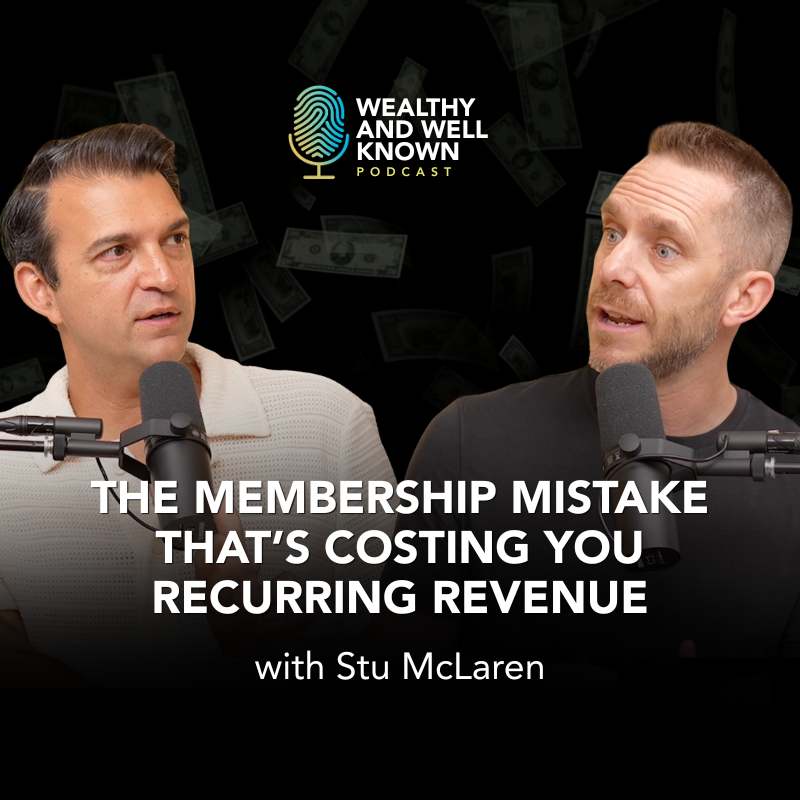
people, but the ones that give people a reason to stay? Today’s guest is Stu McLaren.
For nearly two decades, Stu has quietly become one of the most influential minds in the world of
recurring revenue, memberships, and online communities. He co-founded Wishlist Member,
a platform used by more than 70,000 businesses around the world. But what makes Stu fascinating
isn’t his expertise in memberships. It’s what he believes memberships are really about,
a sense of belonging. and the psychology behind why people commit to something and why they leave.
Because according to Stu, the greatest threat to a business isn’t competition. It’s indifference.
It’s the moment someone says, Ooh, this looks good. I’ll save this for later and never returns.
But how do you go from celebrating your first sale? And it was a whopping whopping $7.95.
And I was ecstatic to building an eight-figure business. And why does one of the world’s leading
membership experts believe the first seven days determine whether a customer stays for months or
for years? That’s where this conversation begins.
Would you like more recurring revenue in your business? Would you like to lower your churn?
Would you like more people coming in the front door, being onboarded properly, staying longer,
and referring more people into your business? That is what we’re going to talk about on today’s
episode of the Wealthy and Well-Known Podcast. I’m joined by someone who is a pretty good friend
of mine, but a really great friend of many of my good friends, Stu McLaren. And Stu is…
one of our industry’s most recognizable experts in the space of memberships,
recurring revenue, reducing churn, and all of those things that I talked about. He wrote a book
called Predictable Profits on this subject, and he’s had a few different exits for different
programs that he created. So in 2008, he co-founded Wishlist Member.
which was the most popular membership platform by WordPress. When he sold his stake,
over 70,000 people worldwide were using that. I met Stu because after that, he went to work with
Michael Hyatt and Michael had a membership program that was high six figures and they partnered
together and Stu helped Michael grow that to a multi seven figure low stress business.
So I’ve just heard so much about this man and his integrity and he raises money for his nonprofit
that he runs and we have so many mutual. friends. And so I invited him today. He was in town in
Nashville and I was like, we got to have him on the show. So Stu, welcome to Wealthy and Well
-Known Podcast, brother. Thanks, my friend. It’s great to be here. I can’t believe we’ve never met
in person. I know. It’s been a long time coming. Plus, I don’t have a lot of Canadian friends. So
every time I’m like, yes, another Canadian friend. Well, you’ll hear my shouts and abouts, I’m
sure, as we go through. So buddy, I know you’ve lived in this space for such a long time.
what I would love to know is I first want to talk about getting new members and what are people
doing right now that is working to get new members. Uh, I’m going to spend most of our time talking
about keeping members. Um, because I think that’s, I think to me, that’s where the magic is.
And that’s the part that people really overlook is keeping members, but let’s start with getting
new members. Yeah. And I know you’ve got lots of different students, lots of different business
models. What are some of the things that you think that people are doing right now that works
really well to get new members? Well, there are three keys to growing a membership. Number one,
you said traffic. getting members. Number one, we’ve got to get traffic. Number two, we’ve got to
convert that traffic into paying members. And number three, we’ve got to keep them happy. So a
membership model is really simple if you just break it down to those three key areas. When it comes
to getting traffic and converting that traffic into paying members, there’s a ton of different
strategies. But generally, what I like to do is break it down into different phases. So if you’re
in the early phases of growing a membership, meaning you have zero people right now, and you’re
going from zero to about 2500 then i’m actually going to recommend a strategy that sounds absurd in
the beginning it’s a closed door strategy and what that means is that we’re actually going to close
the doors and people can’t join the membership Now, this sounds weird, probably because you’re just
like, Stu, I was asking you, how do you get members? Not like keep them out. But the reality of it
is, is that when you have a closed door membership, the way it works is you only open registration
a certain number of times throughout the year. In between those periods, you’re building your list.
So all the things that we want to do to grow our audience, we’re using social media to drive people
to build our list. We’re speaking on podcasts. We’re speaking in public. All the different things
that we’re building our list. And then a few times a year, we open registration for our membership.
A few like three, four, two. In the beginning, I would probably say four would be a good rhythm.
As you start to grow, I would actually decrease it. So a good example, when I partnered with
Michael Hyatt, he at the time did not have a membership. He was coming off the back of his New York
Times bestselling book, Platform. He was getting asked a lot of questions. And I’m sure like a lot
of people in your audience, because they’ve been following you and they’ve been publishing their
book and getting their material out and building their personal brand, they’re probably getting a
lot of questions from their audience right now. That’s a really good sign. And so with Michael,
he was getting a lot of questions. he was answering a bunch on his blog in the form of blog posts
and on his podcast. But the reality of it was, is there was a lot of hunger there. There was a big
appetite. You could see it. So ultimately a mutual friend introduced us. We came together and I
asked him, I said, what’s the biggest challenge you’ve got in your business right now? And I’ll
never forget. He said, Stu, I love what I do. I love who I get to serve and the message I get to
share, but I’m tired. He’s like, I just, I just want to be home with Gail.
And the girls and the grandkids. And I said, I can help. And so we came together and we formed
ultimately a partnership. And it started with his membership. Now, in the beginning,
we were open all the time, meaning anybody could join his membership at any point at any time.
And we would grow about 100 to 125 members per month. But then we had a conversation and he said,
Stu, I love that we’re growing the membership, but. the calendar’s really full.
Like I would love to create some space to do some other things, maybe some other courses,
maybe future books. So I said, okay. I said, well, what if we go from promoting all the time to
four promotions a year? Oh, okay. So this was more of like an accidental thing. It was an
accidental discovery. Okay. So now in that moment, there’s fear because it’s like,
can we get as many members in four months as we do in 12 and so it was like well let’s experiment
so one of the things i appreciate about michael is he’s open to trying new ideas and so we did and
so we did a promotion and we said we’re going to be closing the doors and so now is the time to
register and what was amazing was Typically in a three or in a three month period,
we would get, like I said, anywhere between 300 to 370 plus members. Well, in this one.
Right off the bat, we more than doubled that. We had over 650 plus members join in that promotion.
And so it was counterintuitive. It was less work and more revenue.
Yeah, we’re not okay with that. We’re not okay with less work and more revenue. You must work
harder if you’re going to make more revenue. It was like crazy. And then we asked another question,
which was like, well, what if we go down to two? promotions a year we’re like same fear oh my gosh
can we you know in two promotions get as many members as we did in four well the crazy thing was it
gave us more lead time to build up and create anticipation for that promotion so then when we went
down to two those promotions we were welcoming anywhere between 1500 to 3000 plus members in a
single promotion so it increased even more it increased even more so we were working even less and
making even more and so the crazy pretty soon you go down to zero promotions
But it, so I recommend no, you know, some, we have some clients that actually do one big promotion
a year. I wouldn’t recommend that. I think I would settle in on, you know, no less than two,
no less than two and no more than six. Exactly. Like you want to find a rhythm that is going to be
right for you. In the beginning, I would say probably four is a really good rhythm. The other side
benefit to this is that when you close the doors, It gives you more time to actually just love on
your members. See, people often forget when you’ve got a membership that’s open all the time, you
are… caught between two worlds you’re in promotion mode and serve mode yeah and those are two
different worlds two different mentalities two different um approaches well i mean at brand
builders group we literally have two different teams right two and it’s basically like we operate
two different companies there is the marketing company and the marketing and sales which is all new
business and then there’s just delivery and you know customer service which is all Cause it,
and it is, it’s, it’s hard. It’s a, it’s a thing. Like I’ll never, uh, there was, um, years ago,
uh, one of our clients, Jennifer, she had a membership and she was open all the time. And,
uh, she was in my mastermind and she said, Stu, like, I really want to grow this thing.
Like, I know that I’m capable of much more. And she had been working at it for quite some time. It
had taken her four years to get to the point where she had about 700 members being open all the
time. And Hey, that’s not shabby. Like that’s pretty good. Like 700 members. But she was right.
She was definitely capable of much more. And I said to her, well, you know what I’m going to
suggest? And she’s like, no, I’m not doing that. I said, Jennifer? She’s like, no, I’m not. Okay,
fine. I’m open to. I said, what do you think I’m going to tell you to do? She’s like, you’re going
to tell me to close it. I said, that’s exactly what I’m going to tell you to do. And I said, why
are you hesitating? She’s like, well, I don’t want to do like a big promo. I don’t want to, you
know, it feels like heavy. I said, okay, well, how would it feel light? By the way. The questions
we ask ourselves are really important because if we want to know how to do something,
we have to ask ourselves, like, how can I close the membership and keep the promotion feeling
light? Your brain searches for those answers to close the gap. So that’s what I said to her. I
said, you know, what feels light for you? She’s like, well. you know, Facebook lives feel like,
like those are easy for me. I said, okay. So what if you close the membership and you did a series
of Facebook lives leading up to that close cart day, you just get on and you start talking about,
you know, your membership, why you’re closing it. Cause she was going to make some changes. So it
was a perfect test, right? She can say, look, I’m about to make some big changes to the membership.
So I’m going to be closing it down. And that was her reason in this case for closing it down. So
she did that leads up to it. she welcomed more than 1,100 members during that promotion.
So it had taken her four years to get to 700 members. In one week, she welcomed more than 1,100
new members. But the greatest message I got back from her afterwards was, yeah, she was excited
about the growth in the business, but she was also just relieved that she didn’t have to be in
promotion mode all the time. So closing the doors, it’s counterintuitive, but…
is one of the biggest drivers of new members joining a membership. Now, this is bearing in mind
that you have an audience that you have been growing. Now, you don’t need a massive audience, by
the way. This is another huge misconception that a lot of people have is that you’ve got to have
this big audience to do it. No, no, no. If you’ve got an audience of 200 or more, you can run with
this closed door strategy. And so we can unpack different ideas further.
But in stage one, definitely a closed door strategy. Okay. So I want to just briefly touch about
why is that? My mind immediately goes to it’s because of urgency and scarcity.
If it’s open every month, then people can just procrastinate.
There’s nothing forcing them to make a decision. Well, what they do is the kiss of death for all of
us as entrepreneurs. They’re like, ooh, this looks good. I’ll save this for later.
If I were to look at my phone, I have an Instagram, a whole folder of products,
thousands of them. Then I’m like, ooh, this looks great. I’ll save this for later.
Kiss of death. Kiss of death. Worst thing ever. Have I ever gone back and bought any of them? No.
Actually, I take that back. There was one product that I bought and I had saved it. And in fact,
if I go back to that folder, I’ve saved it multiple times. And, but the reason I bought it was
because they did a promotion and guess what there was a deadline deadline. And I’ll never forget.
I was lying in bed and, uh, I was doing that, you know, late night scroll. And,
uh, I said to my wife, Amy, I said, Amy. I think I’m going to buy this thing. She’s like, what is
it? I said, it’s this thing that I found. She’s like, what is it? I’m like, it’s an electric bike.
And like, it was like this electric bike with big fat tires. And I just envisioned myself riding it
on the trails. And she’s like, okay. She’s like, well, let me look at it. So she, I showed it to
her. She’s like, we should get one for each of us. Oh, nice. So it went from, because they finally
added a little bit of urgency with a deadline. We went from, ooh, I’ll save this for later to not
buying one, but buying two, thousands of dollars in investment in these bikes because they had a
deadline. And the same is true with a membership. You don’t give a deadline. then what happens is
people will save it for later and they never come back. See, it’s interesting. Before we started
Brand Builders Group, I built my career on a book called Take the Stairs. That whole book is about
the psychology of overcoming procrastination. And like I spent the whole first part of my career
doing nothing but studying procrastination and never thought it would be so hyper relevant to
building personal brands. But it’s like the human brain keeps you safe and the best way to keep you
safe. is to keep you doing what you’re doing now and not changing. And so it’s like,
if you don’t force that deadline, you just continue being like, yeah, I’ll just hang out. And you
get the psychological payoff with the save of like, if I need it, it’s there. It’s like insurance.
It’s like, it’s there if I need it. But here’s the other side of this that I think is really
important. I often hear people say, well, I don’t want to give a deadline.
It feels like I’m creating fake urgency. Like that doesn’t feel good. But the flip side of that is,
does it feel good knowing that the audience that you are looking to serve is delaying getting their
problem solved? Does it feel good knowing that they are still going to continue having that
problem? Unless… give them a reason to join today. And so we have to think of it differently.
Like all we’re doing is we are creating urgency so that we can help people, so we can help them
achieve their goals, make progress in their life, overcome obstacles and so forth.
And so I think more than anything. If we’ve got a mindset that this is a great opportunity for us
to serve, we want to create every opportunity and we want to set the stage for people to be able to
come into the doors so that we can love on them and serve them. The thing that makes me think about
is like a marathon. Okay. So you go, what if all marathon runners,
if it was just like, okay, go run a marathon whenever you get around to it and then just report
your score. Nobody would ever train for it. They would never do it. It’s a service to pick a date
on the calendar and go, everyone show up on this date. It’s true. We’re all running the marathon.
And so you train for, you know, like when it’s the deadline that is the catalyst for the
transformation in their life. I think about my business today. We would not be here if I didn’t
have a dear friend who gave me a deadline. So I had been behind the scenes helping people.
grow their memberships. Michael Hyatt was one. And then that took off. And before we knew it, that
was a multimillion dollar a year membership. And so I started getting a lot of other people are
like, Hey, could you help me do that? Can you consult with me that? And so I was behind the scenes
and a mentor of mine was really encouraging me to come out and share this and teach others how to
grow memberships. And so I had been doing some private workshops. And I felt like I had built my
body of work that I could turn this into a program and launch it. So I was talking to a friend of
mine, Jeff Walker. So I said, Jeff, I’m thinking of packaging this into a course. Would you be open
to helping promote it and share it with your audience? He said, yeah, what are you thinking?
I said, well, I don’t really have like a date set. And he’s like, Stu, if you don’t give me a date,
I won’t promote. I was like, oh, okay. August 18th. He’s like, perfect.
And then everything backed up from that date. And so urgency. with a date is really important it’s
not only important for us personally like to get us moving but it’s also important for our audience
to get them off the hump of thinking about and more taking the action to solve their problems all
right so in between the deadlines yeah you said we should be building our list yep there are
literally millions of things you can do to build your list yeah is there anything that you go
again, this is what you should be doing right now that’s really working? I love having list
building events. So a good example of this would be Tara Phillips in our audience.
So she’s a former teacher and she had been in the classroom working with kids with autism for 25
years. Over the course of that period, she realized that she had developed a bunch of resources
that would be helpful for other educators in working with kids with autism. So she started selling
them one off on a site called Teachers Pay Teachers. And she was earning some extra income,
which was great. But then she learned about memberships and that’s when she came into our world.
And so she launched her membership and very quickly she had grown that membership to a couple
hundred members. But then she really wanted to grow it even further. So she now hosts a list
building event once a year and it’s a big summit. And so she gathers the who’s who of the autism
world. And she has a summit where they’re each sharing different presentations.
And just on the front end of that, she is like her last summit that she did,
she generated over $400,000 on the front end. So it’s free to attend.
Then there’s a VIP upgrade package. And in her last summit, she had over 50,000 plus people
register for that event. So if we just pause right there, that in and of itself would be a home run
win. If all she did was just have 50,000 plus people being added to her email list,
that is a huge win. But then she sold the VIP package and she had over 4,000 plus people take her
up on that. So that was over 400,000 plus dollars. This is like a $97 VIP upgrade.
Then she had sponsorship. So this year she’s doing it again. This year she has Sesame Street as a
sponsor. For the virtual event. For the virtual event. Wow. Melissa and Doug Toys. She has Beaches
Resort in Turks and Caicos because they have a whole thing working with kids with autism.
So it just compounds and gets bigger and bigger and bigger every year that she does it. Then on the
back of that, after the summit, she offers her membership. And she’s had anywhere between 800 to 1
,000 plus members join. When you say on the back of that, do you mean… the actual end of the
summit? Or do you mean like a month later or like? At the end of the actual summit. Okay. So
there’s an offer that comes at the end of a, whatever, a week long summit or something. That’s
true. Yep. If we take away the offer for the membership, if all she did was just do this summit for
the sole purpose of building her list, it’s a gigantic win. And I think too often. we are too
passive in our list building. And I would encourage people to be more intentional and strategic.
Get some dates on the calendar where you’re doing some kind of a virtual event with the intention
that It is there to build the list. And yes, we can be strategic and we can look to generate
revenue afterwards. Like I always love covering my costs of building that list. So if I can cover
my costs, to me, that’s a home run win because I know throughout the rest of the year, that list is
going to pay for itself. Yeah. I mean, Michael did this for years. I was on it. You did one
recently. I was on yours. So it’s really great. So we’re building our list.
We’re adding value. We’re building trust. Then we have our closed cart. People come in.
How do we keep these people? Because here, here’s, I’m going to say something that’s going to make
a lot of people mad. Everybody buys into the dream of a membership site and you go,
oh yeah, just get a thousand, a thousand people to pay you a hundred bucks a month. You’ll make a
hundred thousand dollars. You’ll do $1.2 million. The reality is most of those people are going to
stay for two months, maybe three, and they’re going to churn out and you’re going to spend all your
time tracking down. declined credit cards and cancellations and now you got people who are upset
about this and that and like your whole life which it seemed like oh i’m just gonna have passive
income the reality is it’s a churning wheel so how do we stop that well um we’re gonna agree to
disagree on this okay okay um because you will have churn if you don’t have a retention plan in
place so People who have a retention plan in place don’t see that kind of churn. They don’t see
their members staying for months. They see their members staying for years. And there’s a huge
misconception when it comes to retention and churn. And it’s almost like accepted that members only
stay for a few months and that’s just part of the business. No, it’s not. Listen, when people join
a membership, they’re joining because they want to get a result. If they are experiencing progress
toward that result and they’re happy, they will stay. So we’re in the happiness business.
If people join our membership, our whole goal is just to keep them happy and keep them progressing.
Because as long as I’ve been doing this for 18 plus years, I’ve never known anybody to leave a
membership because they’re experiencing too much success. Like, Rory, nobody comes to Brand
Builders Group and says, Rory, it’s been a great ride. We have like, you know,
grown our business to a whole nother level. Peace, I’m out. They’re not saying that. They’re
saying, Rory, this has been amazing. Give me more. Yeah. And so as long as we are helping people
experience progress, they will stay. So the goal is not just get them in and let them churn.
No, no, no. The goal is get them in and love on them and support them and help them experience
progress. And I think they, you, you said it, they don’t have a retention plan because the big
mistake, everyone in this. business is making is all they think about is the new customer, right?
They never think about loving on the person that’s in front of them, like that they have already.
They never think about like the retention plan. So like, what are some of the touch points, I
guess, that we could go like, how do we, how do we have a retention plan? I mean, what does that
even, what does that even mean? Well, I’ll tell you, if you’re looking to save members, the most
important period is the first 30 days. In fact, I would say it’s the first seven days and studies
have shown If people have a positive experience in that first seven days, it will on average triple
the lifetime value of that member. So this first seven days is vital.
It is the most important piece to a new member experience. That’s really powerful.
The key to keeping people for months and years is what you do in the first seven days.
Like that’s a huge insight for people that we don’t, I think a lot of people overlook this.
I’ll give you an example. If somebody has friction in their onboarding experience,
it’s immediately creating a negative seed in their mind. So I had a client recently who hired me
for a VIP day. So once a month, I reserve one day to work one-on-one with a client.
They had an established membership site. They had, it was just shy of 800 members and it’d been
around for quite some time. And they said, Stu, Can you take a look at our retention? Like we’re
struggling. So I said, sure. I said, what I want you to do is I want you to send me a link where I
can join your membership as though I’m a new member. So they sent me a link. I start going through
the signup process. And it was like friction after friction after friction. And one of my favorite
questions to ask them is I said, on your exit survey, when people are canceling your membership,
what’s the number one reason that they’re canceling? And they said they don’t have time. uh to go
through all the stuff so i said okay so time is the the biggest um objection they said yes i said
great great so I come to the registration process. It’s not clear in terms of like the flow of
where I’m supposed to click. Like I join and then there’s a page that gives me instructions to do
three things. I can’t do any of those three things on that page. I have to click to another area.
So I click to another area and then there’s a video and it’s the only thing on that page,
which is good, but there’s no. time on how long the video is.
So I start playing the video. I have no idea if this is like a two minute video, a 20 minute video,
a two hour video. So what are most people doing? If they’re strapped for time, they’re like peace
gone. They’re not even watching it. It is the most important video that you want somebody watching.
And there was like mistake after mistake like this. When I finally got into the members area,
it is a sea of links everywhere. I have no idea where to go,
what to look at first. It was a mess. And this is a huge mistake that a lot of people make.
So when I’m thinking about how do we make that first seven days just a golden opportunity where
people have that positive experience, the very first thing that I’m looking to do is to help the
member get clarity. Where are they in this journey? Where are they going?
And what should they focus on? It’s something that I talk about in my book called The Success Path.
And we want to map out what that journey looks like because not all members are equal.
So a huge mistake that a lot of people make is they just treat everybody the same. It’s like a one
size fits all. But you know, and I know that not everybody’s the same. You’re going to have people
that have more advanced skills. You’re going to have people that are in the beginning. Some may be
intermediate. So one of the very first things is part of the onboarding is you wanna ask a few
questions. You wanna ask a few key questions to identify where are they in this journey. Then after
they answer those questions, you wanna take them to a page that has content that’s specifically
relevant to where they’re at. So it would say, hey, Rory, sounds like you’re at level one.
Based on that, here’s what we recommend you focus on right now.
don’t worry about all the other stuff. Because if you just focus on these few things, you’re gonna
be able to make progress toward this. And that is like a huge weight off of people’s shoulders
because they don’t have to go learn all the things. They just gotta learn the next right thing and
it’s served up on a platter for them. So number one is you want to make things clear.
You wanna give them clarity. Where are they? Where are they going? And what should they put their
focus on right now? Second thing is that you wanna help People connect.
So I always think of when my family moved to a new area. This was a few years ago.
New area, new school for the kids. You got young kids. My kids were young at the time.
you know as a parent you have that like feeling like i just i just want the kids to feel settled
you know like that’s the main thing so i remember amy and i we walk the kids to school we drop them
off they find their teacher in they go and we’re just like please just let this be a good day the
end of the day we come to the school to pick them up my daughter comes running out first marla and
she’s got this she’s coming towards me she’s got this big smile on her face and she comes home i
said marla how was school today she’s like dad this is the best school ever i was like really i’m
like why She said, well, you know how I used to go to a Montessori school? And I said, yeah. She
said, there’s a girl in my class that used to go to a Montessori school too. I’m like, that’s
awesome. She’s like, but dad, it gets better. I said, how? She said, well, you know how I love
riding horses? Yeah. She rides as well. I’m like, that’s incredible.
And she’s like, but dad, even better. You know, the new stable that I’m riding at? Yeah. Her mom
owns the stable. I’m like, what? Get out of town. She’s like, dad, this is the best school ever.
Her whole perspective on this being the best school ever had nothing to do with the school.
It had everything to do with the fact that she had made one meaningful relationship.
Wow. So if we take a step back and we think about that in our own memberships, one of the hardest
things is when somebody comes into a new community, they’re that new kid in school. They don’t know
anybody. So one of the best things that we can do is to help them form that one meaningful
relationship. And there’s a ton of different ways that you can do this. One of my favorites is if
you’ve already got members, have a welcoming committee where, you know, new members join us like
Rory. Awesome. So glad you joined. Hey, where are you from? Why did you join us?
Asking a few questions. And then it’s like, oh, you know what, Rory? Let me connect you with Neil
over here. Oh, and Jane, she’d also be a great contact for you. And do you know Carl?
He lives near you. And so all of a sudden, there’s like this community aspect. You’re finding those
common traits that people have. And you’re connecting them accordingly. And so I always love having
like an introduce yourself post. Sure. community but the last thing that i want is like hey rory uh
go introduce yourself i’m brand new and then crickets yeah nothing nobody responds yeah yeah
because like an introvert you know shout out to all my introverts an introvert the last thing that
we want is to go into a community and be like hey my name’s stew let me tell you why i’m awesome
i’m awesome for this reason that reason like nobody wants to do that right but it’s so much easier
if you’re set up with like three questions hey just go answer these three questions But the purpose
of those three questions is to pull out what I call connection points. So if I were to think of my
own life, what would be some connection points? Well, number one, I was an athlete all throughout
high school and played soccer at college and we won two national championships.
So right away, any of the athletes, boom, we got a connection. Number two,
I… And my wife adopted our son from South Africa. So that’s a beautiful connection point with
anyone who was adopted or has been adopted or has an adopted child. And another connection point is
that both my wife and I, we were born in England and lived in England. So now all the Brits,
we have a connection point. So there’s all kinds of different things that we have in common with
other people. With your questions in an introductory post, we want to pull those common connection
points out so then people can find that common ground. Does that make sense so far? Yeah, that’s
awesome. I love that. All right. So you help them get clear. You’re going to connect them to
community. Help them connect. And the third one is help them get a quick win. So one of the magical
things about memberships is that, as I said, as long as people are experiencing progress,
they’re going to be happy. As long as they’re happy, they’re going to stay. But we often think the
only way to make a member happy is if they get the big wins. Like in your case, a misconception
might be like the only win is if they hit the New York Times bestseller list. And so it’s just
like, oh my gosh, like that is a huge thing. That takes years of prep. And in that years of prep,
people often give up. So what we gotta do is we gotta break that journey down. I like to break it
down into different stages. And then even within those stages, there’s different milestones. And
those are indicators that, hey, We’re going in the right direction. And we want to celebrate those.
So I’ll give you an example. In our community, we celebrate when somebody welcomes their first
member just as much as we celebrate somebody who welcomes thousands of members in a single
promotion. Why? Because I know how important that first sale is.
I still vividly remember my first sale. I, in fact, have a picture that has been plaqued that is in
my office of me sitting in front of my computer like that after I made my first sale.
And it was a whopping, whopping. Seven dollars and ninety five cents. Nice. And I was ecstatic.
And I’ll never forget, like my wife and I, we were working for my mentor at the time and we had
flown to LAX to host a seminar with him. And I remember saying to Amy,
I said, I got to I got to get up and check my stats. She’s like, check your stats. It’s like some
flood of sales are going to come in like during this flight. So I remember we get up to the hotel
room and I log on. And, uh, there it was. And, and I was just like, Oh my gosh,
somebody that I don’t know that’s not mom has just purchased from me. It works.
It works. And I was just like, I was just like filled with belief in that moment.
And I said to Amy, I’m like, babes, you got to take a picture of this. She’s like, why? And I’m
like, this is going to be on the cover of ink magazine one day. I’m like, and so she took the
picture and then, uh, it’s so funny when I look back, but she’s like, she says to me,
I’m so excited for you. She’s like, how much did you make? And I was like,
it was $7.95. She’s like,
okay. She’s like, okay, but how much did you spend to make that?
I was like, it was about $800. She said, pardon me? I said,
it was about $800 in ads. And she’s like, $800 in ads? She’s like,
I’m not the business major here, Stu. You made $7.95 you made and it cost you $800?
She’s like, it’s not adding up. Why are you so excited? I’m like, babes, this is just the
beginning. This is a numbers game now. And I was just like, it just created this belief. And I
think about like all this transpired afterwards. And I don’t know if we would be here today if in
that moment, I didn’t have the belief. that it was possible, that it could happen.
And it came from that first sale. This is why I celebrate that first sale in our community.
Because I know that that creates incredible belief and momentum for people.
And that momentum is the thing that’s gonna carry them to the next thing and to the next thing and
to the next thing. And the more we celebrate, the more confidence they get, the more momentum they
build, and it gets them to the finish line of doing the big thing. But it didn’t happen until they
did the first thing. So back to onboarding. When we think about onboarding, the sooner we can help
people get just that little win and celebrate it and make a big deal out of it, the more momentum
they begin to have, the more confidence they begin to build and the more positive they feel about
this whole experience. They’re like, man, this is incredible. Like I have only been here for a
little bit and look at me. And so there’s a couple of key things here. When someone joins, you
wanna make sure that you draw a line in the sand as to where they are right now because if you
don’t do that you don’t have anything to measure the progress against and so now once we’ve got
that line in the sand we can look back and be like look at you Rory look how far you’ve come in
such a little period of time that’s what feels great so there’s a few tactical things that we got
to do as a membership site owner but at the end of the day if we just keep it simple it’s like just
help them get a win If you help them get a win, it feels good, and that’s what creates a positive
experience. So help them get clear so they know where they are, where they’re going, and what they
should focus on. Number two, help them connect with others so that they build that one meaningful
relationship. And number three, help them get a win. And the sooner you can help them get a win,
the greater it feels, the more likely they will stay. Well, there is a lot more that we need to
cover. We didn’t really get to cover how to keep people using the program and how to renew them and
how to get referrals. There is so much, though. You see how deep Stu went in just this seven-day
onboarding period. So what we’re going to do is we’re going to give you a membership guide that Stu
has put together. And if you go to freebrandtraining.com slash membership, freebrandtraining.com
slash membership, we can continue the conversation. Stu, tell them. What what are they going to
find in this guide? And then where do where do they go from here? Well, there’s a lot of questions.
I know you’ve got more and I know that you want to. That’s why we’re going to end the interview so
I can get free consulting before.
But. What we did was we compiled like the most common questions that we get asked. We’ve been doing
this a long time, helping people in all kinds of different markets and niches. And so we compiled
those top questions and I answered them. But then within that, we give tons of examples and case
studies. So you can see how what we’re sharing is applied in the real world. And so that’s what
they’re going to find is answers to the top 10 questions that are going to help them get moving
into getting their membership site off the ground. And if they’ve already got it off the ground,
growing it to the next level. Yeah. So I love that. So go to freebrandtraining.com forward slash
membership. And I’ll just give a vote of confidence for Stu. Like, you know, that AJ and I are very
selective about who we network with and who we invite on the show. But this man has the highest
levels of integrity and obviously is a deep, deep, has deep, deep expertise in what he’s doing.
So Stu, this has been phenomenal. I am going to walk away like I’m going to have to send this to
our team and be like, we better we need to go audit all of these things and make sure that we’re
doing it. And everything we do at Brand Builders Group is for mission-driven messengers. This is
not a profit maximization endeavor for us. We sold a company. Brand Builders Group for us is an
impact maximization endeavor. And we just want to help people who genuinely care about making the
world a better place. And you do such a good job of that. And your reputation precedes you.
It’s been such an honor to meet you in person. And thank you for being so generous in what you’ve
shared here today. Well, I appreciate it. One of the things that I firmly believe and I struggled
for a long time with was making money. Because believe it or not, we all want to make money.
but i actually struggled in feeling guilty about making money and it held me back for a long time
and i could not break through the four hundred thousand dollar threshold and it was hard because i
i grew up with two hard working parents you know both my parents were two full-time jobs but they
were always at every basketball game and soccer game and i don’t know when they slept to be honest
And so I felt really guilty. I was making more money than both my parents combined. And so what
would happen is I’d get to that threshold and then I would self-sabotage. I would stop calling
clients. I would stop doing the campaigns that I knew would work and my income would come back
down. It was like my subconscious was like, yeah, that’s better. And it wasn’t until my wife and I
went to Kenya to look to build our first school with our charity called Village Impact.
And I was… talking to the chairman of this community. And I was trying to figure out like how
much things cost. We had no idea. And I asked him, I said, how much does it cost to fund the full
-time salary of a teacher? And he thought for a moment and he said, it’s, it’s about a hundred
dollars a month. And at the time I was selling my software for a hundred,
it was $97 for a single site license. So I had this moment of like realization where I said, Oh,
wait a minute. If I, if I just allocate the proceeds from one sale, I could fund the full-time
salary of a teacher and imagine the impact that would have. And then the real light bulb went off,
which was like, hey, Stu, what if you just make a ton more money and you just give a ton more to
the people and causes you’re passionate about? Imagine the impact you could have. And it was that
breakthrough. Because what I realized in that moment was the more money I make, the more impact I
can have. And that transformed everything. I, for the record, love making money.
I love it. And I am proud to say that because it went from feeling guilty. and shameful about
making money like it was a selfish thing to now it’s a very honorable thing because the more money
you make the more you can give to people and causes that you’re passionate about and that very next
year i went from 400 000 to more than a million and now we’re eight figure plus business and it’s
because giving and philanthropy is woven right into the fabric of what we do and so i just want to
encourage everybody as you’re moving forward like take pride in what you do take pride in like who
you help take pride in the impact that you’re having with your work and also take pride in the fact
that you have a skill to be able to make a ton of money. And with that money, you can give to
people and causes that you’re passionate about because there are a ton of people and causes that
need help. And this is the gift that we have as entrepreneurs is being able to use our skills to
make money and to be able to give to people and causes. So I love the fact that you guys are really
focused on. helping so many others be able to get their message out and to be able to help and
serve and uh and that’s a woven into the fabric of what you do so i appreciate you having me and
thank you so much for today yeah well amen brother amen to all of that and i want you to share this
episode with somebody who you know that has some type of membership or coaching business just hit
share send it to them also show stew some love online if you can you know leave leave a comment
below uh obviously hit subscribe so that you don’t miss any more of these And just whatever you can
do to take the goodness that is here. I mean, this episode literally is worth thousands and
thousands of dollars and to the right person could be worth millions of dollars, which means that
they could be giving back to other people and causes just based on what is available here for free.
So I hope you’ll do that. I want to invite you to do that. Make sure you stay tuned to the wealthy
and well-known podcast. It’s our honor to serve you. Go out and find someone to serve. We’ll see
you next time.