


WWK Ep 032: Another Year Wiser

AJ and I are going to share some insights of our biggest wins and our biggest losses over the last
12 months. What we learned, what we’re leaving behind, and what we’re taking forward so you can
apply the same kind of review at mid-year or at the end of the year. If there are problems in your
company, it’s looking in the mirror and going, what’s my part? What do I have to own of this? We’ll
show you how to take radical ownership, rethink how you lead your team, and rebuild a healthier
business from the inside out. Ever wonder what it actually takes to build a reputation that
generates revenue? Rory and AJ Vaden are the powerhouse duo behind Brand Builders Group,
NYT best-selling authors, and the strategists who have helped some of the world’s most influential
leaders scale their personal brands. Now, they’re pulling back the curtain on how to capture
attention, build massive trust, and turn your expertise into a lasting legacy. Get ready to elevate
your influence and your income. This is Wealthy and Well-Known.
Most people determine the success of the year by whether or not they hit their empirical goals.
But I’m going to argue and we’re going to argue that that is not the most important way to measure
success. In fact, in this episode, we’re going to make the case and we’re going to share some of
our personal insights about why success is not what happened to you. It’s what happened in you.
And this is the part that almost nobody tracks. It’s not what you did. It’s who you become.
And AJ and I are going to share some insights of our biggest wins and our biggest losses over the
last 12 months. For example, a year ago, I actually believed that nobody would show up for live
webinars. I kind of thought that people were over and done and finished with live webinars and that
they just weren’t worth doing. And I have completely, radically flipped my belief on that this
year. We know for sure that as much as ever before, people are showing up live.
They’re wanting to build a relationship with you. And if you want to activate your email list, you
want to invite them to live webinars. That’s an example of just one thing that has happened. Today,
we’re going to give you a whole bunch more. Now, today is an episode where we’re going to be
talking about the last 12 months, but it’s not a year-end episode for you. It’s a year-end
episode for Rory and I because this is the end of the last 12 months as Rory and I are approaching
our birthdays. Happy birthday! We’re only one day apart, July 25th and July 26th.
For most of you, this will be an opportunity to have a mid-year check-in. But for us, this is an
opportunity to review the last 12 months with you and help you understand how you could do your
own. you know, year-end review, whether it’s your birthday, the end of year, or is this just a mid
-year check-in? So we’re going to do some reflections on what did we learn? What are we leaving
behind? And what are we taking with us moving forward? And hopefully you’re going to pick up some
of the same things along the way. All right, Vaden. So first question is for you. What is one thing
that this year taught you about yourself that you genuinely did not expect to learn?
I have so, so many things. And I actually was in a mastermind meeting yesterday.
And one of the biggest ahas that I’ve had actually in the recent months is that most of the
problems in our business start with me. It’s like I am the biggest problem in our business.
I’m glad they told you that and not me.
Well, it’s not just me. It’s we. It’s we. Oh, shoot. Me too. And it was interesting to have that
moment of reflection because it’s been an interesting start to 2026. The last six months,
it was definitely a year that I was not expecting to have as much stop and starts,
trying new things, things that aren’t working. The market is changing. The industry is changing.
Technology is changing. It’s been moving at a rapid pace. And then on the personal side, we moved
houses. you know, way past our move in date. We didn’t have time and plans for that. There’s just
been a lot of transition. And I’ve literally been looking around going, what is wrong?
What’s the problem? And literally the last 30 days, I literally have had the realization that all
problems start with me. I’m the problem. And it really hit me yesterday. We were in a team meeting.
And so any of you who are listening to this, who have teams of any size, maybe you can relate to
this. And we have a board, we follow traction and we have rocks, which are just like our quarterly
goals. And every week we have a weekly tactical, a check-in. And on that we put issues and
opportunities and people can bring like, what are the most. pressing issues that we need to discuss
as a team. But this particular issue was brought that was a question for me. It’s like, hey, I’m
not clear what you want for this agenda at our upcoming mid-year meeting. And it hit me.
I’m like, oh, this is what I’ve been journaling about.
I have conditioned our team that I have the answer to every question. And so I am not allowing them
to think for themselves. I’m not forcing them to think for themselves. And I think there’s a part
of it of like, I enjoy having the answer. I can make quick decisions. And so we get to that part of
the meeting. And the person who asked the meeting was like, I just, you know, what do you want
here? This is what I have. But like, what do you want? And I said, you know what, team, I’m going
to try something new today. I’m not going to tell you what I want. And they all literally stopped
what they were doing and said, come again. And I said in the meeting, we have this on recording.
I said, actually, I don’t think that’s working very well. Me telling you everything. So I’m not.
How about we try this? You build out the entire thing the way you think it should be. And then you
tell me what you think it should be. And the person who was asking the question literally paused
and said, everyone, can you please document this? This is being recorded. Can someone confirm that
everyone else heard her say this? And then it really hit me. Oh, this isn’t just I have the
problem. They know I have the problem too. So I think that’s one genuine thing that I have learned
recently. Can I ask an additional question on this? So as the leader, how do you overcome the fear
of going, if you don’t tell them exactly what you want, then they might produce something that was
different than what you wanted. Because there’s a, you know, the benefit of articulating exactly
what you want is you get what you want. But that’s what I’ve realized. I often don’t get exactly
what I want. Even when you say it. Even when I say it, because I didn’t take the time to give.
Every specific nuanced thing. I have the curse of knowledge. They don’t have all the inner
knowledge that I have to produce what makes it so clear to me what I want because I didn’t give
them a three page instruction manual because who has time to do that? But are you letting go of
actually what the finished result is as well? But I think that’s where this was where the big
realization happens. It’s like I can’t continue to be the source of all answers.
I don’t know it all. Surprise. I don’t. And I think one of the things that’s happening is,
you know, the end result yesterday was you complete your entire draft. This is your deadline. Then
we will review it together. I will give you simple feedback and we’ll carry on. But I’m not telling
you what I want because that’s not actually working and it’s not helping my team grow as leaders.
So what you have to be doing here is also yielding a little bit that the outcome will be.
something you create together, you’re giving up the power of saying, this is going to come out
exactly as I want or close to what I want. And I’m going to yield that power. But the payoff is I
don’t have to make all the decisions. But what if it comes out so much better than what I thought I
wanted? Because I don’t have the same opportunity. to have the same thought process,
time, expertise that everyone on my team does. So that was something I learned this year that I
genuinely did not expect is that if I have problems in business at the end of the day, I own the
business, I lead the business, the problem starts with me. That’s a good one. I like it. Okay. All
right. I’ve got a question for you. Hit me. Okay. If there’s problems in the business,
it’s not because of me. That was my… That’s your key takeaway. That’s my key takeaway. That’s
great. Okay, so if you reflect back 12 years ago to our birthdays last year,
okay, that’s where I want you to start. Where did your plan and your reality diverge?
And what did that gap show you about what you actually value?
Ooh, that’s deep. Okay, so 12 months ago, the biggest thing going on in our world professionally
was our book launch. And we were launching Wealthy and Well-known.
And the goal was to hit the New York Times, which we did. And that was powerful because we
established this book as like our flagship. Here’s who we are. This is what we believe.
It’s the anchor. It did that. I thought it was going to bring a flood of customers.
That’s right. It didn’t bring us a flood of customers. It did bring us a flood of leads. But that
wasn’t what I was expecting. I was expecting people read the book and they’re like, OK, I’m in. I’m
buying like we’re sold. And what it actually did was it brought us a bunch of leads.
Now, the part that is here’s an honest thing to share.
We’ve had a harder year financially in the last year than in the last several years.
And part of that was because we had a hole in the back door of our business where people were
leaving the program. faster than they used to. And I think what we realized is there were some
things that we changed operationally. We were the problem. We were the problem. And I think this is
a we thing, is you and I both said, we’ve got to fix the backdoor first.
We’ve got to solidify keeping our current customers over delivering with the people who are here,
and then we’ll work on bringing more people in the front. And so when I think of the big last 12
months and to the point you said, what we’ve realized time and time again in our meetings is we did
this to ourselves. Every ratio that has changed in our business, we can point to a decision that we
made, a change we made in technology, a change we made in leadership, a change we made in protocol,
process, belief, something we wanted to try. And then we just didn’t monitor the data and error
correct quickly. And that is the theme is going, crap, we did this to ourself.
We are the problem. I liked it better when you were the problem.
So a question for you, give me a moment, a specific moment where you realized we need to change
things here. Roughly January 31st, our accounting manager came to me and said,
I can’t be a manager. I need to be managed. And this is I’m over my head.
And we made the mutual decision to part ways. But what hit me is like,
why did it take her having to come to me when I knew six months ago that she was in over her head?
I knew well in advance of her coming to her own realization, which I so appreciate because she
didn’t have to do that. Right. Because how long would it have gone if she didn’t bring it up? To
go, I am not a manager. I need to be me. I need to be managed. And I was that was the moment of
like she said it and I’m like, oh, I know. But I had known for months. And that was really the
turning point for me of like I have not faced the reality of the hard things to do because I’ve
been so I’m using bunny ears. If you’re listening. busy doing other stuff that I didn’t have the
time and capacity to handle the bigger things. And I think a lot of that was there was two
realizations. One, it’s like, oh, I’m not doing things proactively. I’m having to react when they
finally come up, even though I know well in advance. Wow. This isn’t working.
And I’ve paid the price a lot this year of inexperience and reactive leadership.
OK, so. One of the things that’s really a delicate nuance of this that I want you to comment on is,
so this marketing manager was a young woman. Accounting manager. Sorry, accounting manager.
And as a leader, you want to give people a chance, right? There’s a positive part of this where
it’s like, I want to give someone a chance to step into what we need. But then you got to reconcile
that with the going, oh, they’re in over their head. So, you know, you were you were doing you were
trying to do a good thing for that person and for the business. Well, I would caution that I don’t
necessarily reflect back and think I was. OK, interesting. And I think that’s more of an honest
reflection of for all of us as leaders. Are we stepping people into leadership who aren’t ready
because we need them to be ready to get things off of our plate? because we need them to be ready
because we need to fill that seat? Or are we stepping them because they’re actually ready? Like
qualified to do it. I think about this a lot. I’ve been, you know, as you know, but maybe others
don’t, I have a really specific journaling and prayer time every morning with the Lord. And like
one of the things that I’ve been praying a lot about is a good father disciplines his children.
And a good father doesn’t give his children every single thing that they want. And I pray for a lot
of things that God says no to. And then later I’m like, thank you so much. Thank you for knowing
better than me. And if I were to give my kids every single thing they want, it would be a disaster.
And I think a lot of times as leaders, we relent to what our team members want,
even when they’re not ready. And that does more damage to them and the team and the company and to
you as the owner than it does giving them what they want. See, I put this person into leadership
before she was ready. I should have taken the time to go, here’s a path to leadership. Here’s the
training and the knowledge that you have to have in order to embrace that one day. And that would
have given her the opportunity to opt in or opt out, which she later did. at a much larger
detriment to me, her, the team and the company, because now I have this huge open wound in the
company that I had to step in and fill. Because I think if I had done it that way, she would have
never said yes. She would have been like, oh man, I’m so glad that you made me take these classes
or read these books or step into this slowly because I would have realized that’s not for me.
Right. You mask it as like, hey, I’m creating this opportunity. But in reality, what’s going on is
this person’s not set up to succeed for what we need. And ultimately, we all know that.
And then it eventually fizzles out. Oh, yeah. Like how many times am I going to have this exact
same encounter before I change how I’m leading my leaders? Yeah. That’s good.
I mean, I will say I have become a different leader, a different business owner in the last five
months because of this. One of the things we say a lot is what got you here as a performer won’t
get you there as a leader. And I think what got you here as a leader won’t get you there as an
owner. And I think you’re really stepping into being an owner and going in order for you to be the
owner, you’ve got to have. real leaders. And so it’s like, it’s like a second rung of a big
transformation that we’re going through. We teach the stuff. We’ve had a fair bit of success,
but it’s like, it’s, it’s hard. It’s hard. And we’re learning, we’re learning lessons. It’s always
easier to see the log in someone else’s eye than it is yours. But that’s what you have to do as a
business owner. You have to look in the mirror and go, if there’s problems in your company or as a
parent, if there’s problems with your kids or as a spouse, if there’s problems in your marriage,
it’s not about pointing fingers. It’s looking in the mirror and go, what’s my part? What do I have
to own of this? And that’s humbling and that’s hard. And it’s overwhelming to go like,
crap, right? This all starts with me, but. I just believe a healthy friendship,
a healthy marriage, a healthy body, a healthy family, healthy kids, a healthy business. They all
start with someone raising their hand and taking personal accountability of going, this is my part.
I’m not going to own someone else’s part, but I’m going to start with mine. And I think that’s a
hard pill for a lot of us to swallow. Yeah, definitely. That internal locus of control is
definitely one of the things that successful people have in common. It’s like it’s on them. But I
would say it’s like as hard as I would say the last 12 months have been in terms of transition and
change and unmet expectations. There’s also been other things that have happened that have been
amazingly positive. But I just I’m a big believer and I hope that everyone who’s listening who can
relate to this. I have a ton of friends in the entrepreneur community that it’s been a hard 12
months. It’s been a hard six months to the year so far. Every conversation I’ve had,
it’s like, whoa, we’re flat, we’re stalled. We can’t do business development the way we used to.
We’re not getting leads the way we used to. We’re having to pivot. There’s been a lot of transition
across the board in at least the circles that I’m a part of. But one of the things that I just
believe, it’s like, for all of us, we are made better and stronger through the challenges.
And it’s like, if I wasn’t forced to become a different leader, then I wouldn’t become a better
leader. It’s like I would stay the status quo and growth is never fun.
But that doesn’t mean it’s not necessary and there’s not fruit on the other side of it. And I just,
I firmly believe that for all of us, all of our character is built in the valleys,
not in the mountaintops. And it’s in the valleys where a strong team is made and the valleys is
where a strong company is made, a strong family is made. But that also means you gotta muscle up.
And you got to grit through it. But when you do, it’s always going to be better on the other side.
I might take a minute, but it’s always going to be better on the other side. So that’s what we’re
going to talk about next is on the other side. I want to ask, I want to ask the next question, but
I want to answer it first. I’m going to ask it. Okay. So you want to answer your own question?
And then you can answer it too. But here’s the question. What is the habit? or discipline that
proved itself again this year what is the one thing you are never going to cut again oh i know my
answer oh my gosh okay oh i know my answer so here’s what i did i we did as a company a law that we
violated and it is the first law of sales and i learned this going door to door when i was 17 years
old it’s a numbers game It is always a numbers game. No matter what you’re selling, no matter what
the economy is, no matter what industry, no matter what price point, no matter what type of
customer you’re selling to, sales is always a numbers game. That is the law,
the first law of selling, and we violated it. And here’s how we violated it this year.
We convinced ourselves. that we knew good enough about who would buy that we could use a fancy
filter application in our free call pipeline, that we could filter out who the buyers were based on
how they would answer some questions. And when we did that, the number of people who requested a
call with us in one year who got on the phone with us was like 65 or 70%.
That was like 2024. And then in 2025, that number went down from 70% to like 45%.
And that’s because we convinced ourselves that we had enough data to be able to predict who was
going to buy. Well, in all fairness, that’s not exactly why we changed the filter. Okay, well, you
can give your story. But my story is going, however we want to slice it, we turned down a huge
percentage of people who asked to talk to us for whatever reason. We filtered out. and didn’t talk
to them. And that was a mistake because people will answer things on an application that are
different than when you have a human conversation. And I will never do that again.
So that’s how I interpreted it. Yeah. And that’s not the full story, but. That’s your version of
it. It’s my version. It’s my version of the whole story. But the thing that you’ll never cut again
is not just working the numbers. Just the numbers game. Never forget that sales is a numbers game.
Sales is a numbers game. And if you did anything, if you did anything that just reduced the number
of people you were talking to, you are setting yourself up for failure and you can’t blame it on
the economy. You can’t blame it on your team. You can’t blame it on anything else. I agree with
that. If you violate that law. And we violated that law, law number one. Yeah, so many of the
people that we talked to, they’re like, well, my conversions are so great, but my business isn’t
going. And I’m like, well, then you have an activity problem. It doesn’t matter how good your
conversions are if you’re only talking to five people. Like, that’s why your business isn’t
growing. It’s an activity problem. Mine is similar to that. And I would say one of the things that
we have always believed in our entire professional careers in sales, which is now 20 years,
is that there is power in a one-on-one conversation to make a sale.
Oh, yeah. And I think mine is very similar to this because, again, I think this is really important
that sometimes you can take the advice of one person or you can hear the desires of your sales team
or a team member and you hear it even if it’s in micro. environment,
it’s like, oh, well, this consultant said that, or, you know, I heard that on that one podcast and
now my team is saying it. But in reality, that’s a very tiny group of people. Very tiny.
But you can do that. We did that and we’re like, huh, maybe there’s something to it. This
consultant said that no one is requesting one-on-one calls. This viral clip, this random
paragraph from that one book, this speaker. It’s like what happens is your reticular activator
kicks on. Yeah. And it works against you. Because you internalize bad advice as good advice because
you hear it in a few places. Yes. And I do believe like this, it happened with a consultant saying
it, then it happened in a small room. But ultimately, why we changed our application was actually
in coordination with a back to a good father doesn’t give their kids every single thing they want.
A good leader doesn’t say yes to every idea their team has. Yeah. I said yes to an idea that was
presented by our team that was like, hey, we can’t be doing one-on-one calls with everybody.
That doesn’t scale. But we have built our entire business, the last one and this one,
on one-on-one calls. And we said, okay, well, how do we start to do this in a group environment?
How can we scale something that we actually don’t believe in? And really got disillusioned to the
idea of, well, let’s. make this easier for our sales team. Let’s help make this,
this, this, this. And instead of doing one-on-one calls, what we did is we invited people to join
a small group and we tried to do it in small groups. And it, I mean, I think we can say it failed.
Oh, it epically failed and blew up in our face. And at the same token,
it’s like in this, you know, also. Cost us a relationship with another individual because it was
like we made these changes based on an individual’s desires, based on what was healthy and right
for the team and the company. And I will never make that mistake again. So there’s two things.
It’s like, no, there is a power in a one-on-one conversation. So much power. It’s a fundamental
value that we hold that we will never waver on again regardless.
And if you just don’t agree with that, then you’re just not a fit for this team. It’s like we
believe in a power of a one-on-one conversation. That means something because we’re curating at
Brain Builders Group a community, not numbers. And you cannot curate like-minded individuals that
you don’t talk to. So that is important to us. And I think we got away from that a little bit.
But then the second thing is that I will not ever make the decision for the benefit of an
individual over the benefit of the group ever again. So that’s really two things I learned in that.
But man, I will not do that again. It’s been a painful, long lesson that’ll take us a hot minute to
recover from. Okay, here’s a question for you. Talk to us about a relationship,
a mentor, a team member, a peer, a friend, me, whoever that showed up for you in a way that you did
not anticipate in the last year and how it changed the way you think. The first thing that came to
my mind, was all of the people who spoke at our event for our book launch. So that was Eric Thomas,
Trent Shelton, Amy Porterfield, Michael Hyatt, Jasmine Starr,
Julie Solomon. Will Gadara. Yes, Will Gadara was like, we’ve spent years building relationships
with these people. And they came and they spoke at our event. And we did an event with the Wealthy
and Well-Know Book Launch. And this was an important moment for us because this was our first book
launch since starting Brand Builders Group. It was your first book. It was our first New York Times
run with Mission Driven Press, our sister company, our imprint that’s distributed by Simon &
Schuster. And this was like becoming our flagship book. And so it was a really important moment for
us. And I would say both the speakers and the customers who were in that room.
We had so many, because I don’t remember how many books you had to buy.
It was like a package, but you had to buy a lot of books. 250. 250. And we had a lot of people,
like that package sold out pretty quickly or relatively easily. Like we had a lot of people show up
for us. And that, when I think of the last 12 months, that’s the thing that jumps out to me.
And one of our mantras is build relationships before you need them. Build relationships before you
need them. Build relationships before you need them. And I think we do a pretty good job of not
keeping score, of like, oh, hey, you owe me this because I did this for you.
And we try not to ask for a lot of stuff. We try to give more. But man, it meant a lot to me,
the speakers that showed up. because there’s no way we would have been able to afford to pay all
their normal speaking fees. Like we would not be able to afford that. And there were only 30, 40
people in the room. I mean, did you say Michael Hyatt? I said Michael Hyatt. I’m trying to like
make sure we didn’t forget about it. But it’s like when I was thinking about speaking fees, I was
like, definitely cannot afford all of these people. No way. I mean, just, you know, Eric Thomas and
Will Goodere alone. And it’s like, we’re out. But they showed up and then all of the people in the
room, that was a magical room. It was some of our most loyal customers, our longstanding customers.
our BBG OGs, as we say, the Brand Builders Group OGs. That was a special moment.
And it, you know, it meant a lot to me for all of these things, but also, you know, our book launch
meant a lot to me because it was your first book. That was really important to me, our team, our
community.
That’s the moment for me. Yeah. I think one of the things before you tear up and start crying over
there. Um, as he often does, uh, one of the things that’s probably a good challenge for all of you
who are listening right now, it’s, uh, who has been that person that showed up for you in a way
that you didn’t expect in the last year or even this year or even last week. And it’s like, take a
moment today and just text them or even better pick up the phone and call them, um, and let them
know that like, Hey, you showed up in a way that I was blown away by, or maybe you don’t even know
how much this meant to me. I just want to say, thank you. I think it’s a good reminder to never
take for granted the power of a thank you because so often we just assume people know.
They don’t. You still have to tell them. So maybe that’s a good action item for you to do today,
Rory. And then for everyone who’s listening is like, hey, as you’re doing this mid-year check-in
with yourself or maybe it’s your birthday in July and you’re doing an annual review, it’s like,
who are the people I need to make sure know how grateful I am? for what they’ve done for me in the
last year. Yeah, that’s good. All right. Well, I’ve got a lot of text messages to say now.
All right, let’s do community question. Okay. So community question. So this is the segment of our
show where the Brand Builders Group members, so our actual monthly members, get to ask their
questions and they vote up on which question should be answered on the show. Today’s question comes
from Carlos, one of our longstanding members. Carlos just spoke and actually crushed the stage at
one of our events called the Member Showcase or the Speaker Showcase. So once a year or so,
we have an event where our members apply to speak at this event in front of all of the other
members. And so they get live coaching. I think we have like 16 or 18 speakers who will speak.
They get like 15 minutes each. They get multiple camera angles and they get all the photography and
the footage for their demo videos. And then they get coaching from me and AJ. And Carlos’s question
is, what advice would you give to someone who is about to speak, who got selected to speak at the
next Brand Builders Group Speaker Showcase? So although this is super specific to our community and
our members, I would say for any of you who are listening, who are like, okay. I have an upcoming
speech or a presentation. It could be a sales presentation, a presentation at the Chamber of
Commerce. Maybe you got booked for a TED talk. Like it doesn’t matter what it is, but through the
mental of like, what advice would you have? So we’re going to make it specific and general at the
same time in order to prepare for an upcoming presentation. I will hit the specifics of ours.
I’ll let Rory hit the general of anyone who’s going, hey, I have a very important presentation
coming up. What advice would you have for me? But specifically to our member showcase, one of the
things that I would really encourage anyone who’s listening, who’s a member of Brand Builders
Group, in order to prepare for what we do at the speaker showcase, I think there’s three things
that are vitally important. And I think for anyone who’s listening, you can take these and apply
them across the board. But number one, as we say this all the time, is that the most important
thing about your speech is that it’s a great speech. The content has to be good.
And so make sure that the content is tight. This should not be the first time you do it.
It cannot be, not should not. It cannot be the first time you do it. And that may mean it’s like
you’ve done it 100 times on video to yourself or to your parents. to your friends or to your spouse
or to your kids. Like, but it can’t be the first time. If it’s that important, you’re not going to
lay it on the line and let it be the first time. So that’s the first thing is the content has to be
tight. And then the second thing is it can’t be the first time. The third thing is that delivery
matters and you can have amazing content and lame delivery and the content totally gets overlooked.
I have seen so many of my favorite thought leaders on stage. and totally dozed off or left early
because the content was so rich and so good in the book or on interviews. And I’m like,
I cannot wait to see this person. And then I get there and I’m like, stay awake. I’m like totally
zoning out because their delivery was so not there. And so it’s like,
you have to remember, it’s like, this is edutaining. It has got to be part education,
part entertaining. It has got to have a mixture of story and laughter and emotion and variety.
You can’t just stand up there with a microphone and expect people just to get it. It’s like,
no, we have to take them on a journey. So those would be my three things. It’s like the content has
to be good and tight. You have to have practiced it. It can’t be the first time you deliver it. And
then it’s got to be edutaining. Yeah, that’s good. By the way, just a little secret nugget.
Ed Milet and I are going to be teaching a two-day event called Presentation Mastery this fall.
We haven’t announced it, and I’m not officially announcing the details on it yet. But if this is a
topic you’re interested in, you need to stay plugged into the podcast for when we announce it.
We’ve never done this. We may never do it again. But we’re going to be hosting an event in
November, Ed Milet and I, on this topic specifically. So stay tuned for that. I want to give you
the single greatest secret of master presenters. And it still holds true today.
And it is something, whether I’m listening to a sermon, a TED talk, a keynote speech,
here is the mistake that every presenter makes. They try to communicate too many different things
inside of one presentation. And when you have diluted focus, you get diluted results.
Here is what you need to do instead. Start planning your presentation by answering this one
question. What do I want the audience to think, feel,
or do when I am done? Period. If you cannot answer that question,
you’re not ready to start writing your speech. You start writing your speech by answering that
question. What is the one thing I want my audience to think, feel, or do when I am done?
Not 10 things, not five things, not three points. One thing. And if you have to have that as the
clear backbone and spine of the presentation, and it becomes the litmus test by which you filter in
or out all other stories, details, anecdotes, quotes, facts, illustrations, frameworks against that
as the litmus test. So that must be there. It is the most advanced and most simple technique of all
time, but it continues to be the thing that every speaker fails at. And I just cannot say it
enough. Like most speakers can talk for an hour, but cannot answer that question in one sentence.
And that’s why they fail. And that’s why they don’t break through the wall. And that’s why they get
absorbed by the noise and they don’t become famous. It’s not because they don’t have enough good
ideas. It’s because they’re not clear enough about the one great idea that they have.
So you got to be clear on it. Otherwise, you’re going to get absorbed. in and among the noise. So
if you are somebody who wants to grow your business, you want to become a better presenter, you’re
learning from the lessons that the mistakes that we’re sharing here and also some of the tips and
techniques, we would love to talk to you and we would love to meet you one-on-one. So if you go
to freebrandcall.com forward slash podcast, freebrandcall.com forward slash podcast,
you can request a call with our team and we will connect with you one-on-one. And I would just
remind you for everyone who’s listening, as you have listened to us kind of do our own review of
the last 12 months, I think this is a good reminder. It’s like, you’re not behind and you’re not
late. And this year is still being written. This story, your story is still being written.
And there is so much to learn. There’s so much to celebrate. And there’s so much to also leave
behind. And I think those are really important parts of doing this mid-year check-in and going
like, What have I learned? What do I want to carry forward? What do I want to leave behind? And
make sure that there’s a lesson in all of it, right? And so I think that’s a really important
thing. It’s you’re exactly where you’re supposed to be. And there’s a lot of your story left to be
written. Now, as a tee up for next week, it’s going to be a lighter, brighter episode as we talk
about how having fun is a business strategy. So come back next week and we’ll see you then.
WWK Ep 031: The Membership Mistake That’s Costing You Recurring Revenue with Stu McLaren
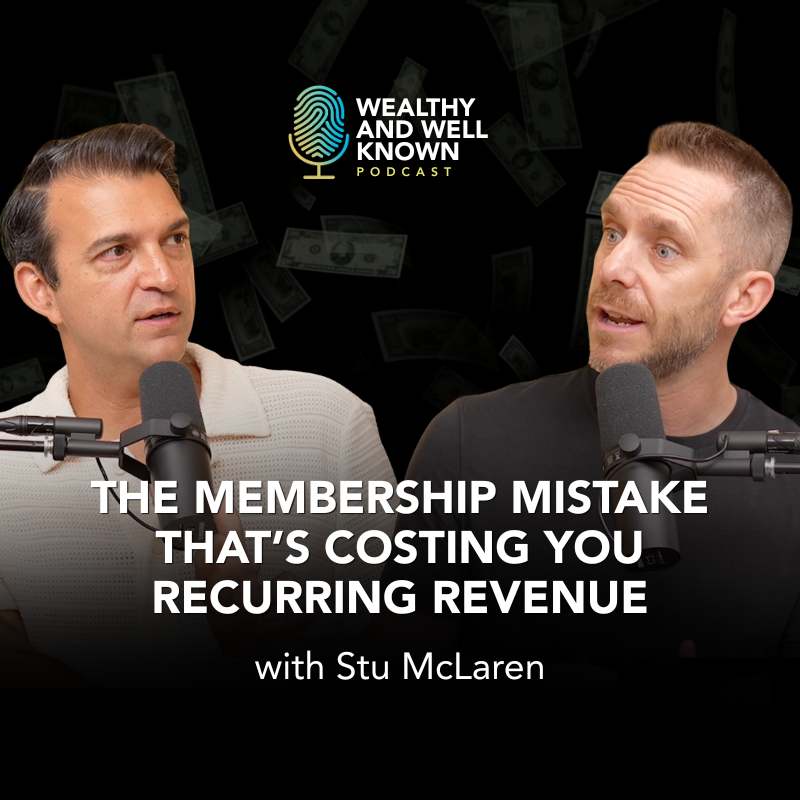
We’re in the happiness business. As long as people are experiencing progress, they’re going to be
happy. As long as they’re happy, they’re going to stay. The internet has taught us that growth is
about attention. It’s about more traffic and more customers. But what if we’ve been measuring the
wrong thing all along? What if the businesses that survive aren’t the ones that attract the most
people, but the ones that give people a reason to stay? Today’s guest is Stu McLaren.
For nearly two decades, Stu has quietly become one of the most influential minds in the world of
recurring revenue, memberships, and online communities. He co-founded Wishlist Member,
a platform used by more than 70,000 businesses around the world. But what makes Stu fascinating
isn’t his expertise in memberships. It’s what he believes memberships are really about,
a sense of belonging. and the psychology behind why people commit to something and why they leave.
Because according to Stu, the greatest threat to a business isn’t competition. It’s indifference.
It’s the moment someone says, Ooh, this looks good. I’ll save this for later and never returns.
But how do you go from celebrating your first sale? And it was a whopping whopping $7.95.
And I was ecstatic to building an eight-figure business. And why does one of the world’s leading
membership experts believe the first seven days determine whether a customer stays for months or
for years? That’s where this conversation begins.
Would you like more recurring revenue in your business? Would you like to lower your churn?
Would you like more people coming in the front door, being onboarded properly, staying longer,
and referring more people into your business? That is what we’re going to talk about on today’s
episode of the Wealthy and Well-Known Podcast. I’m joined by someone who is a pretty good friend
of mine, but a really great friend of many of my good friends, Stu McLaren. And Stu is…
one of our industry’s most recognizable experts in the space of memberships,
recurring revenue, reducing churn, and all of those things that I talked about. He wrote a book
called Predictable Profits on this subject, and he’s had a few different exits for different
programs that he created. So in 2008, he co-founded Wishlist Member.
which was the most popular membership platform by WordPress. When he sold his stake,
over 70,000 people worldwide were using that. I met Stu because after that, he went to work with
Michael Hyatt and Michael had a membership program that was high six figures and they partnered
together and Stu helped Michael grow that to a multi seven figure low stress business.
So I’ve just heard so much about this man and his integrity and he raises money for his nonprofit
that he runs and we have so many mutual. friends. And so I invited him today. He was in town in
Nashville and I was like, we got to have him on the show. So Stu, welcome to Wealthy and Well
-Known Podcast, brother. Thanks, my friend. It’s great to be here. I can’t believe we’ve never met
in person. I know. It’s been a long time coming. Plus, I don’t have a lot of Canadian friends. So
every time I’m like, yes, another Canadian friend. Well, you’ll hear my shouts and abouts, I’m
sure, as we go through. So buddy, I know you’ve lived in this space for such a long time.
what I would love to know is I first want to talk about getting new members and what are people
doing right now that is working to get new members. Uh, I’m going to spend most of our time talking
about keeping members. Um, because I think that’s, I think to me, that’s where the magic is.
And that’s the part that people really overlook is keeping members, but let’s start with getting
new members. Yeah. And I know you’ve got lots of different students, lots of different business
models. What are some of the things that you think that people are doing right now that works
really well to get new members? Well, there are three keys to growing a membership. Number one,
you said traffic. getting members. Number one, we’ve got to get traffic. Number two, we’ve got to
convert that traffic into paying members. And number three, we’ve got to keep them happy. So a
membership model is really simple if you just break it down to those three key areas. When it comes
to getting traffic and converting that traffic into paying members, there’s a ton of different
strategies. But generally, what I like to do is break it down into different phases. So if you’re
in the early phases of growing a membership, meaning you have zero people right now, and you’re
going from zero to about 2500 then i’m actually going to recommend a strategy that sounds absurd in
the beginning it’s a closed door strategy and what that means is that we’re actually going to close
the doors and people can’t join the membership Now, this sounds weird, probably because you’re just
like, Stu, I was asking you, how do you get members? Not like keep them out. But the reality of it
is, is that when you have a closed door membership, the way it works is you only open registration
a certain number of times throughout the year. In between those periods, you’re building your list.
So all the things that we want to do to grow our audience, we’re using social media to drive people
to build our list. We’re speaking on podcasts. We’re speaking in public. All the different things
that we’re building our list. And then a few times a year, we open registration for our membership.
A few like three, four, two. In the beginning, I would probably say four would be a good rhythm.
As you start to grow, I would actually decrease it. So a good example, when I partnered with
Michael Hyatt, he at the time did not have a membership. He was coming off the back of his New York
Times bestselling book, Platform. He was getting asked a lot of questions. And I’m sure like a lot
of people in your audience, because they’ve been following you and they’ve been publishing their
book and getting their material out and building their personal brand, they’re probably getting a
lot of questions from their audience right now. That’s a really good sign. And so with Michael,
he was getting a lot of questions. he was answering a bunch on his blog in the form of blog posts
and on his podcast. But the reality of it was, is there was a lot of hunger there. There was a big
appetite. You could see it. So ultimately a mutual friend introduced us. We came together and I
asked him, I said, what’s the biggest challenge you’ve got in your business right now? And I’ll
never forget. He said, Stu, I love what I do. I love who I get to serve and the message I get to
share, but I’m tired. He’s like, I just, I just want to be home with Gail.
And the girls and the grandkids. And I said, I can help. And so we came together and we formed
ultimately a partnership. And it started with his membership. Now, in the beginning,
we were open all the time, meaning anybody could join his membership at any point at any time.
And we would grow about 100 to 125 members per month. But then we had a conversation and he said,
Stu, I love that we’re growing the membership, but. the calendar’s really full.
Like I would love to create some space to do some other things, maybe some other courses,
maybe future books. So I said, okay. I said, well, what if we go from promoting all the time to
four promotions a year? Oh, okay. So this was more of like an accidental thing. It was an
accidental discovery. Okay. So now in that moment, there’s fear because it’s like,
can we get as many members in four months as we do in 12 and so it was like well let’s experiment
so one of the things i appreciate about michael is he’s open to trying new ideas and so we did and
so we did a promotion and we said we’re going to be closing the doors and so now is the time to
register and what was amazing was Typically in a three or in a three month period,
we would get, like I said, anywhere between 300 to 370 plus members. Well, in this one.
Right off the bat, we more than doubled that. We had over 650 plus members join in that promotion.
And so it was counterintuitive. It was less work and more revenue.
Yeah, we’re not okay with that. We’re not okay with less work and more revenue. You must work
harder if you’re going to make more revenue. It was like crazy. And then we asked another question,
which was like, well, what if we go down to two? promotions a year we’re like same fear oh my gosh
can we you know in two promotions get as many members as we did in four well the crazy thing was it
gave us more lead time to build up and create anticipation for that promotion so then when we went
down to two those promotions we were welcoming anywhere between 1500 to 3000 plus members in a
single promotion so it increased even more it increased even more so we were working even less and
making even more and so the crazy pretty soon you go down to zero promotions
But it, so I recommend no, you know, some, we have some clients that actually do one big promotion
a year. I wouldn’t recommend that. I think I would settle in on, you know, no less than two,
no less than two and no more than six. Exactly. Like you want to find a rhythm that is going to be
right for you. In the beginning, I would say probably four is a really good rhythm. The other side
benefit to this is that when you close the doors, It gives you more time to actually just love on
your members. See, people often forget when you’ve got a membership that’s open all the time, you
are… caught between two worlds you’re in promotion mode and serve mode yeah and those are two
different worlds two different mentalities two different um approaches well i mean at brand
builders group we literally have two different teams right two and it’s basically like we operate
two different companies there is the marketing company and the marketing and sales which is all new
business and then there’s just delivery and you know customer service which is all Cause it,
and it is, it’s, it’s hard. It’s a, it’s a thing. Like I’ll never, uh, there was, um, years ago,
uh, one of our clients, Jennifer, she had a membership and she was open all the time. And,
uh, she was in my mastermind and she said, Stu, like, I really want to grow this thing.
Like, I know that I’m capable of much more. And she had been working at it for quite some time. It
had taken her four years to get to the point where she had about 700 members being open all the
time. And Hey, that’s not shabby. Like that’s pretty good. Like 700 members. But she was right.
She was definitely capable of much more. And I said to her, well, you know what I’m going to
suggest? And she’s like, no, I’m not doing that. I said, Jennifer? She’s like, no, I’m not. Okay,
fine. I’m open to. I said, what do you think I’m going to tell you to do? She’s like, you’re going
to tell me to close it. I said, that’s exactly what I’m going to tell you to do. And I said, why
are you hesitating? She’s like, well, I don’t want to do like a big promo. I don’t want to, you
know, it feels like heavy. I said, okay, well, how would it feel light? By the way. The questions
we ask ourselves are really important because if we want to know how to do something,
we have to ask ourselves, like, how can I close the membership and keep the promotion feeling
light? Your brain searches for those answers to close the gap. So that’s what I said to her. I
said, you know, what feels light for you? She’s like, well. you know, Facebook lives feel like,
like those are easy for me. I said, okay. So what if you close the membership and you did a series
of Facebook lives leading up to that close cart day, you just get on and you start talking about,
you know, your membership, why you’re closing it. Cause she was going to make some changes. So it
was a perfect test, right? She can say, look, I’m about to make some big changes to the membership.
So I’m going to be closing it down. And that was her reason in this case for closing it down. So
she did that leads up to it. she welcomed more than 1,100 members during that promotion.
So it had taken her four years to get to 700 members. In one week, she welcomed more than 1,100
new members. But the greatest message I got back from her afterwards was, yeah, she was excited
about the growth in the business, but she was also just relieved that she didn’t have to be in
promotion mode all the time. So closing the doors, it’s counterintuitive, but…
is one of the biggest drivers of new members joining a membership. Now, this is bearing in mind
that you have an audience that you have been growing. Now, you don’t need a massive audience, by
the way. This is another huge misconception that a lot of people have is that you’ve got to have
this big audience to do it. No, no, no. If you’ve got an audience of 200 or more, you can run with
this closed door strategy. And so we can unpack different ideas further.
But in stage one, definitely a closed door strategy. Okay. So I want to just briefly touch about
why is that? My mind immediately goes to it’s because of urgency and scarcity.
If it’s open every month, then people can just procrastinate.
There’s nothing forcing them to make a decision. Well, what they do is the kiss of death for all of
us as entrepreneurs. They’re like, ooh, this looks good. I’ll save this for later.
If I were to look at my phone, I have an Instagram, a whole folder of products,
thousands of them. Then I’m like, ooh, this looks great. I’ll save this for later.
Kiss of death. Kiss of death. Worst thing ever. Have I ever gone back and bought any of them? No.
Actually, I take that back. There was one product that I bought and I had saved it. And in fact,
if I go back to that folder, I’ve saved it multiple times. And, but the reason I bought it was
because they did a promotion and guess what there was a deadline deadline. And I’ll never forget.
I was lying in bed and, uh, I was doing that, you know, late night scroll. And,
uh, I said to my wife, Amy, I said, Amy. I think I’m going to buy this thing. She’s like, what is
it? I said, it’s this thing that I found. She’s like, what is it? I’m like, it’s an electric bike.
And like, it was like this electric bike with big fat tires. And I just envisioned myself riding it
on the trails. And she’s like, okay. She’s like, well, let me look at it. So she, I showed it to
her. She’s like, we should get one for each of us. Oh, nice. So it went from, because they finally
added a little bit of urgency with a deadline. We went from, ooh, I’ll save this for later to not
buying one, but buying two, thousands of dollars in investment in these bikes because they had a
deadline. And the same is true with a membership. You don’t give a deadline. then what happens is
people will save it for later and they never come back. See, it’s interesting. Before we started
Brand Builders Group, I built my career on a book called Take the Stairs. That whole book is about
the psychology of overcoming procrastination. And like I spent the whole first part of my career
doing nothing but studying procrastination and never thought it would be so hyper relevant to
building personal brands. But it’s like the human brain keeps you safe and the best way to keep you
safe. is to keep you doing what you’re doing now and not changing. And so it’s like,
if you don’t force that deadline, you just continue being like, yeah, I’ll just hang out. And you
get the psychological payoff with the save of like, if I need it, it’s there. It’s like insurance.
It’s like, it’s there if I need it. But here’s the other side of this that I think is really
important. I often hear people say, well, I don’t want to give a deadline.
It feels like I’m creating fake urgency. Like that doesn’t feel good. But the flip side of that is,
does it feel good knowing that the audience that you are looking to serve is delaying getting their
problem solved? Does it feel good knowing that they are still going to continue having that
problem? Unless… give them a reason to join today. And so we have to think of it differently.
Like all we’re doing is we are creating urgency so that we can help people, so we can help them
achieve their goals, make progress in their life, overcome obstacles and so forth.
And so I think more than anything. If we’ve got a mindset that this is a great opportunity for us
to serve, we want to create every opportunity and we want to set the stage for people to be able to
come into the doors so that we can love on them and serve them. The thing that makes me think about
is like a marathon. Okay. So you go, what if all marathon runners,
if it was just like, okay, go run a marathon whenever you get around to it and then just report
your score. Nobody would ever train for it. They would never do it. It’s a service to pick a date
on the calendar and go, everyone show up on this date. It’s true. We’re all running the marathon.
And so you train for, you know, like when it’s the deadline that is the catalyst for the
transformation in their life. I think about my business today. We would not be here if I didn’t
have a dear friend who gave me a deadline. So I had been behind the scenes helping people.
grow their memberships. Michael Hyatt was one. And then that took off. And before we knew it, that
was a multimillion dollar a year membership. And so I started getting a lot of other people are
like, Hey, could you help me do that? Can you consult with me that? And so I was behind the scenes
and a mentor of mine was really encouraging me to come out and share this and teach others how to
grow memberships. And so I had been doing some private workshops. And I felt like I had built my
body of work that I could turn this into a program and launch it. So I was talking to a friend of
mine, Jeff Walker. So I said, Jeff, I’m thinking of packaging this into a course. Would you be open
to helping promote it and share it with your audience? He said, yeah, what are you thinking?
I said, well, I don’t really have like a date set. And he’s like, Stu, if you don’t give me a date,
I won’t promote. I was like, oh, okay. August 18th. He’s like, perfect.
And then everything backed up from that date. And so urgency. with a date is really important it’s
not only important for us personally like to get us moving but it’s also important for our audience
to get them off the hump of thinking about and more taking the action to solve their problems all
right so in between the deadlines yeah you said we should be building our list yep there are
literally millions of things you can do to build your list yeah is there anything that you go
again, this is what you should be doing right now that’s really working? I love having list
building events. So a good example of this would be Tara Phillips in our audience.
So she’s a former teacher and she had been in the classroom working with kids with autism for 25
years. Over the course of that period, she realized that she had developed a bunch of resources
that would be helpful for other educators in working with kids with autism. So she started selling
them one off on a site called Teachers Pay Teachers. And she was earning some extra income,
which was great. But then she learned about memberships and that’s when she came into our world.
And so she launched her membership and very quickly she had grown that membership to a couple
hundred members. But then she really wanted to grow it even further. So she now hosts a list
building event once a year and it’s a big summit. And so she gathers the who’s who of the autism
world. And she has a summit where they’re each sharing different presentations.
And just on the front end of that, she is like her last summit that she did,
she generated over $400,000 on the front end. So it’s free to attend.
Then there’s a VIP upgrade package. And in her last summit, she had over 50,000 plus people
register for that event. So if we just pause right there, that in and of itself would be a home run
win. If all she did was just have 50,000 plus people being added to her email list,
that is a huge win. But then she sold the VIP package and she had over 4,000 plus people take her
up on that. So that was over 400,000 plus dollars. This is like a $97 VIP upgrade.
Then she had sponsorship. So this year she’s doing it again. This year she has Sesame Street as a
sponsor. For the virtual event. For the virtual event. Wow. Melissa and Doug Toys. She has Beaches
Resort in Turks and Caicos because they have a whole thing working with kids with autism.
So it just compounds and gets bigger and bigger and bigger every year that she does it. Then on the
back of that, after the summit, she offers her membership. And she’s had anywhere between 800 to 1
,000 plus members join. When you say on the back of that, do you mean… the actual end of the
summit? Or do you mean like a month later or like? At the end of the actual summit. Okay. So
there’s an offer that comes at the end of a, whatever, a week long summit or something. That’s
true. Yep. If we take away the offer for the membership, if all she did was just do this summit for
the sole purpose of building her list, it’s a gigantic win. And I think too often. we are too
passive in our list building. And I would encourage people to be more intentional and strategic.
Get some dates on the calendar where you’re doing some kind of a virtual event with the intention
that It is there to build the list. And yes, we can be strategic and we can look to generate
revenue afterwards. Like I always love covering my costs of building that list. So if I can cover
my costs, to me, that’s a home run win because I know throughout the rest of the year, that list is
going to pay for itself. Yeah. I mean, Michael did this for years. I was on it. You did one
recently. I was on yours. So it’s really great. So we’re building our list.
We’re adding value. We’re building trust. Then we have our closed cart. People come in.
How do we keep these people? Because here, here’s, I’m going to say something that’s going to make
a lot of people mad. Everybody buys into the dream of a membership site and you go,
oh yeah, just get a thousand, a thousand people to pay you a hundred bucks a month. You’ll make a
hundred thousand dollars. You’ll do $1.2 million. The reality is most of those people are going to
stay for two months, maybe three, and they’re going to churn out and you’re going to spend all your
time tracking down. declined credit cards and cancellations and now you got people who are upset
about this and that and like your whole life which it seemed like oh i’m just gonna have passive
income the reality is it’s a churning wheel so how do we stop that well um we’re gonna agree to
disagree on this okay okay um because you will have churn if you don’t have a retention plan in
place so People who have a retention plan in place don’t see that kind of churn. They don’t see
their members staying for months. They see their members staying for years. And there’s a huge
misconception when it comes to retention and churn. And it’s almost like accepted that members only
stay for a few months and that’s just part of the business. No, it’s not. Listen, when people join
a membership, they’re joining because they want to get a result. If they are experiencing progress
toward that result and they’re happy, they will stay. So we’re in the happiness business.
If people join our membership, our whole goal is just to keep them happy and keep them progressing.
Because as long as I’ve been doing this for 18 plus years, I’ve never known anybody to leave a
membership because they’re experiencing too much success. Like, Rory, nobody comes to Brand
Builders Group and says, Rory, it’s been a great ride. We have like, you know,
grown our business to a whole nother level. Peace, I’m out. They’re not saying that. They’re
saying, Rory, this has been amazing. Give me more. Yeah. And so as long as we are helping people
experience progress, they will stay. So the goal is not just get them in and let them churn.
No, no, no. The goal is get them in and love on them and support them and help them experience
progress. And I think they, you, you said it, they don’t have a retention plan because the big
mistake, everyone in this. business is making is all they think about is the new customer, right?
They never think about loving on the person that’s in front of them, like that they have already.
They never think about like the retention plan. So like, what are some of the touch points, I
guess, that we could go like, how do we, how do we have a retention plan? I mean, what does that
even, what does that even mean? Well, I’ll tell you, if you’re looking to save members, the most
important period is the first 30 days. In fact, I would say it’s the first seven days and studies
have shown If people have a positive experience in that first seven days, it will on average triple
the lifetime value of that member. So this first seven days is vital.
It is the most important piece to a new member experience. That’s really powerful.
The key to keeping people for months and years is what you do in the first seven days.
Like that’s a huge insight for people that we don’t, I think a lot of people overlook this.
I’ll give you an example. If somebody has friction in their onboarding experience,
it’s immediately creating a negative seed in their mind. So I had a client recently who hired me
for a VIP day. So once a month, I reserve one day to work one-on-one with a client.
They had an established membership site. They had, it was just shy of 800 members and it’d been
around for quite some time. And they said, Stu, Can you take a look at our retention? Like we’re
struggling. So I said, sure. I said, what I want you to do is I want you to send me a link where I
can join your membership as though I’m a new member. So they sent me a link. I start going through
the signup process. And it was like friction after friction after friction. And one of my favorite
questions to ask them is I said, on your exit survey, when people are canceling your membership,
what’s the number one reason that they’re canceling? And they said they don’t have time. uh to go
through all the stuff so i said okay so time is the the biggest um objection they said yes i said
great great so I come to the registration process. It’s not clear in terms of like the flow of
where I’m supposed to click. Like I join and then there’s a page that gives me instructions to do
three things. I can’t do any of those three things on that page. I have to click to another area.
So I click to another area and then there’s a video and it’s the only thing on that page,
which is good, but there’s no. time on how long the video is.
So I start playing the video. I have no idea if this is like a two minute video, a 20 minute video,
a two hour video. So what are most people doing? If they’re strapped for time, they’re like peace
gone. They’re not even watching it. It is the most important video that you want somebody watching.
And there was like mistake after mistake like this. When I finally got into the members area,
it is a sea of links everywhere. I have no idea where to go,
what to look at first. It was a mess. And this is a huge mistake that a lot of people make.
So when I’m thinking about how do we make that first seven days just a golden opportunity where
people have that positive experience, the very first thing that I’m looking to do is to help the
member get clarity. Where are they in this journey? Where are they going?
And what should they focus on? It’s something that I talk about in my book called The Success Path.
And we want to map out what that journey looks like because not all members are equal.
So a huge mistake that a lot of people make is they just treat everybody the same. It’s like a one
size fits all. But you know, and I know that not everybody’s the same. You’re going to have people
that have more advanced skills. You’re going to have people that are in the beginning. Some may be
intermediate. So one of the very first things is part of the onboarding is you wanna ask a few
questions. You wanna ask a few key questions to identify where are they in this journey. Then after
they answer those questions, you wanna take them to a page that has content that’s specifically
relevant to where they’re at. So it would say, hey, Rory, sounds like you’re at level one.
Based on that, here’s what we recommend you focus on right now.
don’t worry about all the other stuff. Because if you just focus on these few things, you’re gonna
be able to make progress toward this. And that is like a huge weight off of people’s shoulders
because they don’t have to go learn all the things. They just gotta learn the next right thing and
it’s served up on a platter for them. So number one is you want to make things clear.
You wanna give them clarity. Where are they? Where are they going? And what should they put their
focus on right now? Second thing is that you wanna help People connect.
So I always think of when my family moved to a new area. This was a few years ago.
New area, new school for the kids. You got young kids. My kids were young at the time.
you know as a parent you have that like feeling like i just i just want the kids to feel settled
you know like that’s the main thing so i remember amy and i we walk the kids to school we drop them
off they find their teacher in they go and we’re just like please just let this be a good day the
end of the day we come to the school to pick them up my daughter comes running out first marla and
she’s got this she’s coming towards me she’s got this big smile on her face and she comes home i
said marla how was school today she’s like dad this is the best school ever i was like really i’m
like why She said, well, you know how I used to go to a Montessori school? And I said, yeah. She
said, there’s a girl in my class that used to go to a Montessori school too. I’m like, that’s
awesome. She’s like, but dad, it gets better. I said, how? She said, well, you know how I love
riding horses? Yeah. She rides as well. I’m like, that’s incredible.
And she’s like, but dad, even better. You know, the new stable that I’m riding at? Yeah. Her mom
owns the stable. I’m like, what? Get out of town. She’s like, dad, this is the best school ever.
Her whole perspective on this being the best school ever had nothing to do with the school.
It had everything to do with the fact that she had made one meaningful relationship.
Wow. So if we take a step back and we think about that in our own memberships, one of the hardest
things is when somebody comes into a new community, they’re that new kid in school. They don’t know
anybody. So one of the best things that we can do is to help them form that one meaningful
relationship. And there’s a ton of different ways that you can do this. One of my favorites is if
you’ve already got members, have a welcoming committee where, you know, new members join us like
Rory. Awesome. So glad you joined. Hey, where are you from? Why did you join us?
Asking a few questions. And then it’s like, oh, you know what, Rory? Let me connect you with Neil
over here. Oh, and Jane, she’d also be a great contact for you. And do you know Carl?
He lives near you. And so all of a sudden, there’s like this community aspect. You’re finding those
common traits that people have. And you’re connecting them accordingly. And so I always love having
like an introduce yourself post. Sure. community but the last thing that i want is like hey rory uh
go introduce yourself i’m brand new and then crickets yeah nothing nobody responds yeah yeah
because like an introvert you know shout out to all my introverts an introvert the last thing that
we want is to go into a community and be like hey my name’s stew let me tell you why i’m awesome
i’m awesome for this reason that reason like nobody wants to do that right but it’s so much easier
if you’re set up with like three questions hey just go answer these three questions But the purpose
of those three questions is to pull out what I call connection points. So if I were to think of my
own life, what would be some connection points? Well, number one, I was an athlete all throughout
high school and played soccer at college and we won two national championships.
So right away, any of the athletes, boom, we got a connection. Number two,
I… And my wife adopted our son from South Africa. So that’s a beautiful connection point with
anyone who was adopted or has been adopted or has an adopted child. And another connection point is
that both my wife and I, we were born in England and lived in England. So now all the Brits,
we have a connection point. So there’s all kinds of different things that we have in common with
other people. With your questions in an introductory post, we want to pull those common connection
points out so then people can find that common ground. Does that make sense so far? Yeah, that’s
awesome. I love that. All right. So you help them get clear. You’re going to connect them to
community. Help them connect. And the third one is help them get a quick win. So one of the magical
things about memberships is that, as I said, as long as people are experiencing progress,
they’re going to be happy. As long as they’re happy, they’re going to stay. But we often think the
only way to make a member happy is if they get the big wins. Like in your case, a misconception
might be like the only win is if they hit the New York Times bestseller list. And so it’s just
like, oh my gosh, like that is a huge thing. That takes years of prep. And in that years of prep,
people often give up. So what we gotta do is we gotta break that journey down. I like to break it
down into different stages. And then even within those stages, there’s different milestones. And
those are indicators that, hey, We’re going in the right direction. And we want to celebrate those.
So I’ll give you an example. In our community, we celebrate when somebody welcomes their first
member just as much as we celebrate somebody who welcomes thousands of members in a single
promotion. Why? Because I know how important that first sale is.
I still vividly remember my first sale. I, in fact, have a picture that has been plaqued that is in
my office of me sitting in front of my computer like that after I made my first sale.
And it was a whopping, whopping. Seven dollars and ninety five cents. Nice. And I was ecstatic.
And I’ll never forget, like my wife and I, we were working for my mentor at the time and we had
flown to LAX to host a seminar with him. And I remember saying to Amy,
I said, I got to I got to get up and check my stats. She’s like, check your stats. It’s like some
flood of sales are going to come in like during this flight. So I remember we get up to the hotel
room and I log on. And, uh, there it was. And, and I was just like, Oh my gosh,
somebody that I don’t know that’s not mom has just purchased from me. It works.
It works. And I was just like, I was just like filled with belief in that moment.
And I said to Amy, I’m like, babes, you got to take a picture of this. She’s like, why? And I’m
like, this is going to be on the cover of ink magazine one day. I’m like, and so she took the
picture and then, uh, it’s so funny when I look back, but she’s like, she says to me,
I’m so excited for you. She’s like, how much did you make? And I was like,
it was $7.95. She’s like,
okay. She’s like, okay, but how much did you spend to make that?
I was like, it was about $800. She said, pardon me? I said,
it was about $800 in ads. And she’s like, $800 in ads? She’s like,
I’m not the business major here, Stu. You made $7.95 you made and it cost you $800?
She’s like, it’s not adding up. Why are you so excited? I’m like, babes, this is just the
beginning. This is a numbers game now. And I was just like, it just created this belief. And I
think about like all this transpired afterwards. And I don’t know if we would be here today if in
that moment, I didn’t have the belief. that it was possible, that it could happen.
And it came from that first sale. This is why I celebrate that first sale in our community.
Because I know that that creates incredible belief and momentum for people.
And that momentum is the thing that’s gonna carry them to the next thing and to the next thing and
to the next thing. And the more we celebrate, the more confidence they get, the more momentum they
build, and it gets them to the finish line of doing the big thing. But it didn’t happen until they
did the first thing. So back to onboarding. When we think about onboarding, the sooner we can help
people get just that little win and celebrate it and make a big deal out of it, the more momentum
they begin to have, the more confidence they begin to build and the more positive they feel about
this whole experience. They’re like, man, this is incredible. Like I have only been here for a
little bit and look at me. And so there’s a couple of key things here. When someone joins, you
wanna make sure that you draw a line in the sand as to where they are right now because if you
don’t do that you don’t have anything to measure the progress against and so now once we’ve got
that line in the sand we can look back and be like look at you Rory look how far you’ve come in
such a little period of time that’s what feels great so there’s a few tactical things that we got
to do as a membership site owner but at the end of the day if we just keep it simple it’s like just
help them get a win If you help them get a win, it feels good, and that’s what creates a positive
experience. So help them get clear so they know where they are, where they’re going, and what they
should focus on. Number two, help them connect with others so that they build that one meaningful
relationship. And number three, help them get a win. And the sooner you can help them get a win,
the greater it feels, the more likely they will stay. Well, there is a lot more that we need to
cover. We didn’t really get to cover how to keep people using the program and how to renew them and
how to get referrals. There is so much, though. You see how deep Stu went in just this seven-day
onboarding period. So what we’re going to do is we’re going to give you a membership guide that Stu
has put together. And if you go to freebrandtraining.com slash membership, freebrandtraining.com
slash membership, we can continue the conversation. Stu, tell them. What what are they going to
find in this guide? And then where do where do they go from here? Well, there’s a lot of questions.
I know you’ve got more and I know that you want to. That’s why we’re going to end the interview so
I can get free consulting before.
But. What we did was we compiled like the most common questions that we get asked. We’ve been doing
this a long time, helping people in all kinds of different markets and niches. And so we compiled
those top questions and I answered them. But then within that, we give tons of examples and case
studies. So you can see how what we’re sharing is applied in the real world. And so that’s what
they’re going to find is answers to the top 10 questions that are going to help them get moving
into getting their membership site off the ground. And if they’ve already got it off the ground,
growing it to the next level. Yeah. So I love that. So go to freebrandtraining.com forward slash
membership. And I’ll just give a vote of confidence for Stu. Like, you know, that AJ and I are very
selective about who we network with and who we invite on the show. But this man has the highest
levels of integrity and obviously is a deep, deep, has deep, deep expertise in what he’s doing.
So Stu, this has been phenomenal. I am going to walk away like I’m going to have to send this to
our team and be like, we better we need to go audit all of these things and make sure that we’re
doing it. And everything we do at Brand Builders Group is for mission-driven messengers. This is
not a profit maximization endeavor for us. We sold a company. Brand Builders Group for us is an
impact maximization endeavor. And we just want to help people who genuinely care about making the
world a better place. And you do such a good job of that. And your reputation precedes you.
It’s been such an honor to meet you in person. And thank you for being so generous in what you’ve
shared here today. Well, I appreciate it. One of the things that I firmly believe and I struggled
for a long time with was making money. Because believe it or not, we all want to make money.
but i actually struggled in feeling guilty about making money and it held me back for a long time
and i could not break through the four hundred thousand dollar threshold and it was hard because i
i grew up with two hard working parents you know both my parents were two full-time jobs but they
were always at every basketball game and soccer game and i don’t know when they slept to be honest
And so I felt really guilty. I was making more money than both my parents combined. And so what
would happen is I’d get to that threshold and then I would self-sabotage. I would stop calling
clients. I would stop doing the campaigns that I knew would work and my income would come back
down. It was like my subconscious was like, yeah, that’s better. And it wasn’t until my wife and I
went to Kenya to look to build our first school with our charity called Village Impact.
And I was… talking to the chairman of this community. And I was trying to figure out like how
much things cost. We had no idea. And I asked him, I said, how much does it cost to fund the full
-time salary of a teacher? And he thought for a moment and he said, it’s, it’s about a hundred
dollars a month. And at the time I was selling my software for a hundred,
it was $97 for a single site license. So I had this moment of like realization where I said, Oh,
wait a minute. If I, if I just allocate the proceeds from one sale, I could fund the full-time
salary of a teacher and imagine the impact that would have. And then the real light bulb went off,
which was like, hey, Stu, what if you just make a ton more money and you just give a ton more to
the people and causes you’re passionate about? Imagine the impact you could have. And it was that
breakthrough. Because what I realized in that moment was the more money I make, the more impact I
can have. And that transformed everything. I, for the record, love making money.
I love it. And I am proud to say that because it went from feeling guilty. and shameful about
making money like it was a selfish thing to now it’s a very honorable thing because the more money
you make the more you can give to people and causes that you’re passionate about and that very next
year i went from 400 000 to more than a million and now we’re eight figure plus business and it’s
because giving and philanthropy is woven right into the fabric of what we do and so i just want to
encourage everybody as you’re moving forward like take pride in what you do take pride in like who
you help take pride in the impact that you’re having with your work and also take pride in the fact
that you have a skill to be able to make a ton of money. And with that money, you can give to
people and causes that you’re passionate about because there are a ton of people and causes that
need help. And this is the gift that we have as entrepreneurs is being able to use our skills to
make money and to be able to give to people and causes. So I love the fact that you guys are really
focused on. helping so many others be able to get their message out and to be able to help and
serve and uh and that’s a woven into the fabric of what you do so i appreciate you having me and
thank you so much for today yeah well amen brother amen to all of that and i want you to share this
episode with somebody who you know that has some type of membership or coaching business just hit
share send it to them also show stew some love online if you can you know leave leave a comment
below uh obviously hit subscribe so that you don’t miss any more of these And just whatever you can
do to take the goodness that is here. I mean, this episode literally is worth thousands and
thousands of dollars and to the right person could be worth millions of dollars, which means that
they could be giving back to other people and causes just based on what is available here for free.
So I hope you’ll do that. I want to invite you to do that. Make sure you stay tuned to the wealthy
and well-known podcast. It’s our honor to serve you. Go out and find someone to serve. We’ll see
you next time.
WWK Ep 030: 10X Is Easier Than 2X: Dr. Benjamin Hardy on the Science of Scaling
RORY (00:00)
I’m gonna 10X my comp I’m gonna grow 10 times larger than I ever have been able to get to so far. I’m going to get 10 times further than I’ve gotten my entire life in three years. Yep.
I have to tell you, when I first saw this, I my brain processed what you were saying as hyperbole.
DR. BEN HARDY (00:18)
Exactly. That’s what I meant. People take it metaphorically or they don’t take it literally.
RORY (00:26)
You’re about to hear from one of the smartest people on the planet today. And in the space of personal branding, this guy is a master. He is someone who models exactly what we want to see in terms of true thought leadership. We’re going to talk about how do you forward the thinking of what has been done in your space? How do you separate yourself in a in a world of noise? And specifically, we’re going to talk about how to scale your business, how to 10x your business in the next couple years or less. That’s something that he’s helped a lot of people do.
Who am I talking with? I’m talking with my good friend, Dr. Benjamin Hardy. He has a PhD from Clemson. He is a New York Times bestselling author. He has written several books. Some of my favorites: 10X is easier than 2X, Who Not How, and his newest book, The Science of Scaling, which hit the New York Times bestseller list when it came out. He has sold hundreds of thousands of copies of his books. He’s had hundred million people read his blog articles. He’s been featured in the Harvard Business Review, Forbes.
fortune, so many great places and he’s become a friend. So he’s an organizational psychologist and he’s gonna talk about how to help you blow up your personal brand, how to develop true thought leadership, and how to scale your business as an entrepreneur. Ben, welcome to the show.
DR. BEN HARDY (01:40)
Good to see you, brother. So great.
RORY (01:42)
Glad to have you.
I want to dive right in with scaling. ⁓ I want to understand what is the difference between growth and scaling? Because everyone listening, you know, here is an expert of some type. Most of them are entrepreneurs. If they’re not entrepreneurs, they’re intrapreneurs, right? They’re they’re operating a you know a division of a company or something like that, or they’ve got, you know, maybe like a side hustle or something.
And I think you hear those terms a lot growth, scale. You say there’s a big difference. What’s the difference?
DR. BEN HARDY (02:14)
So for me, the difference is growth is usually taking where you’re currently at and doing more of it. And so you can know if someone’s growing, if they use where they’re at now or what they’ve accomplished in the past to to like set their objectives. So as an example, if we did a million revenue last year, let’s go for two this year, you can automatically know that that person is growing. Also I think a very easy example is if someone is not literally two Xing on an annual basis, they’re growing. So if someone’s, you know, growing by one percent, that could be considered growth.
Right, that’s definitely not considered scale. ⁓ so if you’re doing less than two X on an annual basis, you’re growing. So
RORY (02:50)
2x
means 100%. Correct. 100% growth. Yep. would have it to so it’s really like you can grow ninety-nine percent once you hit a hundred percent. It’s gotta be at least a hundred percent.
DR. BEN HARDY (03:00)
I’d
say so. I I that that that that starts to get a little close, but for us, scale is an exponential. And for something to be an exponential, it has to be a multiple, and that’s gonna be at least a 10x. And so for us, scale has to be at least a 10x. So
RORY (03:14)
we say it as growth is linear, scale is exponential. Would you agree with that? It is
DR. BEN HARDY (03:20)
Yeah. And so scale is at least 10x. And for us, we actually do put the time constraint on it because you could linearly grow for for decades, right? ⁓ usually, usually you’re gonna hit a plateau, but for us, scale has to be speed as well. It’s not just the the size, but it’s also speed. And so for us, scale is gonna be something that happens in a few years, not in a decade. We usually put the time cap on it three years or less.
RORY (03:44)
Yeah, let’s talk about the speed dynamic because you showed a ch there’s a tr t table, a chart in this book, which you also show in your presentation about what it looks like ⁓ on a you know, if the x-axis is time and the y-axis is growth. Sh explain the difference as best you can w visually what does that what does what is growth look like on that graph versus what does scale look like on that graph.
DR. BEN HARDY (04:11)
Yeah,
so you just like have a have a slope, a a growth slope is gonna be very like small, like it’s gonna be very linear, whereas ⁓ scale is gonna be like very sharp. It’s gonna be sharp upwards, gonna have an intense slope, which is also an intense learning curve, right? And so just as an example, like if you want to go from zero to a hundred, right, that that could be considered growth. Whereas if you want to get to zero to ten thousand, right? That’s just those are just random numbers, but the numbers are bigger, but also the timeline is shorter. And so it just forces a different path.
RORY (04:39)
It
forces a different path. Yeah. When you when you look at going to a hundred if you go from zero to a hundred linearly, that would be like ten, twenty, thirty, forty, fifty that and that’s what you’re talking about is growth. But if you go, if I shorten the time horizon, yep. And I go, well, I I can’t get to a hundred and ten years. I gotta get there in th in three, as you guys say. Now all of a sudden you have to go ten, sixty, a hundred or you know, something like that, and it and it shoots up. Yep. So
How do we scale? So I love that definition. All right. So I I I love the idea of going growth is linear, scale is exponential, ⁓ and then shortening the time horizon is a part of requiring it to be exponential. So then how do we how do we identify what
Is going to scale our business. Like when you say 10x is easier than 2x, or you say, you know, like what you guys do at scaling.com, and by the way, shout out to Blake Erickson. So he’s the co-author of this book, longtime member at Brand Builders Group, one of the people I have the most respect for, one of the best young entrepreneurs in the nation. ⁓ and you guys are business partners, co-authors. ⁓ so major shout out to Blake.
DR. BEN HARDY (05:51)
Like
he gives you a lot of credit, by the way, for so much of what he’s learned.
RORY (05:54)
I mean, ⁓ that’s I that’s very generous and I appreciate it. I mean, that kid is he’s a superstar. I mean, I say a kid because he’s so young, but like he he’s got more going on than most like 50 year old entrepreneurs. ⁓ so he’s really, really wonderful. So when you guys at scaling dot com, what you guys do is you you’re you will tell them tell them what the promise is. What because you have ⁓ you have a criteria to even like be considered to be kind of a part of this community. What what’s the criteria?
DR. BEN HARDY (06:23)
Criteria is you can’t first off you have to be at a million revenue. Like that’s a we we don’t it’s we’re not a you know VC firm. We’re not like looking to like find unicorns. We want someone to have some establishment. and then we so that’s like a base, you gotta be at least at a million revenue, but also we require as you come in there, you’re gonna commit to 10xing in three years. So if you’re at one million, you have to at least commit ⁓ both to you know, you might not have the perfect pathway. That’s why we give you a strategist, that’s why we give you case studies, that’s why we we help you through the process, but you have to at least be committed to 10xing.
in three years or less. Yeah. And so like that has to be completely established on the inside because we don’t want to bring people in who part of our philosophy was is we want the only room where everyone’s 10xing. Like and we want, we want everyone in there to be scaling because I’ve been in a ton of rooms and ⁓ a ton of communities where
They’re in it’s an entrepreneurial room, right? People are in there getting training, they’re masterminding or whatever, but only like two or three percent of people are actually like becoming outliers, right? It’s a very bell curve normal distribution where most people are actually fairly stagnant, even though they’re in an entrepreneurial room community getting training, et cetera. Only a few were just rapidly 10xing.
Right. And I’d been in so many of those rooms. I was often one of those outliers. And so we just decide we want to create a room where that’s the only thing happening. And so we require 10X from the beginning. So, you know, we have a comp we have companies in scaling.com that are doing over a billion revenue, but they we require the same commitment of them as well. If they’re not willing to 10x, and we take it very literally too. Like this is something that I think was a mistake of mine when I wrote 10x is easier than two X.
is because I talked about 10x both quantitatively and qualitatively, qualitatively being like transformation, value. Okay. I think a lot of people took it too metaphorically and they didn’t literally set a 10X goal and then use that 10X goal to reverse engineer and re engineer their business.
RORY (08:08)
Yeah,
so I want to talk about that. But I and I just want to like double tap on what you said there, because you you you say it all the time and you you go through that, and it’s like your requirement is someone who is going to make a commitment to 10x their business in less than three years. That is a really big commitment, and it is a very unusual.
Person. It’s a very extraordinary. It’s a very non-aver to even commit to something like that, to even sort of like audaciously say, I’m gonna 10X my comp I’m gonna grow 10 times larger than I ever have been able to get to so far. I’m going to get 10 times further than I’ve gotten my entire life in three years. Yep. That’s a radical, that’s a radical commitment from them, and it’s a radical.
promise that you are promoting. You’re not promising it to them, but it’s a it’s a it’s a challenge that you’re you’re throwing down. ⁓ I have to tell you, when I first saw this, I my brain processed what you were saying as hyperbole.
DR. BEN HARDY (09:20)
Exactly. That’s what I meant. People take it metaphorically or they don’t take it literally.
RORY (09:23)
Yeah, and and or and just as like a marketing gimmick. Okay. So I thought it was like, ⁓ you know, here here’s somebody like ⁓ y you know, it’s like, the you know, the billionaire mindset. And it’s just like, well, you’re just like throwing something out there, like no it but you actually have much much to my satisfaction, ⁓ and much to proving me wrong, you have a framework and a and a set of strategies.
And you’ve codified an actual scientific form of thinking for how this is possible. and the way the way that it’s possible is inherent in the goal itself. So can you talk to us about the talk to us about the floor and the focus and why the goal of 10x isn’t just a superlative, but the goal itself is the strategy.
DR. BEN HARDY (10:19)
Hundred percent. Yeah. And I think a lot of people when they use that word strategy, they think about strategy as pathways to goals. Like that’s how I kind of I think people think about like what’s the strategy or like do you have five strategies to get there? And for me, strategy is mostly about the objective you choose. Right. So it it actually starts with what is the goal we’re going for? What are we after? So like when when ⁓ the US was deciding to go to the moon, like going to the moon was the strategy, right?
And so it’s like now we can figure out how to do that, but getting to the moon was a strategy. So the goal is actually mostly like is like I would consider ninety percent of the strategy, the goal itself that you choose. Getting there now we can figure that out. But choosing the objective is the most fundamental aspect of strategy.
RORY (11:01)
And I think that what you just said there, the goal is ninety percent of the strategy. I think that is a radical insight and a unique insight to where people think of the goal as a destination only. You and your work, what you guys have said is no, the goal is the strategy. Explain that though. Like, how is the destination the strategy?
DR. BEN HARDY (11:07)
Hundred percent.
Hundred percent. So
It kind of goes so one of my favorite quotes comes from a a psychologist named Roy Baumeister. Roy Baumeister is one of the kind of founders of the whole field of positive psychology. And what he said is that the self, he’s talking about like you or me, our self is not a thing, but it’s a process. And it uses the future to organize the present. Okay. And so this goes against a hundred years of Freud based psychology that’s very past based. A lot of the research of a hundred years and a lot of the philosophy of psychology was that if I wanted to understand who a human was, all I have to do is understand their past.
past. Yep. And and the view is is that the past predicts the future. And so if I want to know who Rory’s future is, all I gotta do is look at Rory’s past. If I know about who Rory was five years ago, I’ll know who he’ll be in five years from now. And I
RORY (12:12)
I would say that is actually 1000% true if nothing changes. Sure. Your past will will will continue. Sure. But and that’s what and that’s exactly what most people do, which is part of your point, is they’re doing everything based on a a a lens of the past.
DR. BEN HARDY (12:26)
And we even consider that growth. We when you use the past to shape your future, right? We did five million revenue last year, so let’s go for six. You’re living in that incremental, very slow world. But back to back to Baumeister, and really it’s pretty revolutionary, but to me it’s very natural as well, that humans use their future to organize the present, right? So we use our model or our view of the future, or in other words, our goals. and Victor Frankel talked deeply about this in even Man’s Search for Meaning, right? Man’s Search for Meaning, him talking about his experience in the concentration camps. He said that the only thing that would work
When you’ve had everything removed from you, stripped from you, right? He’s talking about people who are dying in the concentration camps. He said that the only thing that would work is to have a goal that gives your life meaning. Like, and he said it’s the pu peculiarity of people that they can only live by looking to the future. So the most critical aspect of a human being is their future, right? That’s what modern, like that’s what positive psychology shows, that’s what neuroscience shows, is that our future is actually the thing we use to shape, filter, organize our present. And so when you understand that.
You start to understand that human beings operate off of goals, right? And you definitely don’t want your goals to be based on the past. And so when you understand that humans operate off of goals, and we use our goals to organize our present, whether that’s ourselves and our skills, our abilities, when I decided I wanted to go get a PhD, that shaped, you know, ⁓ the research I did and getting, you know, letters of recommendation and getting into a PhD program, right? ⁓ when you decide you wanted this studio, right? That goal allowed you to organize this beautiful room.
Right. And even your business and things like that. And so we use the future to organize the present. ⁓ and so that then takes us to strategy and like what is the future? What is the goal we set? ⁓ John Dore, who’s the billionaire who he basically helped Steve Jobs, all the people at Google, he said that a goal properly set is halfway reached. And so for us, that takes us to the idea of scale versus growth. And that the the first thing you really want to do is you want to scale your goal, right? When you take a goal, say, you know, say
Say I’m a I’m like a million dollar business, right? if I scale my goal to a hundred like a ten X, right? And I would say at least a ten X, so at least ten million, and I give myself a short amount of time, what that goal does is it it forces me to relook at the present. That goal, in our words, we actually say it raises the floor because it eliminates most options. When you go for 10 X or more, most things can’t get you there. And that’s really the point. Like to go for 10X or or even 50 X.
very few things can get you there. Very few pathways can get you there. And so it naturally raises the floor, meaning it un it naturally eliminates most options. Most options can’t get you to 10X. And so it forces you to filter and find the few that can, which most people are not doing that. Most people because they’re operating towards a more linear future, they’re not looking for the most powerful pathways.
RORY (15:06)
Yeah. So I and I wanna I wanna again, I wanna punctuate that moment right there is to go when you so a lot of people feel pressure, like if they set a goal 10X, what that would create for them is pressure and like obligation and like, I don’t think I can do that. And they it’s like, but what you’re saying is you’re going, it’s not the pressure of hitting the goal. It’s that is the strategy because
The moment you say, I’m gonna do something 10 times greater than what I’ve done, all almost every option that you’ve been pursuing becomes irrelevant. If I wanna grow by 10 or 20%, there are a hundred ways I could get there. If I want to grow by 10x, which would be a thousand percent, right? Would be 10x. Yep. If I’m gonna grow a thousand percent, the hundred options quickly reduces to like two or three.
And so the f the strategy is that it it provides focus. It shouldn’t create pressure. It like eliminates a whole bunch of stuff and it reveals what matters, right?
DR. BEN HARDY (16:14)
It reveals what matters, it reveals what has leverage, it reveals potentials that you didn’t know were there because you weren’t looking for them. Yeah. And it and it really fits exactly with strategy because, you know, Michael Porter, who created the field of strategy, he said that the the essence of strategy is deciding what not to do, right? And it really has to do with eliminating most options. And so when you actually set your goal appropriately or effectively, which for us is both in scale and timeline, we want the scale to be extreme and we want the timeline to also be extreme.
And we use that as a tool for eliminating almost all options. We really want the goal. We use the goal as a tool, right? Not as a stressor, not as a pressure, but simply as a psychological tool for firstly eliminating most options, because most options can’t get you very far. Most options are gonna be competitive. They’re gonna the the things that most other people are already doing. They’re not gonna have extreme leverage.
RORY (17:02)
They’re
incremental. yeah. Yeah.
DR. BEN HARDY (17:05)
Yeah, and and and and it just it’s you have to just understand, and as people who understand the eighty twenty principle know, that most things don’t produce all the results. The eighty twenty principle says that a few things create almost all the results, and everything else really doesn’t do very much. And so we wanna use that understanding to say we wanna set a goal that’s gonna naturally force out all the incremental ideas. It’s gonna force out all the bad ideas and all the distractions and all the dead end pathways, and it’s gonna force us to find only the few.
With the 10x upside. We still have to go find those. We have to go exploit those, right? We have to go work on those and navigate those and focus on them. But it fits exactly with what Steve Jobs said, which is innovation is saying no to a thousand things. Right. So the thousand things we want to say no to are the incremental concepts that can’t get us very far anyway, so that we can then go and innovate and focus on and build teams around the few pathways that can. That becomes our focus.
RORY (17:54)
Yeah, and and it it is the it is the huge goal that clarifies the few levers that can actually get you there. And that I think is where you go. You it’s it’s the goal is the strategy because it it reveals that. It it it creates a new frame. Yeah. It creates a new frame, you’re you’re you’re you’re you’re seeing the world. And you know, I ⁓
I process things through data. I process things through observation. I also process things through personal like experience. And I look at, you know, when I share my story of like, you know, I was raised by a single mom. When I was born, we lived in a trailer. We had no money. We had no famous friends. We had no super well-educated friends. We had no rich friends. If you and and most of the people who are born in those types of situations,
There’s generational poverty. Their past tends to repeat itself. But my mom, that you know, one of the things she always said is she’s like, you can do anything that you can dream of. And so my whole life, it was like, ⁓ so I got really big into Teenage Mutant Ninja Turtles and Karate Kid. Right. And so I was like, ⁓ I was watching Karate Kid. You remember Karate Kid? So ⁓ you and I have many things in common. So, you know, I was like, I want to be a black belt.
DR. BEN HARDY (19:03)
Yeah. And I love n Ninja Turtles.
RORY (19:13)
And so that was like the first major goal in my life was like I was 10 years old, I became a black belt. And it was like I didn’t worry about that I had never done martial arts. I was like, I want to be a black belt. And then my mom said, You’re gonna go to college. And she said this to me. She said, You are going to college and you are going to get a full ride scholarship because I will have no money, I promise you. And you’re going. So you need to figure out not just how to get there, you need to figure out how to get a full ride scholarship.
And she set that for me. And that re was a a reverse engineering from that future. And I got a full ride scholarship. You know, Blake and I have a a common passion of I went, I went door to door for five years in college. And so, you know, we’ve spent a lot of time in direct sales. And it was like, I want to be number one. And then it was the world championship of public speaking. And then it was a New York Times bestselling author. And then it was an A-figure entrepreneur. And then we, you know, effectively.
Exited, lost our first company, and it was like, how do we get back there? And when I look at my whole life, it is a series of impossible goals that have been reverse engineered ⁓ versus going, here’s where I am, what what should someone like me be capable of? And that’s what most people do. And it’s that same, so I I see that in my personal life, and it’s like you’ve codified that same principle empirically and quantum.
quantitatively for entrepreneurs.
DR. BEN HARDY (20:42)
Yeah, and I I just want to say I love your story, Rory. Like I love the, you know, I I wasn’t there, obviously, you know, in that trailer park or wherever you were with your mom. But I love that something about your mom told you, like, no, like I don’t care what your present is. You’re not defined by the present. You’re not defined by our generations behind us, even though like we we can still honor them and love them, but like
Here’s a goal. Go get go get a black belt, right? Or you’re going to college. I love that she just planted those, but I also love that you honored your mom and like trusted her and said, I will go and do that. Like a lot of children won’t actually trust their parents. And so I just I love the young version of you, and that says a lot about who you are, that you honored your mom enough to say, I will go do that. And so she planted a much bigger future in your life.
And then you went and did it. And so I just think your story is special. And so I I just think one of the things I love about your story is that you really don’t want the past to determine your future. As as good as the past could have been, ⁓ you don’t want the past to determine your future. You always want your future to determine to determine your present. And that’s why a strategy is so much about choosing a different future and and choosing a future that then
gives your life new meaning and gives your life new direction and requires you to stretch in ways that you never did before. I mean Frankel himself again just said that humans don’t need a tensionless state. Like we all want a tensionless state. He said what we all need is the striving and struggling for a worthy goal. And he says, but it’s a freely chosen task, right? And so choosing effective goals is the most fundamental aspect of being a human being. It’s choosing a goal that then reshapes and redirects your present.
And it allows and it requires you to make trade offs and it requires you to ask, you know, is this thing that I want worth it in in light of this new th this new opportunity or this new potential that I could step into?
RORY (22:31)
And it it it’s choosing a goal reshapes your thinking. It reshapes your perspective. It re it reshapes what you’re paying attention to. ⁓ so one of the things that you talk a lot about is future self. I mean, that’d be one thing that you’d be like, you know, you you if if we had to say you you’re the world’s leading expert, it might be in like future self thinking. ⁓ can you just can you just touch on
⁓ we’ve talked a lot about this, but you’ve got a framework in this book that’s simple. It’s three circles and it you talk about, you know, past, present, future. Can you just walk us through directionally what most people do versus what scalers do?
DR. BEN HARDY (23:12)
yeah. So, you know, in our so we think about time I as a psychologist, I think about time not as like what’s on the clock, you know, and even physicists don’t do that either. But I think about the time that you’re carrying around in your mind, right? Your past that you’re carrying around in your mind. So we all have a past self and we all also have a present self and a future self, right? And most people spend because we’ve been trained to do this and because it’s natural, the l older you get to to over index on your past self, we spend way more way way more of our time being defined by our past.
RORY (23:40)
Which
like more time thinking about our past being defined by your
DR. BEN HARDY (23:42)
Well, it’s really interesting. I think we’d be
defined by it. Humans still spend ten x more time thinking about their future. ⁓ we spend ten x more time thinking about our future, d whether it’s just trying to think about, you know, how to pay the bills or or whatnot. ⁓ but we we index too much on defining ourselves by the past.
RORY (24:01)
Like
our identity, most of us for most of us our identity is determined by our past.
DR. BEN HARDY (24:06)
We do that naturally, ⁓ even though it’s not the best way to do it. ⁓ so I would just say from like a ⁓ a direction of time, most people use their past to shape their present and they use their present to shape their future. ⁓ and and what happens with this is is that and this is just how people have been kind of trained to think. And it also makes sense because when we think about a clock, the clock’s moving forward, right? It goes from twelve to one to two to three. So we just we think about our own time that way, even though that’s not the best way to think about it. ⁓ and so
I think that the the real downside of that, and there’s a lot of research on future self of future self, is is that when you use your past and present to shape your view of your future self, your future self isn’t very different. You know, people think about their future self ten years into the future and they really just think it’s the same person they are today. So in psychology they actually call that the end of history illusion. So the idea is is that, you know, I’ve had all these experiences in the past that have brought me here.
But now if I just think about who my future self will be in ten years from now, it’s basically gonna be the same person I am today. And so they call that the end of history illusion.
RORY (25:03)
like growth, like in a business sense, it’s how you’re talking about it’s like incremental change, but you’re more or less the same person. Yeah. In a few years.
DR. BEN HARDY (25:12)
So how we prefer to help people think about it, and it fits back with that Baumeister quote, is is rather than the past and present shaping the future, for for me, it’s the future that always shapes the present, right? Whatever view and model you have of your future, and mostly that’s your goals, whatever goals you have, those are actually the things most dominantly shaping who you are in the present. And it’s you in the present that shapes and reshapes the meaning of your past.
And so for us, like if there was an arrow of time psychologically, it’s not moving forward, it’s actually moving backwards. The past shape or the present, sorry, the future shapes the present and then the present shapes the past. And and this is really how memory works, by the way, is is that it’s always you in the present that always they call it reconstruction. Memory is always a reconstruction. It’s actually a creative process. Like if I want to go and think about my childhood, I don’t grab from a file cabinet.
I have to like literally conjure up and think about my past. And I then think about it in a different and specific way. So if I want to think about, you know, my neighborhood when I grew up, I now have to like go back and think about that, right? And so we’re always reconstructing or recreating our past in the present. But it’s also up to us to determine what’s the angle we look at that past, what’s the meaning we give to that past. What does it mean and what does it mean for us now and later? So if I think about, you know, your childhood, you know, and you growing up, you know, you could use easily use that past ⁓ as an excuse or to blame.
you know, the society or your situation or your parents, right? But instead you you can also look at that from a hundred different ways. That situation with your mom, that series of events, and say, what do those mean? Why are those blessings? Why are those assets? What’s the value of those? What how can I use that to have a better future and to inspire millions of people, right? You can use the past in any way you want. And so it’s the present that shapes the past. but it’s the future that shapes the present. And one of the most powerful things that I take from this is
With the linear model, ⁓ it as I said, it’s prediction based. So if with the linear with a linear model, your past determines your future, which means that your past and your future are very much the same. Whereas the other way where you let the future shape the present and you let the present shape the past, you actually it forces a recognition of difference. Like it forces a recognition that things aren’t the same. So if I look at the pre if if I’m looking from the present at my past, if I’m thinking about Ben Hardy a year ago.
Because I know that it’s me in the present that is looking at that, I can look at what’s different. How’s Ben Hardy different from who he was a year ago? You know, how do I look, how do I, how do I treat my children differently? How do I, how do I value things differently? What have I learned in the last year that I didn’t know a year ago? And so I think it’s very personally beautiful. And there’s actually research on this as well, that you actually want to separate your past from your present, but you don’t want to be mad at your past. I don’t want to be mad at Ben Hardy from a year ago, even though, you know, Ben Hardy a year ago was pretty ignorant, like compared to what I am now. And I’ve
If I would have if I could go back a year ago, I would do things very differently. But I don’t need to be mad at at my former self’s decision making or thought process. I can just actually respect that there’s difference. ⁓ and I can be blown away at how much things have changed. And I and seeing and recognizing how much things have changed and how much I’m not the same as my past self, ⁓ creates that psychological flexibility, which allows me then to think very differently about my future self. And that’s really when you start to like when you dig into the research on future self, one of the most critical insights.
is the that you want to appreciate that your future self is a different person than who you are today. Yeah. They actually do see the world differently. They do have different values. They, you know, and so you want to start to tap into those differences and even to choose and create those differences. My you know, your future self could largely be in an extremely different situation than you. Care about different things, have totally different leverage capability, options. ⁓ and that when you start to appreciate that, then you stop having such a fixed mindset. Well
RORY (28:51)
It’s it’s it’s it as an adult, it’s kind of like hard to believe that I’d be exponentially different. But when you look at kids, it’s it’s God’s divine design. You go like, think about a one-year-old versus a 10-year-old. They are exponentially different in every way. So then how come there’s not an exponential difference between a 40-year-old and a 50-year-old? There should there should be. Yeah. And not just there could be, right? It’s like there there there should be. ⁓
DR. BEN HARDY (29:12)
I think
RORY (29:18)
And I think that’s what’s so cool, where the goal is the strategy. The goal having a 10X goal reshapes the way you see the world. It reshapes what you pay attention to. It reshapes what you look at. And and one of the last things I just I want one of the last points I wanna make that I’ve drawn out from you and learned from you that I think is relevant to everyone in our audience. And I think you are an example of this as well, is as experts, as mission driven messengers, our job
is to find the levers in the areas we study. Right. So we work with personal brands. So we have to figure out what are the exponential levers that launches a personal brand forward. Right. That’s why New York Times bestselling books and speaking and there’s these things that we spend, we overindex our time on and we try to find the the most the the the the most key strategies, the levers that are going to create the biggest results. So
The science of scaling, as you teach it and talk about it, is a goal setting framework. It’s a business strategy. But I also think for thought leaders and experts, it should be a filter by which we choose what to study and we choose what to teach, right? As you go, AI is going to present an infinite amount of information to everybody. Our job is to try to filter and discover and find what are the one or two most
Consolidated, succinct ideas that move the thinking forward, that move people forward in our space. And that’s what you’ve done with this book. ⁓ So you’ve you’ve modeled it. And that to me is what a thought leader represents. Because it’s like you’re leading the thinking of what’s been done in a space. And if all of us as messengers go out and we ask the question, ⁓
How do I help my clients succeed faster? What is the, what are the few discoveries that really matter? What are the, what are the few strategies that are actually gonna change the lives? Not just so I can sell stuff to people, but so that I can actually create a meaningful difference in someone’s lives. You go, that is how you at sub 40 years old have become one of the leading thinkers in the entire world with you know hundreds of thousands of books.
million maybe millions of books sold at this point. If not, soon soon to be. ⁓ have you sold millions of books? A couple of million yeah so
DR. BEN HARDY (31:49)
Yeah, a couple of millions.
⁓
RORY (31:53)
That’s amazing. So
but but also the the this filter applies to our personal goals, our professional goals, and I think to the work that we do at ⁓ as thought leaders. So Ben, thank you for this work. this is clarifying and inspiring and empowering and practical. And you know, so and and thanks to Blake for partnering with you to help, you know, you guys bring this to the world.
y’all need to go get a copy of The Science of Scaling. ⁓ go to scaling.com also and you know if you’re if you’re an entrepreneur who’s gonna commit to growing 10X, ⁓ you know, you should be you should be talking to these guys and looking what they’re doing. So I really appreciate you, brother. And is there anywhere else you want people to go to to find about you guys?
DR. BEN HARDY (32:40)
No. When you’re ready to 10X your business in three years, come to Skunny.com. We’re happy to we’re happy to guide you through that process. And I just say one of the last things I want to just mention on what you said. I think what you said, you and I, you’re right, have have a lot of ⁓ shared insight. I think the the fact that you’re looking for those few levers that make the t you know, make almost all the results and you’re looking for that in your field, in your craft and you’re willing to dig
harder and deeper than than anyone else in your space is why you’re a master. And I think that that’s to me, that’s that’s what we call power law thinking, right? Power laws or if it’s with the 8020 are the few things that create almost all the results. And it’s just that recognition. And that’s why, you know, that’s part of why our framework works is because it forces that type of thinking. When you start to go for the impossible goal or the 10X goal, it strips out everything except for the few things that can work at that level, right? Only the few things with that level of leverage. The few things and those are the from my perspective, if you want to scale
Those are the those are the only things you can focus on. Whereas everything else becomes noise. And so I just I just love that that’s how you operate and that’s why we wrote about you in this book, is because that’s that’s that’s what you represent in your field. So I just thank you for your example, brother.
RORY (33:45)
Yeah, we wish you all the best, man. Thanks for being here. Yeah.
WWK Ep 029: Are You Using AI… or Is AI Using You?

RORY (00:00)
There is an area where I feel like AI is cheating and it pisses me off. I used a bad word.
AJ (00:04)
Due to the
RORY (00:07)
When people literally clone verbatim scripts of other people’s stuff where they go, this is happening everywhere. They’re going, here’s a video that went viral, use AI to transcribe it, then feed it into a teleprompter and read it yourself, or feed it into your AI avatar and read it. That’s not cool. And I go, that’s not cool because it’s it’s stealing. Yeah. It’s stealing.
AJ (00:27)
Yeah, that’s
Somebody else’s
RORY (00:34)
It’s lying if you’re not disclosing it. I it it’s lying. And most of all, it’s unoriginal where I go You’re not a thought leader. You’re a parrot.
AJ (00:47)
welcome to the wealthy and well-known podcast. I’m joined here today with Roy Vaden, ⁓ who is my better half on most days. No, sometimes. ⁓ sometimes every once in a while. And today’s gonna be a really awesome and interesting day because we, like everyone else on planet earth, are gonna talk a little bit about AI, but really specifically.
RORY (00:59)
Every once in a great while.
AJ (01:12)
Where to draw the line with using AI when it comes to creating and producing content for your personal brands? So, what are some of the things that we’re using it for? What are some of the things that we’ve drawn our own personal boundaries? Of this isn’t for us, and here’s why. So, we’re gonna talk about ⁓ the powerful use of AI because there’s a lot of really great uses. And and when, where, and how do you create your own boundaries, your own lines of engagement?
To make sure that AI is a supplemental tool and it doesn’t become the creator of your own content. Rory?
RORY (01:50)
Yes. Let’s talk about that. Okay. Is that a question?
AJ (01:53)
We are gonna talk about that. So ⁓ I think this would be a great place to start is just how are you using AI when it comes to content creation?
RORY (02:04)
Yes. So we are using AI in terms of research and synth in terms of choosing the topics that we should address, right? So we’re trying to take large amounts of information of things we could talk about and trying to pinpoint and identify what topics we should.
AJ (02:25)
So
I think this is worth pausing of going, that might sound familiar to some of you and some of you are going, well, why would you do that? So can you talk about like what’s the point of doing that and how does that actually help you when you’re trying to grow your following?
RORY (02:39)
All right. So yeah, that’s good. There’s there’s two different reasons and ways we use AI for research. Okay. So one is to identify popular trends. Okay. The other is to identify needs. The purpose of identifying popular trends is to grow organic reach and sort of try to catch the more viral wave.
AJ (03:08)
Topic wise. Just what topics are trending.
RORY (03:09)
Topic wise,
the reason to answer people’s biggest needs and their questions is more of a long term ⁓ and it’s actually to try to show up in AEO answer engine optimization to show up and search. So that’s why we do and what we’re doing. One is kind of a short form viral game. The other is more of a long a long term, you know, AEO game.
And it’s very similar to the difference between social media is trends, but search engine optimization is long term. It’s just the new iteration of that.
AJ (03:45)
So you’re using AI to help you analyze and to provide some research support to know what topics are trending, where to spend time on, and then what questions we should be answering.
RORY (03:58)
Right. Okay. I think one of the important things there is to go, what are we not using AI for?
AJ (04:05)
Before you do that, I want to recap this so just for everyone, so we can make this a very tactical, ⁓ bullet pointed ⁓ podcast episode for you. It’s step one, we are using AI as a research assistant. Okay, so as a part of our content creation, SOPs, it’s like bringing on a
Research assistant. That’s what we’re using it for. Someone to scour what’s happening out there, what’s trending, what’s working, what are the most commonly ⁓ asked questions so that we can be aligned with what people are actually asking for. So research assistant, step one. Yeah. Now continue.
RORY (04:41)
Definitely.
Yes. Okay. So I think an equally important question is what are we not using AI for? We are not using AI to write the scripts that of what I will say in terms of what I think about the popular trends or what AI thinks I should say in answering the question. So we’re using it for research. We’re not
Outsourcing my personality or opinion. And that’s where I think people have to be super careful because when AI creates content, it gravitates towards the middle. It literally takes everything that is out there in the world and it sort of like migrates towards this middle mesh of what like the general population is saying. It’s it’s literally triangulating all of these things that people are saying.
And to be unique, uniqueness is about having a perspective and a point of view and a sort of strong conviction that things should be done in a certain way based on your actual experience. It’s almost the opposite of going, what does the whole world think? And let’s do that. Uniqueness is going, I don’t care what the whole world thinks. This is what in our expertise and our experience of actually doing the thing, this is what actually works.
So we’re not outsourcing or allowing AI to write our the script for what we’re gonna
AJ (06:12)
Yeah, so here’s ⁓ I I would say so step two is really what we’re not using it for, but in that same vein of like we’re not using AI to actually write scripts, think for us, create content for us, establish our thought leadership, which to be clear is no longer yours. It’s AI’s, it’s not yours. but I would say a caveat to that, a caveat to that is a few things that at least I’m doing that is really helpful when it comes to that. So like here’s a couple of best practices around where
To use AI to help with content organization, not content creation, but content organization. So I think this is a really important.
Concept that a lot of people, it’s nuanced, but I think it’s worthwhile talking about. So what I mean by content organization is I’ll ask AI, ⁓ and this doesn’t matter, whatever your preferred thing is, Gemini, Claude, Chat, like whatever, it doesn’t matter. ⁓ to go out there and say, Hey, can you please go out and review all of my top performing posts, categorize them by topics, and then tell me why those are in line with all of my thought leadership that you can find.
In my blogs, on my podcasts, on my website, and through my own personal brand documents that I’ve uploaded to store there. And so that is a very helpful thing. If it’s like it’s giving feedback to me of, hey, what your audience really enjoys most from yours when you talk about these things. So categorically, I have a topic list that I’ll go through. And then from that, I will say, hey, can you please help me create 10
Additional questions that you think my audience would like to hear the answer from from me based on these trending topics. Now, from those questions, it’s not creating my content, it’s just saying, hey, this is what I have found that your audience really wants to learn about or hear about from you. So it’s just helping me compile the questions. So it’s content organization. Then I can take those questions and I’ll rewrite them. Sometimes I’ll be like, I don’t like those, they’re too.
formal, I’m more casual. I want these to be more lighthearted. And I’ll just give it direction. But now all it’s doing is it’s curating a list of questions for me that I can then go grab my phone or schedule some content film time. And now I have a list of questions of like these are questions that feel super aligned to something I want to talk about for my audience. This is what they have actually said they like from me based on what they engage with, what they like, what they share, what they comment on. And so I’m going to take that, I’m going
to organize. I’m going to use AI to help me organize my content so I can then go and have a more streamlined and efficient and effective film day based on topics. So it’s content organization. So I do that a lot. That just helps me be really efficient and effective with the time that I have so that I’m actually creating content that people want.
RORY (09:15)
Yeah, that’s cool. And it’s almost like a second layer of research. You’re you’re researching the best of it’s like what you’ve put out there and it’s going, here’s your greatest hits, like talk more about this.
AJ (09:24)
So wait, well hold on. I have more. I have more. Okay. So it’s not your turn yet. ⁓ so part two.
RORY (09:30)
I’m in timeout. I’ll
stay over I’ll stay over here.
AJ (09:32)
Part two of content organization is this is actually how I’ve been using my drive time. ⁓ and this has been a really helpful thing because ⁓ when being a content creator is not your full-time job like mine, I’m literally having to figure out like how do I use every minute of my spare time to fit this in. Because I’m not a full-time content creator. That’s Rory’s job. At VBG, it’s not my job. Full-time is
RORY (09:57)
Part time. Yeah, part time.
AJ (09:58)
Strong
word, strong word. but so here’s what I’ve been doing is I just use the voice activation component on I so I use Chat GPT. I have found that for this sort of thing content I like it better than Claude. I Claude for other things. But this is what I do is I just talk it out and I’m I literally it’s almost like a voice memo, ⁓ but then I give it some very specific instructions. I’ll tell you, hey, here are some topics and themes that have been showing up in my life that I feel really passionate about talking about.
and I’ll say, hey, I’ve recently had conversations about faith in the workplace, or hey, I’ve been getting asked a lot of questions about how do you get rid of mom guilt or work guilt, right? When I’m with the kids, I feel guilty, I’m not working. When I’m working, I feel guilty, I’m not with my kids. Or, hey, like you’ve had this health transformation. Tell me more about that. Or, you know, all whatever it is. And I’ll just talk it out. And I’m like, hey, these are things that are constantly coming up in my personal life, social life, ⁓ business life. And I just talk
them out and then I just start ideating and I’m like what I’d really love to tell people is this or this or this. Sometimes these messages to ChatGPT are like 10 minutes long, but I’m just doing it in my drive through
RORY (11:08)
In other
words, you’re using Chat G BT as a therapist? Is that what is that what I’m just picked up?
AJ (11:13)
And then the at the end I’ll say, I need you to take all of my thoughts, all of my random commentary, everything I just shared with you. And I need you to organize it for me in questions and categories that I could then go create content for my audience. Love that. And so it is totally unorganized. I have no agenda. I am just using it to be like, okay, here’s my 10 minutes of everything that’s been going on in the last week or through conferences I was at or
client conversations or internal meetings and I’m just it is literally a free it’s a brand
RORY (11:49)
It’s like a brain dump, but you’re but
you’re using it to organize
AJ (11:52)
But
at the very end, my prompt is all please take my random splattering of thoughts, ideas, questions, and content and organize them for me. Help me create a very clear list of how these could be turned into questions and do them categorically speaking. And then for each category that you come up with, give me five, two, ten questions. And again, it’s all about the question. And I’m not saying create my content. I’m saying give me questions that I can then authentically and
in my own voice, go and answer these. So I don’t want your help with any content. You’re good? No thanks. I just want you to organize all my thoughts and create a strategic plan that I can then put on a Word doc printout and use as my as my outline.
RORY (12:36)
Yeah. So one of the things I was thinking about as you were talking about how we’re using AI and I personally am excited to use AI, which I think gives a strong distinction for what we use it for and what we do not. I’m a fan of using AI for the packaging, but not the product. So if you think about a candy bar, right, there’s the candy bar and then there is the then there’s the wrapper. I know we don’t need candy bars, but ⁓
Do I look like I eat candy bars? No. Okay, you’re whatever. Some health bar with no no sugar added. RX bars. Okay. Rx should sponsor the show now. but you’ve got, you know, the thing and then you have the wrapper around the thing. AI is great for take this thing that I wanna say and turn it into hooks so that we can use the opening screen or the opening frame.
AJ (13:28)
Create a CT.
RORY (13:28)
Or create a call
to action out of this. the other thing is like I’m perfectly comfortable having the team use AI to create thumbnails for Instagram posts, for YouTube, or titles, whatever. And yeah, and title ideas. So it’s like, I’m gonna say the thing that I’m gonna say. That’s the product. I’m not using AI for the product, but I’m perfectly comfortable with using AI for the packaging to go, how do you, you know.
wrap this up in a way that is really attention grabbing, that is really enticing, that is is is really eye opening. And totally happy with that. And that
AJ (14:04)
Say,
I would say that’s category three, right? So category one, research assistant, category two, it’s content organization. Category three would be use it for the packaging, right? Use it for titles, thumbnails, hooks, CTAs. It’s to create all the marketing assets around the content, but not the content itself.
RORY (14:26)
Yeah. And we have for our members, if you’re listening, you’re one of our members, you have access to brand bot, which is all of the bots we’ve created. We have a title bot, which is specifically to help you come up with the titles. We have ⁓ something called topic bot, which does this exact thing is it it reads your brand memory of what everything that you’ve the work you’ve done, and then it says, Here are some content ideas, and it gives you like different title options and hooks. Yeah. So that that that’s awesome. And that’s not only how we’re using it, we’re now
Institutionalizing and operationalizing those use cases for our clients.
AJ (15:01)
with our specific methodologies layered on top.
RORY (15:04)
Right. But but even there we’re not we’re not writing the script for them. We’re just creating the packaging of of the piece.
AJ (15:12)
Now I will tell you, so I would go then to category five. Did we say four? Four. Four. Category four. I skipped category four. Category four, I would also say is I do use chat to help me create opening lines. And I’ll say, okay, here, so I’m gonna be talking about today, ⁓ you know, I’ll just pick this one set or how to share your faith in the workplace without alienating other people, right? And it’s like, hey, can you create an opening line?
So that because I think that’s a really important thing. That’s kind of like on the hook. Yeah. but so I will use it to help with that. I will say often though, I’ll just use it as ideation and I’ll go back and I liked this piece, but this is how I’m gonna edit it and make it mine. So again, it’s not creating the content, but it’s the marketing components around that. So I would say on that note with other things I would put in category four, I would just use it for outlines.
I think those can be really good. So if you’re someone who doesn’t create a lot of content, again, this is not creating a script for you. This is not creating your thought leadership, but it’s going, hey, I want to do a topic on, you know, how to keep your metabolism going well into your 50s, right? Maybe you’re a health coach or something like that. And it’s like, hey, this is the topic I want to do. But what I’ll be very specific so you don’t get tempted to like let chat do the thought leadership for you is like, give me.
a three point bulleted outline.
That I can use with these are the big points that I want to hit based on my content. So you can also do it with just like bullet points to keep your I guess your train of thought focused so that your content doesn’t linger to five to seven to 10 minutes when you’re trying to make a 90-second post. So I think those are really helpful. You can just do bullet point outlines if this is something that you’re new to and you’re like, okay, well, this is what I would say. And so again, this is where I use, you know, my voice memo activation.
is I’ll talk it out and then I’ll just say, hey, can you put those into three bulleted points so I don’t miss anything I just said. I’m personally not a big fan of having every single word scripted. I think it’s great to have outlines so you can add lib, right? And I think that’s where some of like the thought leadership is really helpful, but you can use it just to create bullet pointed outlines to help you stay focused and on track, mainly for time purposes.
RORY (17:40)
All right, rapid fire questions. Let’s do it. All right. Let’s talk about video specifically. Okay. So AI generated avatars and voice cloning are becoming normalized. Where do you draw the line on what’s authentic versus what’s deceiving to your audience?
AJ (17:57)
Okay. I’ll just start with a blanket answer because we used AI to do our first round of our audiobook. Yeah. Right. So we wanted to get our audiobook out before we actually had time to go in studio and actually record our real voices. And I think the difference between, you know, what’s real and what’s deceptive has everything to do with what you’re willing to tell people. It’s disclosure. And it’s like at the very beginning, it was like this is read by A.
RORY (18:21)
Disclosure.
AJ (18:26)
AI. And it’s like, and you could there were some parts where you couldn’t tell, and then there would be other parts where it’s like, what was that? Right. And it’s like AI is not perfect in that. But I think the most important thing is to disclose it. Now we did it for a short-term temporary basis to give us enough time to get in studio and get the real voices activated, but we were just very upfront and disclosing.
RORY (18:48)
Which
is way better.
AJ (18:49)
Read by AI. Absolutely. AI is never going to be able to imitate the unique, the uniqueness of voice inflection and human emotion. And thank goodness that that’s good for us. ⁓ we’re still needed ⁓ in many ways. And so I think that would be one, it’s just disclosure. It’s only deceptive when you’re letting people think AI is you. And that goes the same with content creation.
Right? That’s the part where there’s the line, right? It’s like, are you letting people think this was you when it’s not? Or are you being up front and saying, Hey, this this voice audio is, you know, provided by AI or, you know, it doesn’t matter. So that to me is
RORY (19:29)
What whatever
whatever you gain in the automation of creating something, you’ll lose a hundred times that in trust if you don’t disclose it. So don’t think of this this is a classic trap of the escalator mentality, the shortcut seeking, I can just like have AI answer all my phone calls and make and and do all my chats and my DMs and like, yeah, you can, but you better disclose that. If you do not, I’m telling you, there is gonna be a tidal wave that hits you where you lose all.
All the trust from your community because they’re gonna be like, wait, what? This you were this was AI the whole time? This wasn’t even you and you didn’t disclose it? Like that’s a stupid idea. Don’t do that. So if you’re using AI for voice cloning and for video, just disclose it and tell people and let and let them know ⁓ otherwise you’re gonna you’re gonna pay a price later.
AJ (20:23)
Yeah, so I think that that to me is the line of delineation of are you disclosing it upfront? And as long as you are, then everyone knows. No problem.
RORY (20:32)
Yep. Okay. Next question. ⁓ for someone who has been resistant to AI, there’s still a lot of people out there on this, a lot of people. For someone who has been resistant to AI because they feel like it’s cheating, what would you say to shift their perspective on this, especially in a competitive content landscape?
AJ (20:51)
I guess my return question would be, ⁓ depends on what you’re using it for. Cheating how? Like is having an assistant cheating? Right? Is, you know, like what’s cheating? Like is getting support cheating? So I guess the question would be like in what context? So we can make our own assumptions of
RORY (21:10)
I I think this is like people think ads is cheating. People think, you know, yeah, you have a you win because you have a big team. That people think, ⁓ y you know, just i I I think really what’s going on there underneath the surface is a fear about something or also an annoyance of having to adapt and change and learn something. That’s what I think. I think if it if you’re resistant to AI, I think a lot of it is just going
I’m I’m resistant to going having to learn something new. It’s like I don’t have time to learn this new thing. And and so I think often we’ll use things like, cheating as a defense mechanism to write off is like, I shouldn’t have to do it. Is that protects me? The payoff is it protects me from having to like get uncomfortable and dig in and do something new. And ⁓ you know, so to that person I say, I feel you. Like I feel you, like I’m so
it it’s like by the time you feel like you get your hands on one thing and figure it out, it’s like it’s already changed and different and it’s been that way for decades now. And so I’m frustrated by that. But I I think you gotta beware. I think this is how you become irrelevant. I think you become irrelevant by being annoyed that you have to change. And so you don’t and the world moves on and one day you look up and you go, my gosh, like I’m I’ve I’ve been totally left behind. So that’s how I process this question and
⁓ but I feel you and but and I go like I think the resistance is is a is a fear and an annoyance and I think you just gotta be careful about what that really means deep down.
AJ (22:49)
Yeah, I think not to go too deep psychologically, but I think a lot of people who think it’s cheating to get help, it’s really that it doesn’t matter where it would come from. It’s like if you think getting help is cheating, then there’s something probably inside of you that’s like, I have to do it all by myself. Right? and that’s probably where I would lean. I actually I think about my favorite, y’all, little known fact, my maybe it’s a big known fact at this point, but my favorite television show of all time is Modern Family. Ever. Greatest show ever. And
RORY (23:17)
Greatest show ever.
AJ (23:19)
There’s this one episode where Claire has become CEO of Pritchett’s Closets. She has taken over for her dad, and she has been borrowing the marketing assistant as her personal assistant behind the scenes, but no one at work knows, and no one in her family knows. And the entire family keeps saying, I just don’t know how she does it. And she’s got the marketing assistant making, you know, brie and apple sandwiches and wrapping birthday presents and doing laundry and fill her
Is just like overwhelmed with like, how are you doing this? And the kids are, you know, like, Mom, you’re the best, you do everything. And Phil’s like, How is this happening? And it’s just, it’s a great reminder of like what what she doesn’t want to admit to anyone is that she has help. And I think where I hear cheating is a very strong parallel to the same person who refuses to get that assistant or hire that house cleaner or hire someone who’s landscape.
That’s my job. I’m supposed to be able to do it all. Or the mom who refuses to get help or accept a meal or to, you know, it’s like we have this burden of we have to do it all by ourselves. We have to do it. We can do it. I don’t need any help. And I think that this question and from some people that I talk to, it’s like I think it innately comes from more of that place. when the truth is is like we all need help. Like I don’t
think using AI is cheating at all when I disclose it and when I use it for the right things. In fact, it’s it’s helped me become more proficient and efficient at things that I was like, when am I ever gonna find time for this? And now I’m like, my gosh, I can actually do this. This is amazing. And so it but to me it’s like having an assistant.
And it’s not replacing my assistant, but I have support in the areas. And so in my opinion, if you’re struggling with like it feels like cheating, I would say like what other areas in your life do you also feel like are cheating? Because I think this would fit in there too.
RORY (25:17)
Hmm, that’s good. There is an area where I feel like AI is cheating and it pisses me off. I used a bad word.
AJ (25:23)
Due to the
RORY (25:26)
When people literally clone verbatim scripts of other people’s stuff where they go, this is happening everywhere. They’re going, here’s a video that went viral, use AI to transcribe it, then feed it into a teleprompter and read it yourself, or feed it into your AI avatar and read it. That’s not cool. And I go, that’s not cool because it’s it’s stealing. Yeah. It’s stealing.
AJ (25:46)
Yeah, that’s
Somebody else’s
RORY (25:53)
It’s lying if you’re not disclosing it. I it it’s lying. And most of all, it’s unoriginal where I go like, you can’t be a thought leader. You’re not a thought leader. You’re a parrot. Like, like don’t steal other people’s stuff and then try to position yourself as an expert. You’re not an expert, you’re a parrot. You’re cloning, you’re cloning other people’s stuff and going, that’s not cool.
So that is a place where AI is cheating and I’m I’m I’m clearly I’m clearly feisty about
AJ (26:22)
I’ll
say AI isn’t cheating. Humans are cheating. AI is just a tool. Like anything else. It’s a tool. ⁓ can be wielded for good or for bad. It’s a tool. humans get to decide how to use it. So don’t be blaming AI. It’s just a tool.
RORY (26:39)
That’s true.
You’re right. It’s like For now. Yeah. Yeah. Gosh, I hope there’s somebody out there that’s building like happy robots and positive, you know, anti-cyber scamming, ⁓ AI stuff, man, because it’s
AJ (26:53)
I subscribe
to this account on Instagram that only shares happy news. Like it’s it. They they’re only like what good news in the world happened in the last 24 hours. And it’s like pandas are no longer an extinction. Did y’all know that? The great panda is no longer an extinction. And it’s only feeds me positive news. Like the state of Florida just banned ⁓ animal abusers from owning pets. That’s amazing. That’s so great. They shouldn’t get to have pets. ⁓ so
Here listen.
RORY (27:23)
Is there anything
on there about positive AI robots and like AI ⁓
AJ (27:28)
It’s all about
animals. Okay. but it was good. It was positive. So I’m just saying it’s like there’s good things happening no matter where you look, and there’s bad things happening no matter where you look. It’s just you’re gonna find whatever you look for. That’s
RORY (27:42)
All right, community question. You’re supposed to read it this time. Are you ready? I yeah, now everyone’s thinking about pandas. We were talking about AI now.
AJ (27:46)
I am ready. I was thinking about pandas.
Big
deal. Like they were on the verge of extinction and now they’re no longer. Thank you. That’s awesome. That’s really awesome. All right. this is one of our favorite segments of the show. Every week, V BBG members vote up. ⁓ one of the most pressing questions from the community, and it gets featured here, and we get to answer it. So let me read the question to you.
RORY (27:58)
That’s great.
AJ (28:16)
This comes from Danielle. I’ve started using ChatGPT to help me write my content. And honestly, my captions have never been better. But my best friend told me it’s inauthentic and that I’m basically lying to my audience. Am I doing something wrong or is she overthinking it?
RORY (28:40)
This is balance of what we’ve been talking about here. It’s a really good question.
I think if you’re using AI to write your content, I think you’re lying to the audience. But if you created content and you shared your own original ideas and your own original thoughts, and then you transcribed it and you said, AI, turn this into a well-written caption for me. I don’t think that’s lying at all. I think that’s a great use of it. So I guess what I would say here is a way that I could maybe summarize a lot of my opinion on AI. If I’m using AI to outsource my thinking, that’s a problem.
Don’t do that. If I’m using AI to outsource the doing, I’m okay with that. What do you think?
AJ (29:22)
Yeah, I would say it it kind of goes back to like those four categories that we talked about earlier. It’s like use AI. I what did did I say AI? Use AI. I can’t hear my own accent. Sometimes it gets strong.
RORY (29:33)
A sound use A. This sounds really close to I ⁓
AJ (29:38)
Really strong.
I can’t even hear what I’m saying. but if you’re using it as a research tool to help you be like, what are the topics? What what’s trending? What are the questions? That’s fine. If you’re using it to organize your thought and your content, we talked about that. That’s fine. Right. If you’re using it for the packaging, right? And that could be the titles, the thumbnails, the hooks, the hooks, the CPAs, some the captions, that’s okay. ⁓ and then even in, you know, category four, when we were talking about
Hey, are you using it in a way to help you, you know, like kind of pace things out and create bullet points and even my write the opening line? I think that’s okay. That’s all an organization and packaging. ⁓ I think those are all things that are okay. What’s not okay is it actually becomes the source of your thought leadership. That’s not okay. That’s where it’s like the whole reason for you that you’re in BBG is so that you’re coming up with your own content based on your own experiences, your own expertise, your own
Thoughts and those are valuable. You do not need to use AI to create your content. It’s yours. Like it doesn’t know what stories to tell or what life experiences or what emotions you felt or the failures or the victories. Like that’s yours. And that’s actually what people want. And that’s also specifically to you while you’re while you are a member in Brain Builders Group. It’s like I feel called to share something to an audience that really needs to hear it in a way that only I can share it.
A I can’t do that. So the only person you’re cheating by doing that is cheating yourself of letting the world hear your true message, your real life story for hearing from your real life events and the real life feelings. Like it can’t imitate. And and when it says like the captions have never been better, it’s like, says who? Says you?
We’re always gonna be the hardest judge on our own stuff. and so I would just encourage, it’s like a little imperfection is quite beautiful. ⁓ what’s what’s really most important is that people can relate to you and that it’s personable and that it’s real. And you’re only cheating yourself if you’re not letting your real message, your real story, your real thoughts come out. That’s who’s being cheated in this. And so I would just say there’s plenty of ways to be using AI to help you be more efficient, more effective, ⁓ research, organization.
⁓ but when it comes to the actual content, that’s yours. Let it be yours.
RORY (32:08)
It just dawned on me as you were talking about like such a powerful reason for BBG to still exist. Is you go, what does AI do? AI consolidates, reviews, analyzes everything that’s out there that’s ever been created. What can it not do?
Create your original thinking about how you solve the problem from your own vantage point. Your own anything that exists in your head becomes truly valuable and truly unique as the world just gravitates towards more and more noise.
AJ (32:38)
Totally. It’s like it can’t go in and recall all of the stories and the memories and that’s that’s the human experience and it can’t do that. So don’t let it.
RORY (32:49)
Yeah. So ⁓ if you want to have some help doing that, create original intellectual property, to extract your own original thinking, to create your own ⁓ frameworks and proprietary IP, then you should request a call with us. If you go to freebrandcall.com forward slash podcast, we’ll talk to you about that, exactly what our process looks like to help pull out that uniqueness from your own lived experience to create, you know, more human emotion, more human connection and establish.
Your place as a thought leader in the world today and in the world of the future. Again, freebrandcall.com forward slash podcast. This has been a great episode, four ways to use AI and good news about panda bears. That is gonna be on the title and the thumbnail of this.
AJ (33:35)
say like if you’ve been listening for a while and you liked this content and this podcast is resonating with you like do us a favor and write us a review. That would also be really helpful in helping us reach other people who are looking for this kind of content in this way. So if you if you’ve been a fan, if you’ve been following and if you like this, do us a favor and write a review.
RORY (33:54)
And if you hate us, write a review, but don’t hit publish. Just email it to us so that we can see it. ⁓ that’s it we got for today. Welcome. thank you for tuning in to the wealthy and well-known podcast. Subscribe, share this with someone who needs it. We’ll see you next time.
AJ (34:17)
this one go viral. How do we make this one go viral? And then you go, idea. Chatbot, make this go viral. And then you’ll be like, did you say spiral? And then I’m gonna add a chatbot going, initiating spiral. And you’re like, no. Okay. And then we’ll cut it. Okay. Okay. Got it.
RORY (34:34)
What am I s what am I supposed to do? A little more
So you’ll be like, All right baby
AJ (34:45)
Has rained down?
RORY (34:52)
Say it a in in as much of an accent as you can. And then you’re gonna be like, did you say spiral? ⁓
AJ (34:55)
Give. Okay. And got it.
Got
it. Cool. Got it.
RORY (35:06)
All right, babe. We need this we need to come up with some ideas. How do we make this episode go viral?
AJ (35:11)
Hmm. I know. Chatbot, how do we make this episode go viral?
RORY (35:19)
Did you say spiral? No.
Can you can you can you also do so so if that comes together, do it. But the other is go, okay, when you say say say one, just say, I got an idea, mm-hmm, panda bears. Just say that. Okay.
AJ (35:38)
Okay.
So you’re gonna start it again? Okay.
RORY (35:45)
All right, babe, we need to come up with a great idea for how to make this episode on AI go viral.
AJ (35:51)
I know exactly. Panda Bears.
Okay.
RORY (36:06)
All right, babe, we need an idea. We need to come up with something to make this episode go viral.
AJ (36:11)
viral. Ha ha. I know exactly what will make this go viral. Panda bears.
WWK Ep 028: The Truth About Building a Paid Speaking Career

RORY (00:00)
this is a topic that makes me angry.
Is that I think the world of speaking has a lot of predatory vendors. There’s a lot of people selling the dream of become a speaker who have not actually done it. There’s a lot of people who are like, buy my service and I’ll help you get on more stages. They’ve never actually done it. There’s a this this industry, this particular space, for some reason is fraught with people teaching how to do something they’ve never done. And I think it’s because they make a lot of money off of people.
What do you really need to have and do and become to build a professional ⁓ keynote speaking business? All things that we’re gonna talk about on today’s episode, along with
the vast amount of improper information and misappropriated information and misconceptions and miscommunicated information there is out there on this topic. So we’re gonna settle this once and for all. I’m joined by my wife, my best friend, my business partner, and the CEO of Brand Builders Group, AJ Vaden. Welcome to welcome
AJ (01:04)
Well
this is a a teed up episode for you for sure. I think it’d be good to give everyone some recap of your speaking life history and I can start for you since my job as a wife. Why don’t you I will just tell everyone what they need to know about you and
RORY (01:24)
And us. Something we built this together. So,
AJ (01:26)
Yeah, tell them about
it. So Rory’s wanted to be a professional speaker since he was in middle school. He heard a let’s see, let’s actually, this is a good time for you to see how accurate I can get your story. Okay. So in middle school, he heard a speaker. Actually, he helped hire a speaker, and when he found out they got paid, he was like, You get paid to come and talk? How do I do that? Right? Am I good so far?
RORY (01:36)
Yeah, interesting.
So that was close. So when I was in middle school, do you remember the name of the school I went to? Platt middle school. PMS. There it is. PMS. It was I saw a speaker, and then a few years later, I was in student council in high school. You combined two.
AJ (01:52)
Yes, PMS.
being it started in middle school right and that was like a really big dream and passion of his and then ⁓ I think this this is the part that’s just good for everyone to know it’s like this isn’t a new endeavor right and this isn’t also one of those things that’s built overnight right we’re always been wanting to do this and practicing and learning and honing these skills for at this point more than 20 years. Yeah. Yeah your age is starting to show
RORY (02:30)
I know, you were pointing out the gray hairs ⁓ this weekend. You’re like, ooh, there’s a lot of salt.
AJ (02:34)
My point is that it’s this is ⁓ it’s it’s like a ⁓ snowball, right? It it starts with like a dream and an idea, but the more you stick at it and the more you practice and the more you learn and the more you get coaching and the more you do it and the more you do it and the more you do it, the bigger that snowball gets, right? And then it starts building that momentum. And that also requires patience, right? It requires patience. but then
In college, Rory sold door to door and during that process had also really said, like, I want to be a professional speaker and started on the track of ⁓ doing Toastmasters and then post college, right post college, he joined the world championship of public speaking through Toastmasters. ⁓ and so again, if you’re looking for a place to hone your skills, Toastmasters is great because they’re very technical, very tactical in some of those things. And the first year that he did was a young.
Person to ever make it to the world championship of public speaking and made it to the top 10. ⁓ and you were 23?
RORY (03:41)
Yeah.
AJ (03:41)
Twenty two.
I was close. ⁓ then he didn’t win, but he was in the top ten. But I what what people don’t know is the amount of work that went in behind the scenes. And since we were friends at that point That was Yeah, we weren’t dating, but we were friends. It’s like he was like the annoying nerd on the team that was like, Sorry, can’t go out tonight. I have to go speak ⁓ at Denny’s. Like, what are you do speaking at Denny’s? And it’s like and this is the unglamorous part of the speaking story. It’s like it didn’t matter
Who was willing to listen to him? When I say Denny’s, yes, Denny’s restaurant, the restaurant, Denny’s, you heard that right. Speaking to three people sitting in a booth in the back of Denny’s. Why? Because he needed reps. He needed to practice. He was practicing his content. He was honing the skills. It’s like those are the things that people never talk about behind the scenes, right? They talk about the stage time and the glory and the fees and all the other stuff. But it’s like Rory spoke for 300 times that single year. One year. That’s almost once a day for free.
⁓ with no expectation of getting paid, but to hone the craft, to get good at what he was doing, to tighten the message. And for to be in the world championship of public speaking, the speech has to be seven minutes. That’s half of a TED talk, y’all. So it’s like you got to be dialed in. It’s got to be on it. And if you go over, you’re disqualified. So it was like a big deal, right? then he did that again the next year, right? And so it was like two years of just getting speech coaching, watching footage, watching his own footage, hiring coaches.
Like extreme, it was like very intense. ⁓ but he came back the second year and got first runner up, right? Second place, which I still think is pretty awesome. ⁓ you think it’s not as awesome as I do, but for someone in the audience of going like, no, I’ve seen the work behind the scenes. I think that’s what’s really important when we talk about how do you get paid to speak and where I’d really love to start this. And then you started charging, right? But even then, after you were second place in the world.
In the world championship of public speaking, we still spoke for free. Today, 23 years later, you still speak for free for the right audience at the right time, right? It’s different. ⁓ but one of the things that I would want to encourage as we kick this off is one of the best and fastest ways for you to become a highly paid professional speaker is to be the best speaker.
Right? You have to be really good at the content. You have to be amazing on stage. Because if you convince someone to give you money and you get on stage and you’re not good, it’s the last time. Right?
Like you don’t have footage, you don’t have assets, you don’t have testimonials, and you don’t have anyone advocating for you. So, and again, the reason that you sc go and speak for free is yes, it’s awareness, yes, it’s marketing, yes, you’re making contacts, but what it really does for you is it hones your craft. And it’s like if I’m gonna spend $10,000 or $20,000 to bring a person in to speak to our community, it’s like you better believe they better be good. They better be good on stage. I’m putting you in front of my people. And I think that’s what people don’t often talk about. They’re like, when do I start charging fees? Like when you’re dang good.
When you’ve done it so many times that people are like, you’re amazing. This is incredible. ⁓ then you do it. And it’s like it’s don’t rush the process. Be really, really, really good at your craft. And that’s why I think this is the perfect perfect episode, not just because of the marketing, but because you’re an actually very good speaker. ⁓ There’s your warm-up. There’s your intro. How’s that?
RORY (07:06)
Thanks, babe. That’s great.
Thanks. That was accurate. And thank you. ⁓ I’m excited to talk about this because I this this is a topic that makes me angry.
Is that I think the world of speaking has a lot of predatory vendors. There’s a lot of people selling the dream of become a speaker who have not actually done it. There’s a lot of people who are like, buy my service and I’ll help you get on more stages. They’ve never actually done it. There’s a this this industry, this particular space, for some reason is fraught with people teaching how to do something they’ve never done. And I think it’s because they make a lot of money off of people. So I’ve
think understanding the reps and and and what’s gone on behind the scenes and you know you left out a big part of that which is you started a speakers bureau in our first business and you recruited agents, you built up a team of people, and I was sort of like your lead product. So you guys were really building the machine sort of behind getting me out there and we’re working together, right? I’m supposed to bring back leads and and we worked at, but ⁓ yeah, so I think how do we get, how do you get your first
gig. What do you need to know about the world of paid speaking? What do you ⁓ what are the misconceptions that are out there? ⁓ the the first thing I wanna talk about is free speaking. Yep. Because there are ⁓
The fastest way to get clients in anything is to do it for free and you you go and people sample you, right? We use the phrase around our brand builders group community all the time, chicken on a stick. Because when you go to Whole Foods or you go to Costco, they give you like the chicken on a stick sample. And it’s like you have to go out there and people have to see you speak. That’s the number one reason you get hired to speak is cause someone has seen you speak and people say, Well, I I’m trying how do I get people to see me speak if no one will hire me to speak and it’s you go speak for free. And otherwise
AJ (09:03)
Even at Denny’s. It’s like anywhere. But it’s like again, like tactically speaking, associations, local groups, chambers of commerce, it’s like
RORY (09:14)
Why are associations so good? Let’s talk about that that as a potential place to go speak for free. Let’s go through a list of all the reasons speaking at associations are good.
AJ (09:25)
I think
associations are great because they have both. And one of the reasons that associations are great is because they have local chapters, state chapters, and then a national meeting. And so that’s really helpful. It’s like all in this one association, you could try to get the local chapter. Then if that goes well, you can get a state chapter. Then you go to the other state chapters and the other local chapters. So associations are great because they’re in every state.
So all you’re thinking about is like, ⁓ I have more times at bat. Like I’m just trying to go vertical. I’m working deep, not wide. So
RORY (09:57)
You
could do fifty events for one association and you hit all the state chapters.
AJ (10:01)
And
it’s and and they escalate in terms of fee ranges. At the local level, they’re probably not gonna have any budget. And if they have any, it’s a probably a couple of hundred dollars. It’s an honorarium. It’s very small. But then as you go to the state level, they probably have a few thousand dollars. But then as they go to the national level, they have larger, bigger budgets because people are paying to come to those. So it’s it’s nice because it allows you to build relationships within an organization at the local, free or honorarium. Then you get good enough or you get referred, you go to the state level.
And you can work all the states. So it gives you lots of opportunities to go deep in an organization. And that’s why we love associations on how do you actually get your foot in the door? It’s like if I just have all the information of all the, I don’t know, state school board associations, right? It’s like I have at minimum 50 opportunities to just go, I know what you’re looking for, I know what your fees are, and I have at least 50 opportunities, right? Even if you’re really bad.
Like at sales and marketing, if you have 50 opportunities and you can only like get 5% of people to give you a shot, it’s like that’s amazing, right? but it’s good because on a sales perspective, associations are great because they have to, it’s required for them to list their executive committee on their website.
RORY (11:19)
Okay, so first reason that associations are great, you can go deep i in one organization because they have so many chapters multiple fee ranges. Second reason why associations are great
AJ (11:22)
We can go deep.
Multiple fee ranges. Local, state, national. Right.
Their contact information is required to be listed on the website. So you go to any state association or any association and you go to team, about us, executive board, whatever, it’s all in there. But they actually have to share a picture, a name, and an email address.
Bingo. Yes, please. Right. And so they’re very easy and very simple to find. And almost 99% of the time for an association, you’re looking for the executive director. They’re the one who is actually going to make the final decision, the financial decision making. Even if they have a committee, it’s like I just bypass all that. And I’m looking for the executive director. Cause at the end of the day, they’re going to make the final decision and actually write the bill or write the check. Yep.
RORY (12:14)
Third reason why associations are great is because associations exist solely for the purpose of having meetings. What is the value? there’s there’s like 10. Okay, I’ll go, I’ll go. Okay. So they they’ve got
AJ (12:22)
There’s a fourth reset. Well I have another one. Okay. Okay.
RORY (12:31)
What is the value of an association other than people networking and meeting one another? And you go, okay, how do we add value? We have to create content that causes all of these people to show up, i.e., a speaker. So they must have speakers. And oftentimes, ⁓ you know, the there’s the well, so here’s another reason why associations are great. There’s so many associations.
AJ (12:55)
There’s association
for everything.
RORY (12:57)
Everything.
AJ (13:01)
There’s literally
associations for everything.
RORY (13:03)
And a lot of them, you know, a few of them do have big budgets. A lot of them run pretty lean financially. So you’re not competing with Simon Sinek and Brene Brown for that slot. You’re you’re you’re competing against other people who are in the association, who maybe aren’t professional presenters, who maybe haven’t like published a lot of stuff. So they’re gettable, they’re gettable spots. Okay, what’s the next reason associations are great to start?
AJ (13:28)
They’re paid prospecting. Because the beautiful thing about speaking to an association versus a corporation, when you go speak to a corporation, no one else in there is likely to hire you again. They just hired you to speak to everyone, right? These are all frontline employees, they’re leaders of the same organization. They all work for the same company and you’ve already
RORY (13:44)
All work for the same company.
AJ (13:48)
Spoke. You’ve already gotten the spot. You’re already doing it. Now they may hire you again for other reasons, but the point being there’s not a lot of spin-off at corporate events. Associations, everyone else is a prospect. Because the beautiful thing about associations is everyone is coming in from other companies, other organizations. It’s literally the perfect. And that’s why we’ve always had an affinity for them. And we’d be even willing to go, hey, like for the right one, like we’ll do some sort of an agreement of some sort of lesson fees.
By negotiating for other things. We don’t discount, but there could be some sort of exchange of, hey, we’ll reduce our fee by this much because you’re also going to provide me $5,000 worth of film footage or X, Y, and Z. And that’s why it’s like, hey, even if the association itself couldn’t pay the full fee, you’re literally in front of.
dozens, if not hundreds, of other organizations and decision makers that are you’re just it’s a tryout. It’s a paid tryout to get spin off. But that’s why being good on stage is so important. Because if you’re not good on stage and you get that opportunity, it just falls flat. And you’re like, well, associations don’t work. And I’m like, no, associations work. Right? These work. These provide spinoff. It’s how good were you on stage? And that’s where the honing the craft has to come first. But there’s many reasons why associations are a great
place to start. One, they’re easy, low-hanging fruit for you to get your foot in the door when you’re when you’ve never spoken before at the local level. And then you work that network and then you get referred to the state level. And that’s the other thing is like again, these are all they exist for the point of having meetings. And so they don’t have just one speaker. They have multiple speakers. They’re gonna have mainstage speakers and they’re gonna have breakout speakers. And so if you don’t get the main stage spot, take a breakout spot.
so there’s just lots of benefits of going after associations because you get so many times that bat. You can work deep in an organization. All of the decision maker contact information is found online and it’s a paid tryout to get more business. It’s a great place to start no matter where you’re at. Never done it before ever, first time, great, local level, all the way to doing the national stages where you can get lots of spin-off.
RORY (16:00)
All right.
So here’s one of the questions. So Brendan Burchard, Tony Robbins, Tom Hopkins, Brian Tracy, Zig Ziggler, many of the legends of this industry, and then also, including us, have made money speaking at a completely different type of event, which is invisible to most people in the market. This is something known as the seminar model. And ⁓ can you just walk us through what is the difference between?
Between like a a speaking engagement and a seminar, and how do you make money with seminars and like let’s talk a little bit about that in terms of a starting point for people to get paid to speak, but in a way that might be different than what they think.
AJ (16:44)
Yeah, I think again, when you’re a highly paid professional speaker, that’s you’re getting booked by other people. You’re going to someone else’s audience and you’re getting paid to come onto their stages and to be a part of their agenda. In the seminar model, you’re speaking to your audience, right? You’re hosting the event, you are the speaker, you bring the audience to you. And I think those are just two very different models.
RORY (17:10)
Yeah. And I think it you would say in a way you could say there is a pro paid keynote speaking as like you’re speaking to a private audience, right? Of a company as an example. And then seminars are often referred to as like public seminars, where there are all different just people that are in coming as individuals, and you’re either selling a ticket or ⁓ letting them come for free, or it might be some moderate ticket. And then typically the way that you make money on the public seminars is by selling something from
stage or making an offer to the people that are there. And that is, a lot of people don’t know, that is literally the first dollars that I ever made from speaking was I was hosting a free training, actually on humor training, believe it or not. And I let people come to a free one-hour training. I was teaching on the psychology of laughter. And then I sold a ticket to come to like a one-day event with me on where I would teach like the full system. ⁓ That’s also how AJ and I started first business
business together. So walk them through what our model was ⁓ when we first met and and started as business partners.
AJ (18:16)
Yeah, so I think again you have to look at and I I say this to people all the time, you have to redefine what is a speaking engagement, what is an event, right? You can host your own event, you can stick something on Eventbrite, put $200 behind it, and I bet you would have a small event of roughly 20 to 30 people show up in your local market. That’s an event. That’s you speaking in front of people. It’s just kind of have to have a back end offer. ⁓ the challenge with a lot of professional speakers is they don’t have a back end offer. They’re a speaker. That’s what
They do. So that’s the difference between are you on the path of becoming a highly paid professional speaker where that’s what you do, versus are you speaking as prospecting? And those are almost two different career paths for the professional speaker. Are you speaking as a way to generate business for your business or is speaking your business? And those are two different things.
RORY (19:08)
They
are. And and I would really argue that ⁓ most many of the people who make it as a true paid professional speaker, a lot of them survive financially long enough because they do both. They have their own events. They’re doing public seminars, selling their own tickets to their own events, or selling something at their events, and that’s where they make enough money to stay in this industry long enough to where they get known and they get enough spin-off and they build enough brand equity and reputation to where people start hiring them.
To come into the events. That’s not always the case, but a lot of I mean, you you know, some of the legends I mentioned, Tony Robbins, Zig Ziggler, Brian Tracy, Tom Hopkins, Jim Roman, like all of them did that. We did that. ⁓ Mark Sanborn, Ed Tate, these would be people more modern day who have had great professional speaking careers. They were doing both. And
That’s like you’re paying your own bills. You’re kind of like hunting the rabbits while you or you’re hunt you’re you’re shooting the rabbits. You’re hunting the elephants and shooting the rabbits along the way. The elephants are like the paid professional speaking, but then the rabbits are like your own seminars, even they can be small.
AJ (20:15)
So, as what Rory said is, you know, one of the things that we did when we started our first business in this, you know, what what I would call a micro seminar business is we would reach out because we were selling sales training. We were sales speakers selling sales training, and we would call sales teams. Again, somewhat easy to find with a little bit of research online. And it’s even easier. No, yeah. These ⁓ we’re talking about a Wells Fargo home mortgage sales team where the average office has somewhere between eight.
RORY (20:37)
Audio.
AJ (20:45)
To 10 loan officers. I would call their sales manager. Why? Because they have a meeting every week, right? So I’m looking for meetings. My mind is always going who has meetings? Who has meetings? Everyone does, especially sales teams. ⁓ Almost every company has an annual meeting, doesn’t matter what kind of company you are, or quarterly meetings. Like we have a semi annual required all hands on deck in person meeting. It’s like companies have meetings. It doesn’t have to be the big grandiose thousand person company with you know fire on the
stage and smoke machines like we’re talking about just normal meetings and that’s another way of going like hey you have a sales meeting i’d love to come in and offer a one hour free sales training why sales managers don’t have to plan the agenda that’s great for them so you got to think of like one where are meetings they’re everywhere you do it what it’s like your reticular activator will kick in the moment that you go who has meetings and then you realize my gosh there’s meetings everywhere everyone has meetings everyone’s in a meeting
Meetings are happening all the time all around me. You just have to gear your mind towards, well, then why would someone have me into their meeting? What can you do for the person who’s running the meeting? Can you save them having to plan for an agenda? Can you offer them something of value for their team? So that’s what we said. Hey, you don’t have to worry about planning the agenda. I’ll work with you. I’ll let you customize it. I’ll come in. I’ll provide a dynamic one-hour value-ridden sales presentation. You don’t have to pay for it. No problem. My only ask is at the end, you let me tell
about a big event that we have coming up and if they want to come they can buy a ticket. No skin off your back. So that’s that’s another version. I think the the goal of all of this is to reorient your mind around what is a speaking engagement. And a speaking engagement is anywhere you can speak. The end.
y’all, I was telling someone the story this the other day about one of the speaking engagements that I had that was most surprising to me and what really reframed my mind of what is a speaking engagement. We live here in Nashville, Tennessee, and I had just been networking and talk a lot about you know what we were doing. This is in our former business, and a law firm here in town, actually, our attorney was like, Hey, do you ever speak for law firms? And I was like, I most certainly can. I’ll figure it out. What do you need? And
They’re like, well, we are really looking for LinkedIn sales training. I was like, got you. Own this. Got it. I didn’t even have to talk to a person. They booked me through an email. It was $7,500. This was years, this was years ago. $7,500. So I show up literally with a full PowerPoint deck, full dress to the nines, ready to go. And they lead me to this small conference room. And I was like, this must be the green room.
It was not the green room. It was the room. And I’m like, hmm. Who am I speaking to today? One junior associate. Single audience member. $7,500 for that speaking engagement. And I was like, ⁓ I need to rethink about what is a speaking engagement.
RORY (23:41)
One person audience.
AJ (23:50)
It is any time that you are speaking to an audience. And in this particular case, at that time, that was my full fee. I didn’t even talk to them. I was like, this is the easiest sale of all time. Then I get there. It was one person.
And it’s like reframe how you consider speaking engagements. Reframe of just turning on your reticular activator to look for meetings. That’s the only thing I was talking about. Is I speak about this for people with meetings. and it will it will revolutionize your ability to get booked as a speaker by simply redefining how you think about being on stages and how you think about audiences. And that is how I built my own speaking career and was like, I don’t care if it was one person there or if there was a
thousand people there and engagement is an engagement, same money.
RORY (24:36)
I love that. There’s three things that I want to add for speakers that will accelerate your career. So, number one, you want to realize that the biggest marketing asset you have is your speech itself. Okay. So AJ’s been talking about that. The second thing that’s connected to that is that the biggest barrier to you getting your number one marketing asset out there is the fee. If you take the fee away, you get your marketing asset pushed forward. So anytime you need more speaking engagement,
You lower the fee to open up the door to being in front of more people, and then the speech itself drives more leads. The third thing I want to share with you is to go, if you can learn to sell at the back of the room.
Or just capture free calls, then you have created your own speaking career. That is the skill that unlocks the flywheel is going, I’m gonna go speak for free or low fee and offer people a free call with me and ⁓ andor sell something in the back of the room, which takes a lot more skill. But if you can learn that one skill, then it can change everything for you. And as you can tell, these are things that we’ve spent our life teaching people how to do, doing ourselves.
If you want to build your speaking career, go to freebrandcall.com forward slash podcast and request a call with our team and we can talk to you more about this. ⁓ all right, community question.
AJ (26:01)
Yes. I was gonna say before I go to the community question, I just wanted to share one other quick thing. ⁓ in this in this spirit of redefining ⁓ what a speaking engagement is and where should you speak, I just wanted to share another quick personal story that actually happened here recently. And although the dates didn’t work out, I would have said yes to this. And I just I want to constantly just reiterate to everyone who is listening, ⁓ because this is really important. Like if you really want to be a speaker or you wanna speak to Jen.
You have to look at every single opportunity in front of other human beings as something that you would just highly consider. So I have a really close girlfriend. We went to college. My college best friend, she is the principal of a pretty big school here in town. And she had reached out to me a couple of weeks ago and said, Hey, would you be our guest of honor at our middle school career day? And I like some people may go,
No, I don’t have time to do that. And if the date had worked, unfortunately it didn’t, let me tell you why I would have said yes to this. I would have said, one, are you inviting parents? Because if parents are there, I’m in. I’m in. Now, unfortunately, the date didn’t work out. So ⁓ if she’s listening to this, like she already knows the date didn’t work. But number one, it’s like our parents coming.
Right. So some might go like, I don’t have time to go speak to a middle school career day. And it’s like, well, one, I do it one, just because she’s my friend, right? And I, you know, you build those relationships before you ever need them. Two, it’s our parents coming. Three, our administrators there. Right? Because why?
There are school board associations, there are vice principal associations, there are principal associations. So going and being present at that was not just the hour to be the guest of honor talking about being a female business owner in Nashville, Tennessee. It was are parents there.
Our administrators there. And you yourself, my friend, are a principal. Can you introduce me to this Tennessee State Principals Association? What about your vice principal? Can they introduce me to the Tennessee Vice Principals Association? Because I know associations and I know all three of those exist and are in that audience. Reframe how you think about speaking and engagements and what you say yes to, even if it was a middle school career day.
So that was just a recent thing again. It’s a reframe of where are humans gathered together in one place. They’re everywhere. Yeah. They’re everywhere.
RORY (28:23)
If you think about speaking as paid prospecting, it changes everything. Or even just prospecting in general, it changes it changes everything.
AJ (28:31)
It’s a reframe. And all you got to do is reframe who has meetings, where are meetings, and that will literally change how often you hear about them and notice them where maybe you didn’t before. Okay. Now we’re already mentioned we’re moving into our community segment where somebody from our BBG community, that’s brand builders group, gets to propose a question that they would like to have answered on the show. And then all of the other other members upvote what question is most applicable and timely for where we’re at today. And that is
What we’re gonna do right now. So let me read you the question. This is from Marcus. And here is his question. I’ve been speaking for free at local events. Good for you. For about a year and a half. And I feel like I’m ready to start charging. But every time I bring up a fee, the conversation goes cold. How do I transition from free speaker to paid speaker without burning relationships I’ve worked so hard to build?
Great question.
RORY (29:31)
Mm.
Yeah. So the the number one thing that you need to do to move from free speaking to paid speaking is generate inbound demand, right? Anytime you’re making outbound demand, it’s a little bit harder to sell your value and charge for something. So when people are coming to you and asking, that’s a different story. And how do you get people coming to ask? You’re speaking for free or you know, discounted fees and you’re generating spin-off. So when people see you, you can automatically in that initial conversation let them
know, hey, ⁓ is there a budget that you have for this event? Once you share with me your budget, I’ll be glad to share send over my fee schedule and we can talk about whether or not we can make this work. But I think just realize that when leads are coming in, you are in a much better position to sort of establish yourself with a f with a fee. So those are a couple thoughts that I’ve got right off the bat. What do you what do you think?
AJ (30:24)
So I think this
is ⁓ really important ⁓ for everyone to realize is that you always have a fee. You don’t always charge it. Okay, you always have a fee. And I think a lot of people get confused, maybe when we talk about, hey, go speak for free, ⁓ as if you didn’t have a fee. No, you have a fee. You’re just not going to charge it when you’re first starting out. And I think that’s the first thing. This is around positioning. So even with this career day, right? I would have said, hey, my normal speaking fee is this.
I’m guessing you guys don’t have the budget for that sort of thing for a career day. Right? Well, friend, let me tell you why I’m not gonna charge that fee.
Right. And so I think one is setting the pace, even when you’re willing to do it for free, even when you’re first starting out, even if it’s at the back of a Denny’s, even if it’s a middle school career day, even if it’s at a local chapter, they need to understand from the get-go, and it’s not too late to do this, just start doing it now, that even though you’re not charging it, you have a fee. It’s amazing how many people don’t realize that people do this for a living. They just think it’s like.
Charity. They think it’s a a hobby. And it’s like, no, you have to be the one to say, here’s my fee. Here’s my program description. And because it’s local, or because of this, this, or this, I’m willing to waive my fee for this, this, and this. Because I am trying to break into this association because you’re going to put me in front of other business owners, because you’re willing to give me a testimonial, because you are willing to give me referrals, because you are willing to provide me with footage. So I
always have a list of concessions, right? I always have a fee. And then I always have a list of concessions of when, where, and why I would reduce or eliminate the fee altogether because I don’t have to get on an airplane and it’s local. Because I have X, Y, Z ties to this organization, because I’m trying to break into this. But the point is is you have to let people know even when you speak for free, you have a fee.
And I bet that’s why you’re getting a little bit of resistance right now is well, whoa, whoa, whoa, you’ve been doing this for free the whole time. Now all of a sudden you’re charging. Well, one, that’s how business works, right? Supply and demand. But two, it’s also because you’ve likely never shared that you had a fee to begin with.
Right. And so that’s where making the transition from free to or from free to fee gets a little challenging, is it feels like, well, you were doing it for this and now it’s this. Well, I I if if I had known that, I would have never done it. And it’s like, well, let’s start with the very beginning, which is I always have had a fee. I just didn’t charge you for it because of X, Y, and Z. So you always have a fee, and then you need a list of concessions that would reduce or eliminate the fee altogether. And that is
an easier, more simplistic way to go from free to fee.
RORY (33:17)
Mm-hmm.
Yeah. The other thing is to go, like we’ve said, if you can learn to generate leads from your speaking engagements, you only start taking free engagements that are in front of your perfect prospects and you pay yourself, right? You pay yourself from the business that you generate out of that. So there’s lots of ways to get there. ⁓ one other big question or one other tip here on getting paid to speak. When if you have inbound inquiries, one of the first things you should say is, What is your budget for speaking engagements? You also can ask.
who did you hire last year? ⁓ because then you can get a you can get a sense of, you know, do they understand? Do they have a budget for this? Is this a part of their, you know, their normal line item? And you kind of work your way up from there. So there you have it. Anything else that you want to do to say to to wrap up this this conversation on paid speaking engagements and how to get started and where to go?
AJ (34:08)
Think the last
thing I would just say is like the more you speak, the more you get to speak. ⁓ and that’s true for most things. The more you do it, the better you get, the more people realize you do this, ⁓ the more referrals you get, the more the more awareness that you get is like the more you speak, the more you speak. And so be willing to speak for free, but always have a fee. I think that’s really important. But also, if you’re gonna go speak for free, then you need to put on your sales and marketing hat while you’re there. You’re not there to show up 10 minutes before, go on stage and leave. What’s the point of doing that? You need to
To be there before. You need to network, right? You need to be there after. You need to meet people. You need to have a good, clear call to action from stage, at least getting people’s email addresses. And that’s why we say there is a strategy behind everything that you do. you got to build relationships with a meeting planner. Who else could they refer you to? It’s like when and if you’re willing to do it. Yes, it’s for practice, but there’s also a strategy behind it of relationship building, marketing awareness, email capture, ⁓ networking on site. There’s so many.
many things that go into that. It’s never just a one and done. It should never, let me be, let me rephrase that. It should never be a one and done. You get there early, you stay there late. You’re there to generate business. So you got to go there with sales hat on.
RORY (35:21)
Yeah. If you need encouragement, accountability, support to help you do those things, go to freebrandcall.com forward slash podcast. We’ll share with you exactly how we do that for people. And whether you do that or not, please come back and stay tuned in for the next edition of the wealthy and well-known podcast. We’re glad you’re here. Go find someone to serve. We’ll see you next time.
AJ (35:41)
that was some pretty good information today. Yeah.
RORY (35:44)
I mean, we know something about this. So subscribe.
WWK Ep 027: Small Audience, Big Money: How to Monetize Without Millions of Followers
RORY (00:00)
here’s something that I’ve been changing my mind on lately, which is the value of consistency in terms of your posting. if you’re trying to build a large following and you’re trying to be an online marketer and you’re trying to really grow that aspect of your business, consistency is really key. It’s really important. If you’re a small, small,
Business, and if you are sort of a micro influencer who’s gonna make a lot of money from a small audience.
I actually don’t know that you should be spending all your time cranking content consistently. And the reason why is because the algorithms are no longer just rewarding you for cranking out a whole bunch of content.
AJ (00:42)
In a world where everyone thinks that bigger is better, today we’re gonna talk about the power of a small audience. And I think this is a good reminder for all of us, including me. So maybe today is just for me that bigger isn’t always better. And that a small audience can actually generate just as much, if not more, revenue than a big audience. Would you believe that a smaller audience can actually be
More powerful in generating revenue from your business than a huge audience. And would you believe that some of the highest paid experts in the world actually have an embarrassingly small audience? And so that’s what we’re gonna talk about today is how do you monetize a small audience and that it’s never too late to get started, and that it’s most powerful to serve the audience that’s right in front of you. And you can do that whether you have 10 followers or 10 million followers. So, Rory.
Here’s my first question of today. All right. All right. If you were to narrow it down to some of the best monetization models.
That would help someone go, I don’t have a big audience. Actually, I have a relatively small audience. We’ll say below 5,000. Below 5,000 followers online. We’ll say email us and all of that. But if you have you have a small audience, what are some of the best monetization models that you can use to actually generate revenue and create a business with a small audience?
RORY (02:09)
Yeah, so it comes down to one word, I would say really is like intimacy or access. When you have a small audience, what people are gonna pay you for is more access. Right. When you have a big audience, they they they don’t get close to you. But when you have a small audience, you can serve people in a very close way and they will pay money for that access. So I think, you know, my brain immediately goes to coaching and consulting as the actual business model to.
Make a lot of money from a small audience. Why? Because those are the most intimate environments from a business model where you go, I’m really getting to know people. I’m I’m working closely with them and their team. I’m probably walking with them over some period of time. And so they get access to me. And then also to the extent that I can do more done-for-you services, that is going to be the primary, those are the primary levers that I’m pulling: access and execution.
To go, hey, we we can get a lot of money from a very small audience. Even one customer, you know, two customers, five customers, ⁓ you know, you can make a lot of money serving people. And when we say you make a lot of money serving people in a deep way, that’s what we mean. You’re up close with them and you’re walking, we’re walking with them to the point of executing exactly what you have to share.
AJ (03:34)
So for clarity’s sake, can we just define what is coaching versus consulting?
RORY (03:39)
Yeah,
that’s a great question. ⁓ I want to hear your answer to this too. Okay, so basically
the the the simplest delineation in my mind between coaching and consulting is I think of coaching as B2C business to consumer. I’m working with an individual person. ⁓ I think of consulting as you know B2B business to business. I’m working with a group of people or a company. And even if I’m I can be coaching as a subset of consulting, but it’s like I’m consulting an organization and as part of that package
I’m coaching individuals. So I think that’s the main delineation that I have, but it’s it’s still they both sit inside the vein of: I have a framework, I have a methodology, I have unique intellectual property, I have a unique method, something we would call your modular content method, and I’m deploying my method.
to an organization or an individual to help them apply that to resolve a problem and achieve a payoff. And it’s just am I doing that at the organizational level or am I doing it at the individual level? That’s it.
AJ (04:47)
Yeah, I’d I’d say my definition’s pretty dang close to that. ⁓ it’s just a a one to one versus a one to many. It’s like when I think about a coaching relationship, it is a one to one relationship. When I think about consulting, it’s what am I institutionalizing that is one to many. ⁓ it’s for the people who are here today, but also for the people who will be there in the future. I’m putting systems and processes in place that allow people to run on a track. ⁓ so it’s more systems and process driven. It’s more
are what I would say corporate.
RORY (05:22)
Give give give us some tangible examples because ⁓ so here’s something that I don’t think not everybody knows about you because you know today you’re the CEO of brand builders group and we do what we do. ⁓ in our former business, among other things, you ran a consulting division that was a multi-seven figure division inside of the whole company, and you were doing a lot of this B2B. What when you say installing systems, giving people a track to run on, taking a methodology and applying it one.
to many. What are examples of the kinds of systems? What are the ways you’re institutionalizing your expertise in an organization at scale that allow you to charge high fees and and more importantly, bring high value worth high fees?
AJ (06:07)
Yeah, I think one of the biggest opportunities for people who want to be consultants or who are consultants and who are maybe even asking this question of like, well, how do I better monetize what I’m doing in my consulting business with a really small audience? And the beautiful thing about consulting is you don’t need a big audience. you couldn’t handle a dozen projects if you wanted to. Like if I had three projects running at the same time, I was like
trying to breathe air through a straw in the middle of a tsunami. Like more than three or four projects. I couldn’t handle more than that. But that has a lot to do with how do you define consulting, right? And it is the institutionalizing of systems and processes. So here’s one tip to ⁓ actually help monetize a consulting business is I started every consulting project with a research phase. And I think a lot of people don’t do that. In fact, I know a lot of people don’t do that because we have hired many a consultant
that never offered that. Or at least we considered hiring them. But I think that’s a really big part of like I was like, I can’t even tell you what you need. I can’t even offer my services to you because I have no idea what you have in place. So if you really want to consider this, what I will sell you where we start everyone was a flat consulting package that was just a research package. Now, this isn’t a research study. This is hands and feet
Hitting the pavement and being like, I’m coming in and I’m secret shopping. Right. I spent three months as a somewhat undercover retail operations person for a client that I cannot name publicly here because I don’t think that would be fair and right, but it’s like I had the uniform.
Right. I was working in the retail stores, ⁓ doing research. That was a part of what I was being paid to do. Why? I needed to go. Did the systems and operations that they had as a company actually make it to deployment in the stores? Were they actually using the scripts? Did leaders actually do what they were taught to do? Right. So it’s one thing to have systems and processes. It’s another thing for your people to actually use them. We know that even internally at our small company. So a research phase is going, hey.
If you really want to see movement and success in your organization, then I first have to assess where you’re at. I can’t help you get to where you want to be if I don’t know where we’re starting from. ⁓ Also, that’s a part of the adoption process. It’s going, I have to be able to culturally align whatever I’m doing to something that’s going to fit in your organization. And that’s why I charge a premium. Everything I’m doing, even though there are systems and processes, I’m going to adapt them. I’m going to mold them. I’m going to customize them to fit within your culture.
Cultural parameters based on something that I think your people would actually do, that they would actually adopt. And I can’t tell you how to do that if I don’t know your people. So I would be reviewing scripts. I’d listen to sales calls. I’d sent in call centers for hours and hours at a time, listening to how people answered the call, had the conversations, ended the call. I would ask them how they documented stuff. They thought I was there often being onboarded as a new employee. So it wasn’t deceptive. I just didn’t share a whole lot. And I was introduced as hey.
She’s here shadowing today. And it’s amazing how many people never asked. What are you shadowing for?
RORY (09:26)
And so you
you would actually companies would actually pay you to basically just go listening. Just listen, read, watch what they’re doing. You’re not actually teaching them anything. You’re not doing anything for them. You’re just learning effectively. You’re learning their organization and how they do what they would do.
AJ (09:33)
What’s happened?
Absolutely. And then at the end, I provide my feedback analysis and recommendations. And at that point, my part of the process could be done. And I was like, you can take this research report. because this is hands-on research of what’s happening at the frontline level, at the mid-level manager, at the executive level. This is what’s being used. This is what’s not being used. Here’s why it’s not being used. Here’s what’s working. And here are my recommendations of what need to be improved. And on a consulting basis, most people
Are going, hey, we’re trying to increase increase top line revenue. ⁓ 99.9% of the time, it was something to do with revenue generation or revenue retention. ⁓ and then I would say, here’s the real problem: there is no consistent sales training. There is no sales training, there are no scripts, there are no processes to follow. You don’t even have regular meetings, there’s no chain of communication, there’s no
No, whatever. The point is, is that is one way for anything that you’re doing as an actual consultant to be implemented and to get real results, is that before you go and deliver, which we often hop to, it’s go, hey, first I have to assess. And it didn’t matter how small the company was. I did this for companies that were as small as twenty or thirty people. And I did this for corporations that had hundreds of thousands of employees.
RORY (11:08)
And to so to tie this back to monetizing, if you have a small audience, right? You can’t provide that level of service to clients and have hundreds of clients to go spend four hours watching their videos, watching their people, going through their website, secret shopping them, reviewing their internal training materials, interviewing their leaders, interviewing their frontline. And you go, that is a massive value add. And it’s exactly what we’re talking about when we say it’s more access to you.
It’s a more intimate experience. And the end of that first project is just telling people what to do. So you learn and assess and then you tell them what to do, but you don’t tell them how to do it. That’s what they hire you for on the ongoing basis. But so that would again a few clients, a big big big
AJ (11:57)
There’s a great ways to a great way to increase monetization if you’re a consultant. And then coaching was always just a part of what we included in the next phase. That’s like part of what you need is you need coaching. Like these people need help. They need support. They need guidance. so I would just say like that is one way to monetize a very small audience because you can only handle a very small amount of people doing that level of intense work. So you don’t need huge audiences for one-on-one coaching or for consulting.
And again, it doesn’t matter the organization size. ⁓ It’s like, you know, you’re paying a premium because you are paying me to do something that is completely custom for you. It’s this isn’t a course. This is like I am in your uniform, in your call center, following your people, going on sales meetings. And so you can charge a premium for that because it’s so custom and it’s so tailored.
RORY (12:50)
Yeah. And it I think when you think about monetizing a small audience, I think about this as like David and Goliath, right? It’s like if you’re Goliath, you’re big. You’ve got a big audience and that gives you certain advantages. But most people who have a big audience monetize it by selling lower price products to a lot of people because they built a big audience by sort of generally applying at a sort more surface level to a lot of people. If you have a small audience, that’s like David, right? You’re more nimble. ⁓ and
You go, I can serve a small number of people, but in a much deeper way, a much more intimate way, and a much more customized way, which I think is a big word that you use there. And people will pay for that premium. They’re not paying you a lot of money because you have a lot of followers. Nobody pays you a lot of money because you have a lot of followers. People pay for a result. They pay for you to solve a problem. They pay for you to be helpful and to be customized and unique to their situation. And that doesn’t have anything to do with how many followers you have.
have and you could actually argue that the smaller the audience you have, the smaller the team you have, the more time you have available to be with clients because there’s less time you’re having to do to like manage your team and your media company and and do all of those things.
AJ (14:03)
Thanks.
So here’s what I would say is if you’re because the question really to go back to this is what are the top monetization models that you can use with someone who has a ⁓ smaller following, under 5,000 people? And we’re saying it’s one-on-one coaching or it’s consulting. Now, I think something that’s really valuable to add on to that if you’re, you know, sit in that coach or consultant category is to go, well, how do I get started in that? Right? Like if what if this is ⁓ a business model that I’m new to? Like, how do I introduce myself as a
coach or consultant. And here’s where I would say that true expertise is your biggest advantage. And this is where I would also say that our what I think is one of our most powerful quotes out of our book, ⁓ which is about the person you serve. And what we say all the time is what, Rory?
RORY (14:51)
You’re most powerfully positioned to serve the person you once were.
AJ (14:55)
Okay, so pause right there. You’re most powerfully positioned to serve the person you once were. This is the fastest way to activate a coaching or a consulting business. I’ll give you a couple of ⁓ nuanced micro examples that are varied just to help you have a little understanding of like what
I don’t know. It’s like I I’ve been in roofing sales for the last 20 years. Like, how would I do that? So we have a client at Brand Builders Group. Who is that person? He was a top 1% in the nation salesman for a nationwide roofing company.
Okay, they went through a merger acquisition, something. And anyways, his office got closed and he found himself ⁓ without a job. he was getting recruited left and right to join all these other roofing companies in his local area in Florida. But he didn’t want to do that. He goes, I actually want to build my personal brand. I want to get out of being an employee for another company. And I I at this point doing this for I think he had been doing 30 years, he goes, I want to build my
personal brand. How do I do that? And I’m like all these companies that are recruiting you to come and be their top performing salesperson, just saying you’re not for hire, but you are available as a consultant.
Right. True expertise, true results was the pathway for him to building his coaching and consulting business. He didn’t even have to go find these people. He just had to take these recruiting calls and turn them into sales calls. So that’s one way, right? So let’s just say you found yourself being laid off or there was a merger and an acquisition or whatever, but you’ve got real expertise and a real reputation in your industry. That’s why building a personal brand, ⁓ even as a corporate employee, even as a frontline
Salesperson for someone else matters a lot because he had a reputation and decades of real results and experience where people started calling. They were blowing him up. And all we talked about is take those recruiting calls and turn them into sales calls. You’re not available for hire, but you are available as a consultant.
RORY (16:59)
And an easy line to say there is to say you’d have to pay me so much money to be an employee, you could not ever afford it, but you can fractionalize that and I can not only d you know help your team, I can install the principles that makes everyone on your team do in exactly what I did. And that’s because you had the results to prove
AJ (17:19)
That’s right. So that’s the first example. The second example is how do you make this transition? So let’s say you are trying to make the transition out of corporate. And one, let me just say this as a caveat. I do not think everyone should leave corporate. I do not think everyone should own own their own business. I do not think everyone should be a coach or consultant. That does not serve everyone really well. I think it is great and amazing for some of us to be nine to five employee jobs. That is like what we were built and suited for. And companies need you. Companies need it. So like let me just say that. Like not everyone should do
RORY (17:48)
It’s
also not as easy as glamorous to be an entrepreneur.
AJ (17:51)
Like first,
I’m not saying everyone should just like bail or threaten their employers. Cause if my team says, ⁓ listen to that podcast, I’m gonna have like a full on like meltdown and be like, delete that podcast, right? That’s not what I’m saying. ⁓ but I do think this is important. ⁓ if and when the time comes where you’re like, hey, like, I do have a calling on my life and I do know I need to go do this other thing. Like a great transition out is to contact your current employer and be like, hey, I’ve got to go do this other thing. Like, I feel called to do it. I can’t be a full time
I’m employee anymore, but would you ever consider retaining me as a consultant?
So that could also be another path to transition. ⁓ not allowed for our team members, of course, because you want to be full-time employees here at VVD, but for other companies, that is a really good transition that I have actually had lots of people at Brand Builder’s Group go, hey, because I was so valuable, because there was so much trust equity in the decades and decades that I had been there, this was a good, healthy transition for me and for them. Instead of leaving the organization, I became a consultant on retainer as I started.
building out this other business and it was a win-win for both entities. That doesn’t work all the time. It does it’s not a good fit for every situation. But one is to turn recruiting calls into sales calls. the second thing is to make your current employer your first client as you’re making this transition out of corporate. So those are two things. The third thing that I
RORY (19:14)
Just on
one thing on that. So and often what happens is the the company’s gonna pay you less money. So one, you had to get great results when you’re there.
You had to kill it. And then what happens is they go, Okay, I can actually pay less money to hire someone else to do your job. You’re gonna train them to do that as a and then and now I’m your customer and you have to take care of me as getting one customer to go off into the into the future. So but that does happen, ⁓ that that that can be a good way where you’re saying it is a win for everybody and sort of like a springboard for somebody.
AJ (19:45)
Yeah,
it’s a it’s a healthy transition path for both parties. because losing top talent is hard for any organization and starting your own business is especially hard for any individual.
RORY (19:55)
But as a consultant, you have to think that way. You go and I’m I’m trying to replace myself. People are paying me a lot of money, but not forever. They’re paying for me to install a system and a process that other people can step into. And that’s what you’re doing. And when you’re not serving a lot of customers, you’re not having to cater to a large audience, then you can do that kind of deep work.
AJ (20:19)
And then the third thing I would just encourage is I think the third way that you could kind of start up in this is really where you’re actually, and I I really do strongly believe this, is that you are a local presence. Like I really do believe that most people’s initial coaching business and initial consulting business comes up with local clients, local prospects, because you are a local presence. That means that you’re a part of different associations and networking groups in the town. You are an active member of your church.
You serve on nonprofit boards, you are a well-known community member. And I think that’s really important in an era where it’s really easy to sit behind a screen all day long. And I just remember this, ⁓ I heard this a long time ago, is like be with people before paper, people before paper, people before paper. and this never rings more true is that when you’re actually trying to start your own thing as a coach or a consultant or even your own business, is that you already have an established community.
community presence. And people are coming out of the woodworks to go, how can I help? Who can I introduce you to? Because you are an established person in that local community. Because I bet most of your first clients will come in your local community.
RORY (21:33)
Mm-hmm. Yep, I agree with that. I mean it’s gonna be referrals, it’s gonna be word of mouth. Th and you know, crush it where you’re at, right? The best way to get your the next thing is to be awesome at your current
AJ (21:44)
Exactly where you’re at.
RORY (21:45)
And
when we say the the best marketing in the world is a changed life is going, you need one customer who has an amazing experience with you who’s gonna introduce you to their people. That’s right. And if that’s not happening, that means they didn’t have an amazing experience, which means you need to go back and work on your product a little bit. So there’s a question ⁓ here, what role does content consistent consistency play in small audience monetization?
we hear a lot of people feeling like they’re po posting into the void. How do you keep going when the numbers don’t feel like they’re reflecting the effort? That’s good. So here’s something that I’ve been changing my mind on lately, which is the value of consistency in terms of your posting. ⁓ if you’re trying to build a large following and you’re trying to be an online marketer and you’re trying to really grow that aspect of your business, consistency is really key. It’s really important. If you’re a small, small,
Business, and if you are sort of a micro influencer who’s gonna make a lot of money from a small audience.
I actually don’t know that you should be spending all your time cranking content consistently. And the reason why is because the algorithms are no longer just rewarding you for cranking out a whole bunch of content. ⁓ And as a small business owner, as a micro influencer, the way that I think most of you are going to make money from social media is not that media is generating leads. It’s that it’s the new website. It’s that when you’re at your local chamber of commerce and someone hears your name.
They’re gonna go look you up on LinkedIn. They’re gonna go look at your Instagram profile before they talk to you or before they agree to a meeting or just in their decision-making process. And what I think matters more is having
A few pieces of really quality content that people see on your feed, they’re not gonna buy from you because you post every day at 9 a.m. But they are gonna buy from you when they look at your last 10 videos and they go, my gosh, all 10 of these videos are killer. I got 10 tips in 10 minutes that blew my mind that were more valuable in their free content and more beautiful and presented well than what I paid my last consultant in their monthly retainer, right?
That’s how I think the future of making money from a small audience connects to social media. And I’m, I think I’m gonna stop encouraging the people with the really micro audiences to just be like, you just gotta keep creating content and create content and create content and post thousands of times a day. I don’t see that, I don’t see that small creators are making a lot of money that way. I think if you wanna build up, be a micro influencer and you get to 10,000 followers, you’re gonna get some brand deals, but that’s not how you’re gonna get rich. And I think the consulting and the coaching, you make a lot of
of money by having a few pieces of really quality content and you make sure every one of your prospects sees them and you you feed it to them in your email nurture sequence like you know send them an email with a link to your best performing YouTube video. I think that’s what it really is about because the algorithm there’s too much noise and the algorithm is just not rewarding volume. ⁓ and AI is, you know, people are produce producing so much garbage.
AJ (24:54)
So
I would ⁓ so I think this is a worthy content topic to go, okay, so posting every day might not be all that fruitful for someone with a small audience, but what’s the frequency that you need to hit at minimum?
RORY (25:08)
You need to not look like you’re a ghost, right? You need to not be like, I posted I posted in 2023 a picture with my cat. That’s not that ain’t it.
AJ (25:16)
Yeah. So but even if it’s good quality content, and I can just tell you, like as somebody who is vetting vendors and employees, like if you haven’t posted something in the last 30 days, I skip over you. Like if I’m going and looking LinkedIn profiles would be a great example. It’s like, because that’s where we do a lot of our business recruiting and or vendor vetting. And it’s like if it’s not a complete profile, i.e., there’s not even a picture, or the last time you posted anything was months ago, I literally I’m like
Like I’m a
RORY (25:47)
They’re an inconsistent person. They look like an inconsistent person.
We were literally texting about this this morning. A vendor we’re evaluating that is one third the cost of other vendors that we’re looking at, but but their their content is very inconsistent and the service they’re selling us doesn’t at all match up with the content that they have posted. And it’s like, yeah, they’re cheap, but it it looks like that’s why they’re cheap, is it it doesn’t match up what we need. And it’s like, ⁓ I don’t know, like we have to we have to discuss this and figure it out. But that’s a great example.
AJ (26:19)
Well, and I would
just say, like, even as an employer who’s recruiting, right? And it’s like the first thing I do, literally, I think this is good for us all to think of like where do personal brands really matter, right? And it’s like the first thing I do before I go through your resume is I go to your LinkedIn profile.
I come back to your resume to verify, but I’m going there to go like, are you engaging? I want to be like, what what did you have to say online? Have you gotten endorsements? It’s amazing how no one has recommendations. And I’m like, huh.
Like, are you not asking for them? Do they post? What are they posting about? What are their interests in? Your resume is the static thing that you fill out and you forget it. It’s a set and forget thing that people are only updating once they’re looking for a job. ⁓ that’s not a
RORY (27:08)
Public. It’s
also not public. So you don’t have the corroboration of
AJ (27:12)
It’s not an
indicator of a good candidate or not, in my opinion, anymore in today’s time. It’s, you know, you update it only when you’re looking for a job. It’s like, it’s not something you keep up to date. It doesn’t give me anything cultural for me to go, like, are you really a values alignment? So I go to your LinkedIn and it’s amazing because we’re in the middle of hiring somebody for our finance team and it’s like
There’s no pictures. There’s incomplete profiles and it’s like their resume looks amazing. And I’m like, you don’t even have a picture. You don’t even have a complete profile. Like I I no. Moving on.
And so again, even in a finance and accounting world, I don’t expect you to be some content creator or ⁓ you know, some finance, you know, influencer. But I’m going like, this is a public facing representation of who you are. And there’s nothing there. There’s no recommendations. There’s no interests. There’s an incomplete profile. There’s not even a picture. And the last last job that’s mentioned is one that you had five years ago. I have a problem with that.
As a business owner in today’s time, when I’m going like, hey, I have to know more than just what it says on a piece of paper that can’t be corroborated.
RORY (28:21)
So one of the things that we’ve been doing recently that’s been awesome is we take members of our actual paying community at Brand Builders Group and they ask us questions and the other members vote up the topics. And those are the questions that we choose to answer here on the show. So this one comes from Trevor. Trevor says, I’m a business consultant with 12 years of corporate experience, and I know I have real value to offer, but
But I only have about 1400 LinkedIn connections and barely any social presence. Everyone I see succeeding online seems to have hundreds of thousands of followers. Is it too late for me to build something real or am I starting from too far behind?
AJ (29:03)
No, it’s not too late. No, you’re not starting too far behind. Remove the word only before 1400 and the perception you have is not accurate. So let’s dissect this question a little bit. Like one, you have 1400 followers on LinkedIn. That’s amazing. You only
Again, it’s like again, this is I think is really important. You’re a business consultant. We just talked about this. Like this whole episode is for you. Trevor, I really I’m gonna figure out who you are and I’m gonna send this episode to you because this is really important. Like you don’t even need 1400 to have more business than you can handle. You are a business consultant. That’s what you do. We just said if you had more than three or four clients, you’d be so inundated you couldn’t breathe. ⁓ so again, it’s it’s reframing what we what we really need to focus on, which is how many clients do I need? How many of my
What new ones am I trying to get this year and reverse engineer that? So one, remove only. You have 1,400 people who have invested into your content. That’s amazing. How can you go better serve those 1,400 people? How can you better outreach to them, but build better relationships with them, give them the content that would generate your next 10 clients? So one, congratulations, you have 14. It’s not only you have 1400 connections on LinkedIn. Amazing. ⁓ Number two, it’s never too late. ⁓
clients in our community who are in their late seventies. Like they’re crushing life. They’re crushing it. It’s never too late. that is something that we tell ourselves when we feel like giving up.
When we look around and we compare our step one to someone else’s step ten thousand and go, everyone else seems to be, you know, doing this or this. And it’s like, one, that’s comparison, and you just can’t compare. Right? ⁓ perhaps they’re not business consultants. Perhaps they need that volume. ⁓ we cannot compare. So I would just encourage put some blinders on when it comes to that, because you cannot compare things that aren’t comparable. It’s like, you know, do I like this Kiwi or do I like
Rice. It’s like they’re not even the same thing, not even in the same category. We cannot compare those two things. and then it’s like, are you starting from too far behind? No, you’re not behind. I don’t know why you think that. Like, who has told you that you were behind? You are not behind. You’re exactly where you should be. You have 1400 LinkedIn connections. You’re a business consultant. You can’t have 1,400 clients. You probably could only have 14 clients. You are not too far behind.
RORY (31:30)
I think a big thing people need to understand in here is that the number of followers that you have is not a demonstration of the level of value you can provide. And in many ways, the larger the audience you have, the more obligated you are to serve them and to be available to like nurture that community, which means the the less available you are to work with any small number of those people in a very deep way. When we hire people to do various services for us personally.
For the business. We don’t look at how many followers does this person have at all. It’s not even in our consideration of do we hire them. We do look at: is it relevant? Is it up to date? And is their content worthwhile? Is it useful? Is it valuable? Are they demonstrating that they are an expert at the thing that we are considering hiring them for? And I just want to ask All of your clients are doing the same thing.
AJ (32:28)
And I want to add two other things to that to what we said because we’re not talking about hiring people. We’re talking about hiring vendors. ⁓ the two number one things that we also vet is were they referred to us?
Did someone else recommend them who has used them and can vouch for them? ⁓ and then two, it’s like, do they have a list of testimonials that prove that they’re really good at the thing they say they can do? Right. And it’s like, one, can I go and validate those testimonials? Are these real humans with a first and last name? Like are they videos? and it’s like I weird, we’re just living in an an era right now where Amanda P says, I’m like, Who’s Amanda P? Like, is she a real person? Like, I I I need to know. I need to see her picture. I wanna know her last name is, I wanna know where she works.
I need to go validate this because that is an like if you weren’t referred to me, it’s like this is how I’m proving that you’re trustworthy. Is I’m basing the experience of someone else who’s hired you. And if it’s just partial human, it’s like I it’s not enough for me. Right? It’s not enough. So I think those two things in addition to everything you said are also really important when we’re looking at these things. It is not follower count though. That’s not even a piece of consideration.
RORY (33:33)
And and and to me, testimonials, what we’re really looking for is sample work. Yeah. We want to see a sample of what you’ve done and a testimonial, depending on what trait you’re in. Like, you know, if you’re a videographer or photographer, I should just be able to see a portfolio. When you’re a consultant, it’s a little bit tougher to see your sample work. And so testimonials is the closest thing to that. But we’re trying to go, can you create the thing that I’m considering hiring you for? Point blank. That is that is the question. But it’s not about how many followers you have. The only
Person who’s concerned about that is you. And that is a fear living in your own head. It’s false evidence appearing real. It’s a figment of your imagination. Do not let you do not let it hold you back. Doesn’t mean you shouldn’t create quality content and demonstrate your expertise, but do not let the number of followers be the reason why you can’t grow your personal brand and turn your reputation into a massive pile of revenue. That’s right. All right.
AJ (34:26)
Preach it.
RORY (34:28)
So, if you have a small audience and you want to make a big amount of money from a small audience, which by the way, arguably we are some of the best in the world at making a lot of money from a smaller audience. We don’t have a huge audience, and much of our audience has only grown here in the last couple of years, really. ⁓ so if you are that person or if you know somebody who has a real expertise and a real passion for helping people and a real mission-driven, ⁓ you know, sort of purpose and stance in life, make sure you share this episode with them and then let them.
know they can request a call with us at freebrandcall.com forward slash podcast and we’ll do the first call for free to understand where they’re at. We’ll show you our entire four phase journey and we’ll create a custom plan for exactly what steps you need to take next, whether you work with us or you don’t.
⁓ and for the rest of you, please ⁓ thank you for tuning in to the podcast. Please rate and review this show wherever you listen or watch. Make sure you hit subscribe, follow, ⁓ and share. And we’ll catch you next time on the wealthy and well-known podcast.
Now, before you go binge watch all the rest of our episodes, we want you to know we’re committed to serving you as an individual in a much deeper way.
AJ (35:43)
And we actually mean that. We don’t have to make these episodes. This is something we want to do to serve the person who’s really listening. And the first way that you can do that is to actually subscribe, to tune in and to learn more on every episode that goes live.
WWK Ep 026: 100,000 Followers or 1,000 Emails? The Truth About What Actually Grows Your Business
WATCH THE INTERVIEW LISTEN TO THE EPISODE BELOW A big following feels impressive, but it does not automatically create trust, leads, or revenue. In this episode of The Wealthy and Well-Known Podcast, Rory and AJ break down one of the most common traps in personal branding: assuming that more followers means more business. They unpack why neither followers nor […]
WWK Ep 025: The Real Secret to Becoming Wealthy & Well-Known
RORY (00:00)
you are the definition of well-known like in your space in your communities and that’s what I want people to see is to go like everybody is modeling after like these people with a bunch of followers but like even the people with a bunch of followers the equity they create is their offline relationships and like
AJ (00:17)
Way to save it, Rory. Just trying to come back here. How have I become so unwell known?
RORY (00:20)
Yes, so tell us.
Yeah, how have you become well-paid without knowing anybody and anybody knowing you?
AJ (00:28)
Wow,
Alright guys, time to talk about some real truth. Most of us have been told and most of us have believed a lie about what fame really is. And we’re gonna share some real…
truth about fame and what really matters when it comes to building your personal brand. See what most of us think is that becoming famous means going viral and having a huge social media following and being known by the wider world. But what we want to do is break it down and talk about micro fame, how to become famous to your audience, how do you become famous in your small niche and why that matters more today than ever before.
All right, Rory, I’m going to kick us off with a question about…
⁓ Please welcome my co-host, the co-founder of Brand Builders Group, my best friend, my husband, New York Times best-selling author, Hall of Fame speaker, Rory Vada.
RORY (01:38)
joking
on another episode that she always always introduce her and she always forgets to introduce me she’s just like alright let’s get into it okay anyways now that that’s Eddie out of the way let’s get into it micro fame strategy love this conversation
AJ (01:53)
And really what I talk about is like how to become famous to your audience. And I think that’s the part about becoming well known that people often just misconstrue. They’re like, this whole personal branding thing, it’s about ego and vanity to popularity contest. And it’s like, no, it’s not. It’s about being known to the audience.
you want to serve, right? So it’s becoming famous in your niche, famous to your audience. And that is important.
Because if you have something that really serves that audience, then you owe it to them to let them know that you exist. Right? So it’s not how do you become like Mr. Pitbull worldwide over there. It’s not being the rock Dwayne Johnson, but it’s how do you become famous in your niche? So let’s talk about that. How do you do that? How do you become well known to the person that you want to be known by?
RORY (02:52)
Yeah, I can tell you a strategy that I’ve never said out loud before about how to develop micro fame and it’s not something that people talk about a lot or expect to hear.
AJ (03:02)
Well,
you’ve been holding out on us.
RORY (03:04)
I’ve never
had this question posed in this way, but I actually, you one of the questions on our sheet here is how do you get podcast invitations when you’re not famous yet? And I kind of consider myself a master of that. Like I have gotten on many of the biggest podcasts in the world and like am so far away from famous or like what most of the other guests are. And that question and the way you tee this up made me think about, huh, how have we really done this? And here’s a strategy that you’ve you’ve never heard before. And I’ve never talked about this.
figure out in any niche there’s like 15 people that really matter a lot. there’s 15, like if you just said who are the 15 people that matter most in my space and then ask yourself how could I be extraordinarily valuable to those 15 people?
And if you actually did that, which is what we have done, right? We figured out these are the people who are very important in our space, very influential. Rather than trying to go viral reaching millions, we said, how can we become extraordinarily valuable to these 15 people?
AJ (04:09)
Influen.
RORY (04:23)
and we did that and they became the gateway to other people. And I think that that strategy is not one that is just unique to us. think that that is how you create micro fame is you figure out who are the most influential people. It’s a small group. And rather than shotgunning to try to go viral and reach the whole world, there’s a small number of people in any sort of niche or industry or vertical.
that really are the people who matter. And if you can figure out how to be extraordinarily valuable to them, then you’ll ride in their wake and they will take you everywhere you want to go.
AJ (05:00)
So I love that and I think that is it’s like, how can you provide use resources? How can you be of service to someone else? Like what have you learned? What have you gained? What do you have that you can give to someone else to build a relationship, right? So give us some ideas. Like for someone who’s out there going, love that, I could do that. How do I do that? What would you say?
RORY (05:24)
Let’s talk about how not to do it. Okay, here’s what most people do is they go, these are the 15 people that are that matter in my space. And they think about how could I get on their show? How could I get on their stage? How could I get they think about what they could get? That’s the wrong question. The whole mindset has to be what can I give? How can I be useful? Is it’s it’s redirecting your reticular activating system in the opposite of how everybody else
AJ (05:38)
not the give.
No expectations
of anything in return, no monetary compensation. It’s just how can I be of use?
RORY (05:57)
right. Yeah. we actually in inside of our ⁓ pressure free persuasion course, we we teach that sales starts with relationships. I’ve never heard anyone else talk about sales, that relationships is actually the first part of our cycle of selling, we call it the service centered sale selling cycle. And you go service centered sales cycle.
AJ (06:17)
a lot of us is service.
Again, service centered
selling cycle. Yeah, there we go.
RORY (06:28)
And, and we have something that’s just called like the relational equity matrix. And we go, okay, what are all the things you can do? So one is, you can give people encouragement, you can send people referrals, you can send people recommended vendors, you can help them hire people, you can ⁓ advise them on some portion of their business, you can send them gifts, you can create experiences for them, you can volunteer for them. Like there’s
all of these things that you can do for people that add value to them. And it’s not just money. you you know, if you have money, some of it is right, like, you know, a lot of if you’re trying to get to really, really successful people, it’s like, don’t and you have money, donate money to their foundation, volunteer to be on their board, but like,
the way to get to people is not by saying what can I do for you or what can I get from you? It’s what can I do for you? And it’s really just being open to what do they need? ⁓ You know, I use the story of Gretchen Rubin a lot who’s not a brand builders group client. And, you know, has over the years become more and more of a friend. But all I did was wait for when she had a book launch, reached out to her, pitched her to be on my podcast. And I said, Hey,
I don’t have a huge podcast, but I know a lot of podcasters. And if you come on my show and I get a feel for what you’re looking for, I will personally go out and pitch you to like 20 shows. And she did that and I did that and we became friends. it was a slow been a slow relationship over the years. But those are the kinds of things it’s not what can I get, it’s what can I give? That’s good. And there’s lots of different things you can give people.
even if you can’t give them an audience because you don’t have an audience, there’s other things you have that you can give.
AJ (08:15)
Yeah, everyone has something. Definitely. It’s just how do you position that in the best service to the person you’re trying to build a relationship with.
RORY (08:23)
And it
starts by doing something that you actually do really, really well. It’s listening by watching. It’s not just listening, like listening to what they say, you watch what they’re involved with, you watch what they’re interested in, you watch what they’re doing, and you sort of anticipate the needs that they have. Because you can’t ask them, what do you need, then you’re just creating work for them to do.
AJ (08:50)
I would tell you like to that, ⁓ and I love that you should probably formalize that strategy and share it more often. That’s really good. One of the things that I have become really focused and intentional about doing is every single time I meet someone as they’re talking, my number one objective is to pinpoint who I can introduce them to. Like it doesn’t matter how long I’ve known you, how long I’ve talked to you, it could be five minutes or five hours. ⁓
Every conversation is going to end with, have someone you should meet. You said something that made me think about this. Let me know if you’d like an introduction. I do that no matter what to every client, every prospect, every friend, every stranger. Like if you’re engaged with me, my number one goal is who can I connect you to? I am very intentionally trying to become a connector in every single conversation. I just think that’s one of the most
value-ridden things I can provide is valuable connection.
RORY (09:53)
And it’s mutually valuable to both of them and valuable to you as a byproduct.
AJ (09:57)
But it’s
also something that I’m intentionally wanting to become known for. And so I’m very intentional about everywhere I go. like, want people to know that they can come to me for connections and referrals and resources. Like, I want to be known as the person to go to if you’re looking for blank kind of connection. And I think that’s just that. And I share that only because anyone can do it.
Like anyone can do that. You don’t have to have some like Navy SEAL expertise or like some like secret skill set. Anyone can become a master connector.
RORY (10:35)
Totally. And I’ve always been a big believer. You know, one of my favorite quotes is that Mark Twain quote that says every man is my superior in some way. Related to that, I’ve always thought to myself, everybody is a somebody somewhere. Yeah, right. Like, everyone has a hookup or a connection to something somewhere. And if you can figure out what does everybody have the like hookup to the connection, and then other people need that and vice versa.
AJ (10:52)
something to
RORY (11:02)
It’s just like you become this this facilitator, this conduit, and the value rubs off on you as you create all of these connections. ⁓
AJ (11:11)
I
love that just for a second like for those of you who are going well, I don’t know anybody like I Don’t have anything I could offer. It’s like first of all, that’s a terribly limiting mindset So whoever is listening who’s already saying that as you’re listening driving down the road is like stop that right now But it’s like I literally was thinking about like I have a person to go to I’m like Hey, who’s selling raw milk out of their trunk? Like where we’re gonna find it or you know, like it doesn’t matter like what it is It’s like a lot of friend who does that I have a friend who sells raw milk or I have a friend who has fresh
or you know I have a friend who whatever it’s like no matter what it is so it doesn’t matter what the thing is or what your socioeconomic status is everybody knows somebody somewhere right and so it’s like really try to train your brain on like how can I just become a resource but that that only works if you’re actually listening like if you’re actually
listening. Like I was in a conversation earlier this week with a couple of other parents who homeschool their kids and our kids are homeschooled and I always have to clarify I am not a homeschooler because some people will hear that and think I am, I am not. I’m not equipped for that amazing role but our kids are homeschooled. They go to a homeschool academy and so they were talking about well how did you do that and how did you get into that and I was like ⁓ let me tell you and like I had like three or four like teed up resources had nothing to do with work. It was all about homeschool and I’m like well this
is where we, you know, register with and this is how we did this and this is who I go to do the fat for that. It doesn’t matter what it is, right? It’s like whatever is whatever it is, have your list, be a resource, but you got to listen for it. Whatever it is.
RORY (12:46)
Yeah, whatever you’re into. That’s
a good transition to this. This question, I think is powerful. And it is what’s the difference between being well known and being well paid? ⁓ And how do I achieve both? But let’s start with the first part of the question of what’s the difference between being well known and well paid? Do you have to be well known to be well paid?
And I’m curious your thoughts on this because you’ve become well paid over the years and not you’re not necessarily the most famous person. So that’s my introduction.
AJ (13:20)
So rude.
She knows no one and no one knows her.
RORY (13:27)
you know everybody here’s the thing is you are the definition of well-known like in your space in your communities and that’s what I want people to see is to go like everybody is modeling after like these people with a bunch of followers but like even the people with a bunch of followers the equity they create is their offline relationships and like
AJ (13:49)
Way to save it, Rory. Just trying to come back here. How have I become so unwell known?
RORY (13:52)
Yes, so tell us.
Yeah, how have you become well-paid without knowing anybody and anybody knowing you?
AJ (14:02)
Wow, actually was gonna start with both of those things are really relative. Like what is well known? What is well paid? I think that’s all super relative based on who you’re talking to, right? Like yeah, if you compare me to Mel Robbins, I’m very unknown comparatively speaking, but if you compare me to, you know,
RORY (14:10)
and what is well paid.
AJ (14:27)
Sally Jo down the street, I’m probably fairly well known. So I think it’s all relative. I think that the balance and all of that is don’t compare yourself to anyone else. And I think that’s probably why I’ve always been fairly well paid, as I don’t really compare myself too much to other people. I don’t really care what they’re doing. I never really have, you know, that’s a gift I’ve been given. ⁓
RORY (14:51)
You have a
zero impressibility score. Other than Dolly Parton, there’s nobody in the world that impresses you.
AJ (14:58)
She’s impressive, I’m not gonna lie, she’s impressive. ⁓ But I do really think it comes down to this whole idea of being well known. And what I love about the conversation today is I don’t need to be well known by a lot of people, I need to be well known by my people. And that all starts with knowing who my people are.
⁓ I go into some, know, like Rory very much represents like the marketing side, like the digital marketing side of BBG. you know, he’s always trying to get me to go to like these different events with him with all these very well-known like influencer and, you know, and I’m like, that’s not my people. Those are your people. Like I don’t fit there.
Like I try and I’m like, they’re talking all this stuff and I just glaze over. I don’t know, I got dozed off, blacked out. It’s not my thing. And what I have been really okay with is like, I know my people. And I’m pretty well known in the entrepreneur crowd of our town because I make an effort to be so.
Right? I’m involved in the entrepreneur organization. I do networking lunches with them. I host dinners for them. I help be on boards with them. It’s like, I’m trying to be well-known in this space where I want to be well-known. And it’s not a huge space. It’s a very niche space in my town. ⁓ So it’s small.
but that’s where I want to be known. And so that’s where I focus my time and attention. And I think that’s what it means to be well known is you just have to be very clear on who do I want to be known by and where are they? And you got to show up.
RORY (16:32)
Yeah, the other thing is you’re talking this ties back to what we were saying earlier is I’m realizing, ironically, one of the best ways to become well known.
is to help other people meet each other. And when you help other people meet each other, you get caught in the crossfire. Like going back to my Gretchen Rubin story, right? It’s like Gretchen Rubin would never know who I am today. If I had never introduced her to all these people and introduced her to this like mastermind that I’m in that now she’s a part of, right? And it’s like now
I am somebody to her. And she would recognize me not because of my accomplishments and my audience and you know, like, I mean, she sold so many books compared to how many books I’ve sold or whatever, right. But it’s like I’m known to her because I helped her know other people. And I think the same is true about wealth, right? It’s like, if you want to help other people, if you want to get wealthy, help other people get wealthy. One of my favorite quotes I heard recently was billionaires are just people who create millionaires.
AJ (17:31)
Yeah,
I love that.
RORY (17:32)
So good. Yeah.
And so true, right? And it’s like, everyone’s approaching it. This whole conversation is about flipping this switch from going, how do I get and how do I become to how do I give and how do I help others become? And the irony is that when you focus on how do I give and help others become, you get when you focus on how do I get and how do I become you don’t get. And that is just like super ironic.
AJ (18:00)
Yeah. And the thing that we can all give is introductions and connections. It doesn’t matter. And so I guess back to how do you become well known? It’s one, it’s relative, right? Don’t compare. But most importantly, it’s like, you got to know who you want to be well known and you have to know where they gather. And then you have to show up consistently. Right. And so I think that’s, that is how you become well known in a niche space, right? Famous in your space. Now on the other part of well paid,
Again relative, right? ⁓ It’s all relative. So once don’t compare whatever well-paid is to you whatever well-known is to you a lot of you are trying to build local presence own it be good with it Some of you are just like I would just like it’s my dream to make six figures Awesome, don’t compare yourself to someone trying to make eight figures. Don’t do it. It’s not worth it So just stay in your lane put some blinders on and be like this is my calling This is my path my race. You can only run your race
You cannot run someone else’s with all of that said, ⁓ how to become well paid. You just said that awesome quote is that the billionaires are just people who make millionaires. heard another quote here recently, similar to that, that I’ve really latched onto is that seven figure earners, seven figure earners master the basics that six figure earners are too advanced to do. And I’ve really hung on to that of like,
No, seven-figure earners are just people who are not above doing the basics and the fundamentals. They are masters of the basics that six-figure earners are too advanced to do. And I think that’s so good and it’s so wise and a great reminder to all of us is that making money is not hard. It’s a numbers game. And it requires you to become a master of the basics, which is
work the numbers.
RORY (19:59)
Literally, I think even us right? We’ve had multiple eight figure ventures now at this this point three ⁓ and the You and I spend our time going how do we get more calls on the calendar? How do we renew more customers?
AJ (20:19)
Same conversation.
RORY (20:20)
how do we get more referrals? And even on our financial calls, it’s like we’re just trying to get our our PNL tight and go like get it accurate and go are these benchmarks in place? And what is it compared to our budget? And what is it over prior year? Like the most fundamental I had somebody reach out to me, a friend of ours that we you know, we haven’t seen for a few years. And he reached out to me with the most beautiful question. And this is someone who doesn’t earn a lot of money.
AJ (20:35)
more.
RORY (20:50)
It was a really beautiful question and I was honored that he reached out. don’t even know if I told you this, but he has a son and he’s a single dad and he said, if I could just save up $5,000 for my son, Rory, I know you know this stuff, tell me what to do with it so that he could have money when he’s grown up. Right? And this is like a friend of ours that doesn’t have a hard work. You know who I’m talking about?
AJ (21:14)
I know exactly your time.
RORY (21:16)
I was like, first of all, such a beautiful question to go, this dad is trying to change the legacy of his family. He’s trying to do something for his son. And he is going, I want my son to have a better life than I do, or a different life than I have. Next, I was totally honored that he reached out to me. just like, don’t know, I haven’t talked to this guy in a couple years. And I was like,
I am so flattered and honored that you had asked me and that you think I would actually have some type of answer. And then I definitely responded with a very thorough but simple answer as I said, Hey, Jane, I don’t do crazy investments. We don’t own like a whole bunch of stuff. We do growth stock mutual funds and we invest early and I said if you just take $5,000 and you put this in a simple IRA,
and you don’t try to gamble and make bazillions and you just let because of your son’s age he’s like five years old if it grew at eight percent for 60 years it would be worth over five hundred thousand dollars and that was powerful and and also you know i hope the lesson in for him was like it’s simple like it’s it’s it’s simple stuff
Most people are like, how do I get rich quick? How do I say I want want crypto I want so I want to I want to own 27 companies I need to invest in 47 different and I want I want apartment complexes I want fix and flip and I all this stuff and it’s like no we’re like really boring with our or you’re awesomely boring and and and I also think back you know a lot of my friends that when we started brand builders group which it was our you know a new endeavor at the time
AJ (22:52)
awesomely awesomely boring
RORY (23:07)
A lot of them go, I can’t believe how fast you’ve grown. And they’re like, I remember when you talked about 1000 messengers when you started the company. And like, you actually are still doing the thing like we, we haven’t even gotten there yet. And but we haven’t changed direction. Like it’s been the thing. It’s, it’s totally the fundamental.
AJ (23:26)
It
is the fundamentals. It’s not the sexy thing that everyone wants to talk about, but it’s becoming a master of the basics. And to be well paid, it’s like, you got to work the numbers. Right? It really is a work the numbers. It’s just, you don’t, and that’s the beautiful thing about it is like, you don’t have to be a masterful marketer or a masterful salesperson. You just got to work the numbers and let the ratios fall out. And the more you do it, the better you get.
It’s kind of a great thing. I would say the only thing that has made me a pretty good salesperson over the years is like, I’m just going to outlast everybody else. My follow-up game is strong. My organization game, my calendar game is strong. It’s like, I’m just going to outlast everyone else. That just gets bored and moves on. It’s master the fundamentals and work the numbers.
RORY (24:18)
Another thing on this monetization strategy is the David and Goliath. And ⁓ everyone knows the story of David and Goliath, but also Malcolm Gladwell wrote a book called David and Goliath. And the argument that Malcolm Gladwell makes in that book, and it’s a fascinating book as is everything he writes, is that we all think that David had this miraculous moment where he overcame the giant. ⁓
there’s an argument for that for sure, and God was with David, but… And what Malcolm, the argument he makes is he says, yeah, but David also had an advantage. This guy was huge and was weighed down by all of this armor. David was nimble and quick, and he had spent his young life fighting lions with a slingshot. this wasn’t just like a random lucky shot. He had spent his life preparing, and this particular set of circumstances worked to his advantage.
AJ (24:49)
But God equipped David, prepared David.
RORY (25:14)
The reason I point that out, a lot of people listening that don’t have huge followings, they think they’re at a disadvantage of like, huh, I’m not famous enough, no one is gonna buy from me, et cetera. ⁓ Or they think I’m new to entrepreneurship, how am I ever gonna compete with people who’ve been doing this for 20 years? And what you don’t realize is that the earlier you are, you have an advantage. And the advantage is that you have more time.
Right? When you’re you either have time or you have money. And you always know which one it is because if you don’t if you don’t have have time if you have if you don’t have money, then that means you have time or you’re not spending your time right. But when you’re starting out, you can offer a level of service that is intimate and up close and personal that is worth way more money to fewer people. It’s easier to sell
higher dollar offers to fewer people who pay you more for more attention. That is the fastest path to a lot of money. People who have huge audiences and huge teams, they can’t offer that level of service because they don’t have that much time available because they’re busy managing their team and managing the empire and all this stuff. So what you think is a disadvantage actually is an advantage. It’s like David being small and nimble and quick. And when you’re new to this business, here’s the other thing.
you can charge less, right? Like, people who are famous and have a lot of demand, they can’t sell one on one coaching for a low dollar amount because the demand is so high, they have to charge more because they don’t have that much time available. You can what you have the advantage of when you’re just starting out is supply, you have lots of supply. Now demand is low and supply is high, which means the price is low. That’s an advantage. You can go to the market,
and sell at a lower price, which is what you should do. And then you raise your prices over time. So what feels like a disadvantage of not being famous actually totally is. What feels like a disadvantage of being new as an entrepreneur actually is a tremendous advantage. You just got to change the mindset and the limiting beliefs that are there.
AJ (27:31)
Yeah, I love that. All right, well, this is a good transition into our community question. All right, Rory, tell us what this section is all about and what’s the question of the day.
RORY (27:39)
Community questions. So this
is great, right? So at Brand Builders Group, we have members that are in part of our coaching program that we foster relationship and help them build their business. And inside of our actual portal, they can write in questions to me and AJ and other members vote up the questions. And then the top ones we pick here for the show. So this one comes from Michelle. It says I am a nutritionist who works specifically with women over 40 going through perimenopause.
I know exactly who I serve and I love the work, but there are so many health and wellness influencers out there that I feel completely invisible. How do I break through and become the go-to name for my exact client without competing with people who have 10 times my following and 100 times my budget? What a perfect question for what we’ve just been talking about.
AJ (28:33)
I was
just thinking the same thing. That’s just the perfect question for you. Women over 40 going through peri-man-pause. Can you not relate to that? Exactly. I love this question. It’s like, how do I break through and become the go-to name for my exact clients? So what I love about this is that, knowing what you do and who you are, I bet you don’t need thousands of clients. I bet you couldn’t even handle hundreds of clients. I bet
you’re looking for dozens of Fast, bet. So how do you become the go-to name for your exact client?
RORY (29:05)
if even doesn’t.
AJ (29:11)
Assuming you have some clients, it’s to double down on those clients. It is to give them a life changing experience and then ask them to refer you to their friends. And that’s the unique thing about your exact business, Michelle, is that women over 40 going through perimenopause, they know other women who are over 40 going through perimenopause because we’re all talking about it. That’s for sure. Everybody’s talking about it, right? So you can find them. You know where they are, right? And so it’s like one, it’s like, don’t forget the best
client you have is or the best client to get is the one that you already have. So use those people to get referrals and get referred but don’t just ask for a referral be like hey I know this is a hot topic with everyone I’d love to host a lunch. If you would just invite five friends I would love to do a free luncheon, a free webinar.
It’s like just ask every single one of your clients. Like if you would invite five of your best friends who are going through the exact same thing, you are, I’d to take everyone to coffee. I’d love to host a lunch. I’ll do a virtual webinar, whatever it is. If you have local clients, great. If they’re, if they’re out of town, fine, do it virtually, but just start going like, I just want to meet these people in person. I want to look them in the eye. I want to learn what their issues are. And I want to let them know that there’s a better way and start with the clients that you have. Do coffees, do luncheons, do happy hours, do
Saturday morning workouts and ask people to invite people to come with them, your clients, invite their friends. We’re all talking about, we all know who each other are. That’s where I would start. Then the next thing that I would do, because you don’t need 10 times the following and a hundred times the budget, as I’d start going to every single person who services these people who are over 40 going through perimenopause, I’d build relationships. I’d start with my OBGYN, right? I’d start with my physician.
I would start with every single person that serves me as a 42 year old woman, not yet going through perimenopause, but like I would start there and it’s like, these are all the people that serve me. I’m going to start building relationships with people because I know they have more people like me, right? I know they know more people like me. And I’m going to just take that grassroots local referral word of mouth marketing because I serve my clients so well. It’s an easy yes, because I’m giving them life changing results.
It’s an easy yes to invite other people into something for free to learn about what I do. That’s what I would do if I were you.
RORY (31:36)
Yes, this so good. And I have to come back here to the story of David and Goliath in the Bible. There is one of the…if you read Scripture on this story, it is going how David…they tried to suit David up in armor, and he said, I can’t wear this armor.
He was, David was smart enough to know or spirit-led enough to know that he couldn’t compete with Goliath at his own game, size versus size. David was smart enough to say, I’m going to embrace my strengths and the things that God’s given me and I’m going to use those tools, a slingshot and no armor. And small entrepreneurs need to do the same thing. You might not be able to compete on size of audience. What you can compete on is intimacy and access to the clients.
serve a smaller group of clients in a deeper way. There’s, you know, you can make $100,000 by selling 1000 people $100 product, you got to have a big audience to sell 1000 people $100 product. The other way you can make $100,000 is to sell 10 people a $10,000 product. And it’s way easier to do that and serve a small group of 10 10 people in a very, very deep way.
That’s how I’d be thinking I’d be doing exactly the things that you.
AJ (32:53)
said. Yeah. And if you’re out there listening and you’re going, well, how do I take all this information and apply it to what I’m building to my audience, to my business, then honestly, we would just really encourage you to take us up on our free call offer. ⁓ One of our team members at Brandbender’s group will sit down with you for a one hour free strategy call to talk about what you got going on, how we can help. And even if we’re not a fit with you, give you some tips and advice and some struck an instruction to keep you on the right
path. if you want to take us up on that, ⁓ we would encourage you to go to freebraincall.com forward slash podcast.
freebrandcall.com forward slash podcast and grab a call with someone on our team so that you can talk through how can you take some of these ideas and apply them to help you grow your business and serve the audience that you’re meant to serve. Now, we’d also love it if you would share this episode. So if you’re not ready for that call, but you’re all like, wow, this was helpful. I have more friends who need to hear this, then please share this, like it, leave us a review on whatever platform you listen to it.
We would so appreciate it. And most importantly, we invite you to come back and listen to another episode the next time on the Wealthy and Well-Known Podcast. We’ll see you later, y’all.
listen up. You do not need the whole internet to know your name.
RORY (34:17)
just the ones who are in your wonderfully weird little corner of it.
WWK Ep 024: Why Less Qualified People Make More Money Than Experts

Rory (00:00)
It’s one of the things that breaks my heart and makes me so angry about the world that we live in today is that I think a lot of the most under qualified people are getting the most attention and the most revenue and I don’t think that’s fair. But whether I like it or not, it is what it is. So we’re going to teach about how to
AJ (00:17)
That’s interesting because
I don’t have that same disdain that you do at all. don’t.
Rory (00:28)
Here is something uncomfortable that I’ve learned that you probably aren’t going to like. It’s painful to hear this, but customers don’t buy from you because of your credentials.
This is one of the most frustrating things that we hear time and time again from mission driven messengers. Why am I more qualified than other people out in the marketplace, but I don’t seem to have as much traction. That’s what we’re going to talk about on today’s episode is how to convert your credentials into customers and why they don’t convert just by themselves. So if you are someone who is qualified to build a great personal brand, but you feel sometimes like a little bit of the world’s best kept secret, we’re going to unblock that for
you here on the show. Joined by my business partner, best friend, CEO of Brand Builders Group, co founder, co author, New York Times bestselling author.
AJ (01:17)
You’re
always so nice about introducing me and I always forget to Like as you were doing that I’m like I always forget I just roll into the conversation
Rory (01:21)
Yeah, you never introduced me.
That’s how you are. You’re like, all right, let’s get down to business.
AJ (01:33)
business.
Yeah, I’m like, let’s get on with the conversation. Today. So yeah, so here’s I think this is a good question, because I think that we’ll have similar, but varying responses. Yeah, of why don’t credentials actually help you grow your personal brand? Because I think we spend so much time just as professionals, of trying to get that next certification, right? Get that next credential, get those next three letters behind your name. And it’s like at the end of the day, that
Rory (01:35)
What is our conversation?
AJ (02:03)
doesn’t really necessarily move the needle. Why not?
Rory (02:09)
The answer I would say to why that doesn’t matter is because people don’t buy you. They buy them. Right. They’re not buying really who you are. They’re buying what they want. They’re buying their dream. They’re buying their transformation. So so it’s it’s not I think people who are chronic overachievers and academics. OK. Right here you got two people who did really well in school. Right. I was I was a study bug as was AJ.
AJ (02:34)
High School Valac
Tutorian over there.
Rory (02:36)
I was high school valedictorian of a very small school. I beat the other guy. ⁓ We had 90 people in our class. you know, it was, it was something, but I think those of us that value traditional academia and research and credentials and things like that, we tend to assume that other people will not only value them, but that they will buy because of them and pay more because of them. And it’s just not true. People will pay whoever is available.
AJ (02:57)
them.
Rory (03:06)
whoever is accessible and whoever they think can help them get a result. And I’m not saying I like it. In fact, I’m saying I hate it. It’s one of the things that breaks my heart and makes me so angry about the world that we live in today is that I think a lot of the most under qualified people are getting the most attention and the most revenue and I don’t think that’s fair. But whether I like it or not, it is what it is. So we’re going to teach about how to
AJ (03:33)
That’s interesting because
I don’t have that same disdain that you do at all. don’t. ⁓ I think that it’s really important. It’s really valuable, specifically in some professions. There are some industries, some professions where that does hold more clout and more weight and I would expect for you to charge more and that would be justified. ⁓ But I think for a lot of people, they’re going, no, I just want to know that you’ve done the thing.
Not that you’ve studied the thing, learned about the thing, researched the thing, like reported on the thing. I want to know you’ve done the thing. And I think a lot about like, even as we do a lot of interviewing and recruiting at Brandbuilders group, I have literally stopped looking at education. I don’t know if that’s good or bad. Sorry to admit it here. I don’t care what your GPA is.
I don’t care where you went to school, don’t even care what your degree is. I want to know what was the last five years of your work experience.
Rory (04:33)
Right. Have you done the thing? Yeah.
Well, and that to me is OK. Right. And that’s where to me, I think that’s an important conversation is where does real credibility come from.
AJ (04:42)
But to the point, right? It’s like, yes and, right? It’s like, it’s great when we go and we do all of that academic. We were talking about this the other day.
Rory (04:51)
There is somewhere that credentials matters a lot, a lot, a lot.
AJ (04:54)
Yes, but we were also talking about the other day of, you know, we have some friends that we know in our life who were like, a, students, valedictorian, top of their class and love them to death, but can’t think for themselves. It’s like literally if it wasn’t in a book, if they couldn’t follow the exact process for it, like they can’t think for themselves.
Rory (05:18)
They can memorize information, but they can’t critique.
AJ (05:21)
It
cannot, it will not transfer to real life. There’s not a system for that. There’s not a process for that. There’s not an SOP for that. I don’t have a one pager for that. Like I just need you to go figure it out and they cannot do it. And so I think there’s, there’s some of that, that, you know, I think academia can almost, almost drive the natural creativity out of us that has starting to really kind of expose itself. It’s like, well, yeah, you’ve
researched and taught all the things, but you’ve never actually done the thing. Now that’s different for the person who has researched it and done it. So just, want to make a clarification that it’s not saying getting your MBA, master’s, PhD is an important and valuable. I really do think in a lot of places it matters a lot. And in other places it doesn’t. So it’s knowing the difference of the two. So if I would actually just take a side, you know, like a master’s MBA or PhD for a second.
And what I find more people are doing or going like, where can I get this next certification? And will this next thing help me do this? And it’s, that’s the part where I’m like, you are spending your time in the wrong areas. You’re trying to go get certified in something, somehow thinking some letters behind your name is going to get you business instead of actually doing the sales work that needs to be done. It’s creative avoidance in a regard. It’s trying to figure out, Hey, is there some sort of way I don’t have to go make the sales calls or have the conversations.
and can I just go learn some stuff and hopefully people will find me.
Rory (06:51)
the part I think where you know you say disdain it’s like I don’t have heartburn with somebody who has done the thing getting the business I actually love that even more than the academia and the research and I go like to me all you need to be credible is that you’ve actually done the thing yeah your most powerfully positioned to serve the person you once were you conquered the challenge you walked the path you solved the problem you triumped over the tragedy you overcame the obstacle to me that is
is the ultimate level playing field of what deserves credibility. I don’t mind when that person wins. What I don’t love is when the best marketer wins without either the credibility, without either the academic, what I’m saying is academic credibility or the life experience. And that’s what I’m seeing a lot today.
AJ (07:29)
without,
breaks
my heart. That’s frustrating. That’s annoying. But yes, yeah, I was thinking about one of our clients that we were talking to earlier this week, and she has her PhD in seismot…
Rory (07:52)
seismology
she’s an earthquake
AJ (07:54)
No, I’m not
a PhD in this. But yeah, she’s an earthquake engineer. And I’m like, yeah, I need you to have a PhD. Yeah, I really want you what’s the next class you can take? Yeah, I really want you to make sure that, you know, architectural foundations are secure and high earthquake prone areas. Like I need you to have a PhD. Like that’s important. But then in other areas, like to your point where it’s the person who’s just
you know, marketing that they’ve done the thing, they haven’t done the thing, haven’t studied the thing, they have no credentials. And when they’re winning, that’s, that’s, that’s giving us all a little bit of a bad rep.
Rory (08:31)
Well, and I think, you know, don’t hear what we’re not saying. We’re not saying that credentials aren’t important in particularly one area. If you stay tuned, we’ll talk about where credentials really do matter. So we’ll get to that. But
what we are saying is that the people who are winning today aren’t the smartest, they’re not the most qualified, they’re not even the most experienced, they are the best marketers. And that it comes down to marketing and sales and those, and in some ways that is just doing the thing. Like when you’re building an entrepreneur, that’s what it means to be an entrepreneur. One of the things I’ve been saying a lot like in the last year is that creators favorite form of creative avoidance is to create. Creators favorite form of creative avoidance is to create.
is an academics favorite form of creative avoidance is to study, like to study stuff, to learn the thing and not actually, you know, do the marketing and sales. And so I think what we want to talk about is why first, so let’s start there. So why doesn’t credentials equal customers? What do you think?
AJ (09:18)
the
Genuine believe that credentials don’t equal customers because true experts are spending all of their time, money, energy, and resources actually honing their craft and not telling anyone about what they do. I believe it really does sit on the individual where they are so consumed with the next research and studying and analytics and diving into case studies. And they’re so busy doing the thing that they have never looked up and actually told anyone about the expertise they have.
I think that real true experts, what we’re actually talking about are the world’s best kept secrets because they have not had the desire or the reason to equally study sales and marketing. They have an amazing passion for a thing and it does not include the business components of the thing.
Rory (10:34)
is interesting because we have an explosion in our community of like doctors, like lawyers, professional advisors who spent their career doing the thing. And I think what we’re learning, we talk about this in Wealthy and Well-Known, is that there are two parts of your art. There is the art of your art, and then there is the art of letting people know that your art exists. Marketing is art. Marketing is part of
your art and as people wake up to that, right, I think about Dr. Gabrielle Lyons, one of my favorite, you know, success stories of one of our clients who just she just kills it. She’s like a deep, deep expertise, spent her whole life researching like the real deal doctor, you know, like not an honorary degree, like a straight up this is the this is the real deal. And then she’s also become a master in in marketing the last couple years and branding and positioning and she’s just crushing it and she’s changing lives. And
AJ (11:31)
But that’s also because academia doesn’t teach those types of professions, business, sales and marketing. And that’s a real problem. And I hope that really changes in academia because it’s like for anyone to be insanely successful at their craft, they’re gonna have to learn the business components of how to run that business.
Rory (11:55)
I
mean, it’s crazy. I did get an MBA from a private school, you know, a great university shout out to Denver University, go pioneers. ⁓ But like,
that MBA, everything that we were taught about how to start a business was all about like raising money and pitch decks and like other people’s money and investors like, and the reality is that most entrepreneurs, they bootstrap it, start, you got to sell, you got to market, it’s more of that like guerrilla tactics and it was like, I didn’t learn a thing about any of that.
even the marketing we learned is like, you know, the four piece of marketing with you if you’re managing a $500,000 a year advertising budget, but it’s like, that’s not where entrepreneurship happens, right? It’s not where you start.
AJ (12:39)
That’s why I think most people are spending all of their time honing their craft, which is why they’re true experts, but they yet have not made the time to hone the skills necessary in the sales and marketing arena.
Rory (12:51)
So let’s talk about the skills
required in the sales and marketing arena. And this is a thing that us academics need to understand that we do not. When you have poured your life into your craft, you tend, I’ll speak for myself and people that I know, we tend to think people should respect us for what we’ve done and
operate accordingly. And this is where I think doctors and academics get a little of a bad rap of like, oh, they’re arrogant, because it’s like, yeah, because I put in the time to do this. But in the marketplace, people don’t buy because of you. They don’t because of how smart you are. They don’t buy because of how many degrees you have. Usually, they don’t even understand what the initials after your last name even stand for. They only buy because of what you can do for them. And if everything is about you and how great you are, and what you’ve done, and your research, and why you’re the best,
They frankly don’t care. They care about, can you help me succeed? How fast and who else have you done that for? Not how long have you studied it? Not what awards have you won? Not why you’re the world’s greatest? Just do you have a plan to help me succeed? Have you helped other people succeed? Can you do it fast? And can you articulate that clearly? And if you spend all your time talking about yourself, you’re going to be a highly qualified, very broke entrepreneur.
AJ (14:13)
Well, I think the other thing is too, I think this is really worthwhile, is that I think if you are in a industry, a profession where credentials carry a lot of weight, medical field, health care field, financials, like some of those other kind of things, ⁓ to be honest, they’re just the standard prerequisite. It’s almost the expectation that it’s
Rory (14:39)
just have a
CPA or that you have all these financial designations that
AJ (14:44)
You don’t get the
credit that they warrant because it’s kind of like the price of entrance. So I think there’s some of that that’s occurring where it’s like, well, yeah, of course, that’s just what you, that’s what I expect for you to do. But we had the opportunity to hear Dr. Henry Cloud speak a week ago and he was talking about how he selected his knee surgeon. And I thought it was very interesting. You know, he’s an academic.
Right. He’s got a PhD in psychology and he had gotten multiple referrals to three different types of doctors and one was world-class, well-known LA.
you know, knee surgeon to the stars and another one was recommended that was out of state. And then there was another one and another one had founded a clinic and he went through all these things. And it was so interesting to me how he selected the one he selected. And the one he selected is the one who actually took the time to ask questions about him, had done research on him, said, I see you’re a golfer. And like, it was all these things. Cause again, people aren’t buying your credentials.
Right? They’re buying what you can do for them. And out of all the doctors he selected, he chose, he lives in LA, to leave LA, or he did at the time, and go to Little Rock.
Rory (16:04)
Yeah, Arkansas.
AJ (16:05)
to have
this knee surgery done. And it’s like he was surrounded by world-class surgeons all around him. And he was like, but they didn’t care about me. They didn’t ask me questions. It was about, see this all the time. I know I’m the doctor. And the one he selected was like, hey, I see you’re a golfer. When’s the last time you got to golf? I can’t believe you’re walking around on that thing. Tell me when the pain started. And he said, they took time to get to know me and catered what they did to my goals.
to what I wanted to restore to, and that’s the one he selected. And I think that’s the same that goes for anyone, doesn’t matter what credentials you have or have not, it’s are you going to take the time to get to know your customer? Because it’s not just about what you’ve learned, it’s how can you apply what you’ve learned to help the person right in front of you.
Rory (16:53)
Yeah, and I think, you know, a risk is if you’ve put a lot of time into credentials, you want people to view you as important because you’ve earned that. But people don’t buy because you’re important. They buy because you make them feel important. And that’s a really important, that’s a key shift to understand. You know, I think about the speaking industry, right? Like, I see this all the time. I’ll lose a speaking gig to someone. I’m a certified speaking professional. I’m a CPAE, Council of Peers Awards of Excellence for the Hall of Fame. I’ve been a two time world champion.
of public speaking finalists. And, and never has anyone hired me for any of those things. In fact, I lose gigs a lot to people who don’t have any of that kind of training, but they’re more well known than I am. They’re a better marketer, they’re they their book sells better, whatever, like, they have more, they’ve done a better job of getting to the decision maker, and, and making their expertise more relevant to the decision maker than I have now. So I think that’s, that’s important.
AJ (17:25)
so impressed by it.
Rory (17:53)
distinction for people to understand. And it doesn’t mean that the credentials aren’t important or worth pursuing. It’s just they’re not the things that lead to conversion.
AJ (18:02)
Now you did mention earlier though, there’s one area where credentials really matter. I think we should talk about it.
Rory (18:08)
Should we talk about that?
The area that credentials really mattered is when you are getting featured as a guest on media. It really does matter. And people ask me this all the time. I think it was last week we just had our 116th client become a national bestselling author, which was also the 24th client that we’ve helped hit the New York Times.
we are helping clients hit the New York Times, honestly, ethically, and regularly right now, knock on wood. And it’s through a lot of hard work, and it’s a lot of energy, and it’s a lot of time, and it’s a lot of resources. And people say, is the New York, does the New York Times bestseller list still matter? And it’s like, to the average person on the street, it matters zero. In our national research study, we actually proved that the average person on the street
cannot tell the difference between a New York Times bestselling author, a Wall Street Journal, USA Today, Amazon, they can’t even tell the difference between a traditionally published book, a hybrid book, or a self published book. They do not know, they do not care. So when it comes to making money from customers, they only care, can you help them? for the media, it matters. If you’re gonna get on Good Morning America, if you’re gonna get booked on the biggest podcast, you know, I use Louis just because he’s, you know, a friend.
AJ (19:19)
The idea matters.
Rory (19:29)
Lewis gets so many books, Lewis Howes I’m talking about. So School of Greatness, they have one of the biggest podcasts in the world. Every week people send them books. And there’s two piles. There’s the automatic no pile. And then there is the maybe pile. And if you’re a New York Times bestselling author, you automatically get into the maybe pile. Doesn’t mean you get it. It means that you are immediately separated from 90 % of the people you probably get a look. And that’s true.
for a national or a local, particularly a local TV interview, that’s true for a speakers bureau, a literary agent, ⁓ any type of podcast or media interview. And if that’s why, if you show me someone who’s getting $50,000 to speak consistently, I will show you a bestselling author. I’m not saying I like it, but I’m telling you that is how it is. And companies have to be able to justify paying a certain amount of money, and they use credentials as part of it. So credentials still matter a lot
in those circles in the in the street cred of your industry right in those rooms at the National Speakers Association being a CSP and a CPA ⁓ it makes a world of difference. At Toastmasters it means nothing at Toastmasters being a two-time world champion of public speaking finalist is a big deal. There’s nowhere else in the world does it matter at all like nobody knows and so that’s but but if you’re trying to get a meeting
AJ (20:57)
video.
any industry. Totally like credentials matter in your industry because you’re all speaking the same language. You know what it takes, but outside of your industry to get customers, not as much. But I would say like that’s the same for like industry conferences, getting on panels, credentials matter for that. Why? Because they held a different standard. They act as a filter of somebody who has done more work, earned something that most do not. Books act as a filter, right? If you have a book, that’s one thing. It was a best selling book. It was at Amazon. Was it USA Today?
day, was it New York Times, they act as filters. But for consumers, for dollars and cents, maybe not as much. So I want to break the rest of our interview up into two categories. there’s a lot to cover in this conversation. And here are the two categories. The first one is, okay, what if I’m someone who doesn’t have a lot of credentials? But I do have a lot of experience, like a street cred, right? How do I build my credibility without a big name or really well known resume? So that’s
Part one. Part two is, okay, what if I have all the credentials? Like I am a full blown expert and I have all the letters behind my name to prove it and I spent all the money to do it. And time. And time. Like I have got all the things and yet it’s not really working for me. So those are the two categories. What can each of those category of people start doing today to help them grow and scale their business?
Rory (22:04)
BULL
All right, so we’ll talk about the first person who has the experience and maybe not the former credentials. This person struggles the most with imposter syndrome. They doubt whether or not they’ve earned the right to do it. And I would argue that…
If you’ve walked the path and overcome it yourself, you are as qualified as anyone else in the world to teach what you’ve done and to teach the way that you’ve done it. And that’s why we say you serve the person you once were. And so you need to know that because nobody cares about the customers don’t care about the credentials they care about. Can you help them? And if you’ve been through it personally, then you can help them.
And that makes you really, really qualified. Now what I would lean into if I don’t have the formal credentials, there’s two things we always encourage people we teach this in our expert bio lesson inside of phase one, course one, finding your brand DNA expert bio, names and numbers, names of people you know, names or names of people that you’ve helped names of organizations you’ve worked with. So so names of customers, if you can use any type of recognizable name.
of a university you went to media outlets you’ve been featured in stages that you’ve spoken on specific names of organizations or people that you’ve been associated with. You’re drafting off the credibility of those names, make sure they’re legit and you’re not lying and making stuff up. But the other one is numbers. And this one is specific for people who lack formal credentials is maybe you didn’t go to a fancy named college, maybe you haven’t worked for a fancy named company, maybe you don’t have fancy named clients. But if you’re a real expert, you have numbers.
What numbers am I talking about? Numbers that quantify how many years you’ve been studying this. How many people have you helped? How many hours have you put into it? How many articles have you done? How many people, clients have you helped? Names and numbers, I would really lean into that for that person.
AJ (24:22)
Okay, I love that. I’m gonna give an alternate. Love all of that. I would say the alternate to that is to lean in heavily into your story. I would double down on my story and targeting to the bullseye, to like that little tiny red dot in the bullseye of who am I going after?
Rory (24:33)
Yeah.
AJ (24:47)
And as you were talking, it made me think about how we hired our executive life coach.
And I kind of owned the task of doing all the interviews. And I was looking at all different types of different organizations who are very well known, who had well credentialed executive coaches, life coaches. And one of the things that I kept finding in all of that is like, man, they just seem like they all have it too together. And I was in a place in our business where I’m like, I don’t, I know I won’t show up authentically talking to someone.
who their entire story is, I’ve done it right every step of the way. And I was like, I probably went through six or seven different like, you know, sample calls, sample interviews with all these different companies. I was like, I was like, they’re, they’re, they’re too good. They’ve never, they’ve never fallen off the pedestal. And the reason that we picked our executive coach is because he was so authentic with his story of how he was at this certain position, made some choices.
really fell from graces, ⁓ lost a lot, had to go rebuild ⁓ and reset it. And he’s like, I’ve been through the fire and I know how to help you get to their side. And it was like, no, I need someone who’s been through the fire. I want someone who’s was here and then here and then came back here. Like I need someone who’s walked the walk who knows exactly how I feel. Where am I right now? And who’s on the other side. And it wasn’t his credentials.
It wasn’t the numbers or the names. I didn’t care. didn’t even ask. It was like, no, you’ve been exactly where I am and you’re somewhere I want to be. You’re the guy. And so I would lean in heavily to the story of your most powerfully positioned to serve the person you once were. Right. And that’s just knowing what problem you solve. What’s the cause of that? What’s your unique message and how you can get people through it? What are the payoffs and go knowing who you’re going after?
And I just think about how I hired our executive life coach, no names, no numbers, no credentials. I didn’t ask. I just knew the story and I knew what was mine. And so we hired him. So I would just also encourage you to lean into your story, lean into the thing that you’ve been through, lean into the thing that you’ve made it through. You know, what is the challenge that you’ve overcome? Uh, and who’s the person you serve? And that would be the alternate to not to negate what you said, but in addition to that, drive that home.
Rory (27:11)
Yeah. And if you struggle to tell your story and understand your uniqueness, your brand positioning statement, all those things, that’s what we do. So go to freebrandcall.com slash podcast, you can request a call with us for free. We’ll talk you through it. We’ll spend an hour understanding your story and ⁓ knowing where you are and we’ll create a little custom journey for where you can go to take your personal brand next. And part of that may or may not include ⁓ working with us and letting us support you. So check that out freebrandcall.com slash podcast.
AJ (27:16)
So we do.
Rory (27:41)
But I will double down for both categories. for both categories, whether you have the credentials or you don’t, I would actually double tap on what you said about sharing your personal story. double tap, tap, tap. If you ⁓
AJ (27:42)
because of the other category. Let’s hit the other category.
Rory (28:01)
I think this is also a sobering thing for people to realize if you’ve spent so much time and money having the formal credentials, those are not going to connect with people as much as your personal story or even the stories of your clients.
AJ (28:14)
Well, even if the credentials matter, the story is what differentiates you from everyone else who has the same credentials.
Rory (28:21)
It is in the story is what creates connection. And it’s like, what are credentials credentials give you credibility. But the story is what creates connection, connection creates trust and trust must happen before a transaction. So I think the story is really powerful. Honestly, I think that’s something that you and I don’t do enough of is sharing our personal stories and our stories of like,
where we come from and things. I mean, we share a lot of client stories and we dabble in the stories. that’s one thing I’ll speak for myself to say I need to get better at sharing more of my story. And I think I fit in the category of someone’s like, I did get an MBA, I was valedictorian, like, I have done national research studies, I did write a bunch of books like
AJ (29:08)
I disagree with that because I don’t talk about any of my credentials because I don’t have any. I don’t talk about them at all.
Rory (29:16)
Whatever,
There’s a strategy. Just don’t have any credentials, then you won’t have to worry about talking about it. I mean, ultimately, what matters most is talking about your prospects story and your prospects dream and your prospects life.
AJ (29:23)
It saves so much money.
You got
to be relatable to the person that you’re serving and they got to believe that you’re in it for them. And I think that that really matters the motive and that matters. All right, we did talk about this other one. I don’t want to run out of time. So what if you do have the credentials? They’re not they’re not doing the thing for you.
Rory (29:50)
Yeah, you got one of my favorite quotes is from a guy named Larry Wingate. And he said, at the end of the day, business is very simple. You have to have a really good product. And you have to ask a lot of people to buy it. And there’s a really good chance that if you have a lot of credentials, you have a really good product. You know what you’re talking about, you spent your life researching it. There’s also a really good chance you’re not asking enough people to buy it.
And you are probably hiding using research and creation and testing and validation as a advanced form of creative avoidance of not getting out and telling the people about what you do and sharing what you have with the world. And so that’s where you need help. And that’s one particular group that we really specialize in helping is overcoming some of that call reluctance that feels
AJ (30:38)
What’s
one thing that person could start doing today? That’s one thing outside of requesting a call. You’re saying? Yeah, like if they’re kind of hiding behind their credentials and they’re going, yeah, I’ve done all the work. I’ve done all the research. I do have that. Like I am an expert.
Rory (30:44)
to generate more business.
They should be speaking for free everywhere. Everywhere. Like literally think of yourself as chicken on a stick is the metaphor we use at the food court, right? Or at Whole Foods. It’s like people just need to sample you. And you probably are a little bit reluctant to sell. And that’s probably because you’re so used to being successful. The idea of rejection just terrifies you. ⁓ And so one of the ways
to kind of go around that, right? We can talk about going through that at a different time. But one of the ways to temporarily go around that is to go teach what you know for free everywhere, everywhere, podcasts, going live on social, virtual webinars, pre-recorded things, YouTube videos, Instagram, like stop trying to be perfect and just go teach what you know for free. And then tell people, hey, if you want help applying this to your organization or to your individual life, email me and request a call.
Like it is that simple. Not simple, but and there’s an emotional element here that is really hard. really, want to sink in on because again, the more successful you’ve been at school, and these types of things, which there’s a very like black and white do this thing, get this grade, get the, you know, get the degree, get the diploma, whatever. When you get into the human side of entrepreneurship, and sales and rejection,
AJ (31:49)
Not easy.
Rory (32:16)
It’s a very scary place for that person to go.
AJ (32:20)
That’s a good transition
⁓ to our community question, because every episode we take questions that were submitted by our community at Brand Builders Group. They get voted on and we pick one to share an answer on the podcast today. And what you were just saying is very complimentary to the question of today. And we’re going to wrap up with this. So this is from James who says, I have an MBA, 20 years of corporate strategy experience and a real track record of helping companies grow significantly. But I feel invisible on
line compared to coaches with half of my experience and a fraction of my results. I keep thinking I just need to explain my background better but it’s not working. What am I actually doing wrong and how do I flip the switch?
Rory (33:07)
I he says it right here. I think I just need to explain my background better. That’s not why anyone buys, right? Spoken like someone who’s worked really hard and built a real, and I feel for James because this is what it feels like to be a mission-driven messenger, to feel like the world’s best kept secret is like, I’ve paid my dues, why is nobody buying from me? And it’s because honestly-
AJ (33:30)
It’s
even I’ve paid my dues. It’s like I help companies get real results. Like I can help you.
Rory (33:37)
but it’s a little bit self-centered. And that’s the thing you gotta be careful of is how to explain my background better. It’s self-centered. It’s how do you share your story in a way that people relate with it? And how do you ask questions that make other people feel important and where they come to their own realization that you have a method that can help them? I think it’s as simple as that.
AJ (33:58)
Yeah, would just, know, a couple quick quick things to add to that. It’s like, it has nothing to do with you explaining your background better. It’s helping you become an advocate of the problem you solve. Right? If you’ve helped so many companies have monumental success, what was the problem that you saw for them? Like, what was it? What was the problem? Like, because if they have it, so do many other prospects.
So do many other companies. have to become a screaming advocate of the problem that you solve. A lot of people know they have a problem. They’re not often aware of why they have the problem, right? And so that’s what we call the cause, right? There’s a problem, right? A lot of people are aware like, hey, like I’m in financial debt. Like I have a problem. They don’t understand why they’re in debt. It’s because they keep spending when they shouldn’t. Like, why are you doing that? I’m trying to keep up with the Joneses.
I’m comparing myself to everyone else and you you’ve got to identify what that is and then you have to help people know it’s like I cannot only identify your problem. I can tell you why you have that problem and I have solution to fix the problem. So it’s not about your background. It’s like I know the problem. I know why you have it and I know how to solve it. Request a call with me right? So I think it’s less about your background and it’s more about you got problems. I know how to fix them. Let’s talk.
Rory (35:04)
there
And if you feel like James…
that you are the best kept secret and not enough people are buying from you. We know how to fix that problem. We should talk request a call with us free brand call.com slash podcast. In the meantime, if you’re not ready to talk to us just yet, just keep tuning in. Keep tuning in share this episode with other friends and family and other entrepreneurs and executives and other experts that you know, if you think they’ll enjoy it. And if you haven’t yet, please rate and review this podcast wherever you listen to it and come back next time. We’ll see you on the wealthy and well known podcast.
AJ (35:58)
Credentials tell people what you did, but a story tells them why you did
Rory (36:03)
It’s not like anyone is out there going, whoa, certified twice, take my money.
WWK Ep 023: Your Logo Can’t Shake Hands: Why Founders Must Be the Face of the Brand

RORY (00:00)
analogy that I’ve landed on that’s really helped me with this is launching a rocket ship into outer space. And you go when you’re first launching a rocket,
like I think it’s like 80 % of the fuel is used just getting it out of the Earth’s orbit, right? Is this this gravitational thrust. And when you’re launching a company, that’s exactly how it is. It’s like getting it off the ground is so difficult, you have to do everything in your power to get it up.
AJ (00:28)
Ready?
When’s the last time that you bought a service from a company just because of its logo? And then ask yourself this, when’s the last time that you bought from someone that you know, liked and trusted? Here’s the difference between those two questions. We don’t buy from companies. We buy from people. We don’t buy logos and colors and typography and iconography. We buy trust and we…
by reputation. And that’s why for those of you who are hiding behind your company’s logo, thinking that’s what’s gonna help your company grow and you’re putting all your money into branding and advertising and marketing your company, those days are over. We are in the face forward era of why being the face of your company matters. And we’re gonna talk about exactly how to get you from out behind the logo and into the spotlight to help your business grow today.
RORY (01:30)
This is an important lesson for entrepreneurs, a lot of entrepreneurs who do hide behind their logo. And I want to I want to ask you this, right? So as the CEO of Brand Builders Group, you’ve got a lot of things on your plate. You’ve got a lot of things vying for your attention that do have are not the things that have to do with you being a face forward part of our business. Yes. But you also don’t particularly love social media. You also don’t particularly love like online
networking, you also don’t listen to like a ton of podcasts yourself, but yet you prioritize some portion of time inside of your schedule to make sure that your face is a part of everything brand builders group. How do you justify doing that when there’s so many other things that are vying for your attention? And how do you like make that calculation and consideration?
AJ (02:26)
It’s a genuine discipline. Today is a great example. We had time set aside to record podcasts today. This is the last thing that my brain was telling me that I should be spending my time doing. After three and a half hours stuck in front of financials trying to troubleshoot some things for Q1 close, justifying why I should go leave the finance team and disarray.
and come over here and record some content, my logical brain said, that does not make sense. My get it done, type A, task rabbit mentality was not telling me this is where I should be spending my time. The reason though that I do schedule for it and I do make the time for it is because I actually believe
that having an executive face forward presence of the company makes a significant difference and why people choose to buy from us, why people choose to work for us and why people actually choose to stay.
both employees and customers of Brand Builders Group. And if I spent all my time behind the scenes ⁓ working on spreadsheets or putting strategies together and I was never out in front, two things would happen. One, I would lose touch with what our customers, our community actually needed.
I’m not going to learn that in numbers on a spreadsheet. I’m not going to learn that in just the financials. I’ve learned that from being with our customers. I learned that from figuring out what problems they have, what needs they have, what they love, what they don’t want, they want more of what they want less of. And I don’t need to hear it third party. like personally, I like to hear it direct because I don’t have any filtering. The second thing is that if I’m always behind the scenes, I also lose touch with our team.
And they lose touch with me. Both things happen. And so I don’t get to talk to every single team member every single day, but this is a way to multiply my efforts, multiply our thoughts, our beliefs, our values, not just to our team members, which I do hope they listen, but I don’t know if they do. ⁓ but also our community, right? It’s a way of going, Hey, you don’t get to know the behind the scenes, everyday life of me. But when I choose to come out behind all of the
multiple calls and KPI reviews and month in close reviews and all the other things that happen. This is a chance for me to one help make sure that values and beliefs aligned individuals can find us and vice versa, but also team members. Then the benefit for me is that I’m not just looking at data. Data tells one half of a really important business story. People tell the other.
and you gotta have an equal balance of team member input and customer input to balance out the numbers. And that’s why I make time for it even when it’s highly inconvenient, even when timing definitely doesn’t make sense. But it’s like anything, if you don’t schedule it, most likely it won’t happen. And if this wasn’t on the calendar today, I guarantee you.
It would have been the first thing cut from my, just go make some content when you have a break. There would have been no break. There would have been no content. So it’s scheduling and prioritizing the thing that you believe will move the needle.
RORY (06:00)
So how do you, if you’re an entrepreneur and you have been sort of leaning into putting yours to your company brand and hey, I don’t need to be seen, it’s not about me, it’s all about, all that people need to know about is the company. And then whether it’s through our national research study, which if you go to freebrandstudy.com slash podcast, you can download where we talk about the data that proves how important.
it is for an executive to be seen or just through kind of what you’re sharing here or just through intuition that you go, okay, I do buy into that the idea that people don’t buy from businesses or companies they buy from people. And I do I do want to start building my personal brand. How do you separate your personal brand from your business brand? And how do you draw those lines? ⁓ How do you delineate? Like, what do you share personally versus professionally and how much
Do you share of your personal life? ⁓
AJ (06:58)
Okay, those are
a lot of questions. You pick one question. was 36 questions. Pick one.
RORY (07:05)
So how do you start building a personal brand if you’ve been, I’ll say hiding behind, solely behind a company brand? How do you go ahead and start building a personal brand without confusing your customer?
AJ (07:19)
I wouldn’t start with my customers. I would start with my employees. Yes, building a personal brand. I think for most people who’ve been hiding behind their company logo, they’ve been doing the same thing internally within their company. They haven’t been really allowing themselves to be known by their team of employees either.
RORY (07:23)
Building a personal brand. What does that mean?
AJ (07:39)
Right? They come up and they’re like, I’m the boss. I’m the leader. I have to know. I have to have the answer. I have to be the one to have it all together. I don’t think a lot of employers come in and talk a lot about their personal life or their personal beliefs or personal values. I don’t think they’re testing out content or thought leadership with their teams. I don’t think they’d, I think more people have a proclensity to actually record a video and share it with strangers than they do their own friends and family.
I find that to be true in most cases. And I bet if you asked yourself when’s the last time that you had an in-depth conversation with a friend or a family member about what you do versus how much you talk about it on social media, on videos, I think the percentage would be widely skewed towards talking to strangers than friends and family.
RORY (08:30)
So you’re saying that if an owner is not building their personal brand as part of building their business, they’re also probably not sharing much of who they are with their own team member internally. You think that’s usually going to be the case.
AJ (08:43)
I ⁓ almost always. And I would say you start building your personal brand by making sure that you have a personal brand within your own company. We just got off the heels of one of our twice annual speaker showcase events at BBG. And one of our amazing clients, Steven Hoschka, had this amazing quote, which I will be saying for the rest of my business career, which is, culture is the mindset.
of the company. And I think that a lot of companies that lack culture lack a shared mindset because the owner isn’t actually creating a culture that is from their mindset. I think a lot of companies have this culture that they’re like, well, this is what I want the company to be. But sometimes it’s even disconnected from who they are.
And I think that one of the things that entrepreneurs can do to start building their personal brand is just to start actually within the company of like, do my own employees, do my own team members, does my own executive team really know who I am? Do they know how hard it was when I started the company or did they just know the company today? Like, do they really know what I did before I started the company?
Did they know how hard I worked? Did they know why this was important to me? Do they know why I’m still here? Do they know what keeps me up at night? Do they know what my dreams are for the company? Do they know what my dreams are for my role and where my gifts are? Do they know where my challenges are? I don’t think most leaders share that. I definitely don’t think most entrepreneurs are sharing that. And I think the first place to start is you’ve got to build a personal brand within your company, your team members, your employees.
need to know who you are first. And I think that’s a great place to one. Well, one, it’s easier because you have a captive audience, right? You can schedule a team meeting and like, I got a keynote right here. Like you got a captive audience scheduling an all company meeting. ⁓ You already have a captive audience. It’s like, why not start with being like, hey, I’m going to start my very first newsletter just to my own company.
RORY (10:56)
help me understand, okay, if I’m an owner, how do I even think about what’s the difference between a personal brand and a company brand? Like, I understand my company brand, I have a logo, it’s my business. How would I, how do I define a personal brand? Because my identity is probably connected in many ways to the company I’ve built. you know,
AJ (11:19)
Well, I we say this all the time, right? The definition of a personal brand is the formalization, digitization and monetization of your reputation, right? So your personal brand is just the. Formulized reputation that you want to have, right? A simpler way of saying that is your personal brand is what people think about when they think of you. And I think the reason I would say the best place to start for entrepreneurs is within your own company is ask yourself or even ask your
team. What do you think about when you think of me? Again, you have a captive audience where you can make people respond and be like, does that actually align with how I want to be known? I think that’s a first gauge, a first point of going like, hey, if I really want to do this externally, I have to start internally. It’s got to be known with the people that I spend most of my time with in order for me to help get it known by a whole bunch of other people. So I think part of it, it’s like personal brand is just
Are you known for the thing that you want to be known for? What do people think of when they think of you? A company brand, and I say this all the time, it’s like a company is just a collection of other people, right? But how many times have you bought from a company and you’ve had an incredibly inconsistent experience just simply based on who you worked with? Sure. Right?
And therein lies what Stephen was talking about with culture is the mindset of the company and mindset is a shared set of values that starts top down. Right. But I think a lot of times we don’t do that. We want other people to do it.
And it’s like, that’s a great way to start. But I also just find it’s like, it’s a great way to test content and share things and see what resonates and make sure this is the thing that I want to go take public to make sure that it does have a connection point to my company. And the difference of a company and your personal brand, we think about an entrepreneur is your company is just the business model of your personal brand. It’s not a completely different thing that you’re going off and building. And I think that’s where people get really confused and they get it wrong. If you take
Either you or myself, we both have independent personal brands, right? Of course we do. We have our own reputations. We have our own messages, our own life experiences, our own life stories, but our business model is the same, which is brand builders group. My personal brand’s connection to brand builders group is that it is my business model. So my personal brand, regardless of what I’m talking about, is just helping generate awareness to brand builders group.
RORY (13:53)
a
lot of executives, particularly at large companies, assume that if someone’s building their personal brand, they equate that to like their moonlighting. It’s a separate, it’s a side job. It’s a different thing.
AJ (14:04)
PNB, but it doesn’t have
RORY (14:06)
And it certainly can be which can be can be an issue. But if they’re just directing all of that attention and awareness back to the company, it’s like each person is a billboard for the company, each person is 100 % is an advertisement for the company, like they’re out there in the community, which is like, well, they should be that anyways, to their friends and family. It’s like, people ask, where do you work? What do you do? And it’s like, that is an opportunity for every
team member to be a contributor to lead generation and marketing for
AJ (14:35)
It’s
like every person’s bio has what their role is and where they work. Like, I mean, it is a walking billboard. I say this all the time. It’s like, no one ever has ever hired a company to be on a podcast. Companies don’t speak on podcasts. Human beings do. No one ever has booked a company to be featured in media.
It’s the owner of the company, the founder of the company, the executive of the company. No one has ever hired a company to come speak on their stage. They hire people from companies to come speak on those stages. And so I think that’s a huge part of what we need to recognize is a company isn’t hired to sit on a panel. A company doesn’t get the community service award. Those are people, right? And people make up companies. And so for entrepreneurs,
Really what you have to think about is like, are the walking advertisement for your company, for your mission, for your values, for what you believe in, for your customers, for the service, for your team. You are the walking marketing campaign.
RORY (15:40)
Same, same for a nonprofit, church like.
AJ (15:42)
All of
You have got to be the thing that is just, you know, bubbling over ⁓ with everything that is your company. And your company also needs to be a reflection of you, right? Like you got into it for a reason, right? There’s got to be a connection of what you do and who you are. ⁓ And a lot of that has to do with like, there’s some sort of belief that you have, ⁓ a customer segment that you want to serve, a service that you just deeply believe that matters.
in the world and you just got to find that connection and become a massive advocate for it. And I believe that’s how entrepreneurs build their personal brands that thus help their companies grow.
RORY (16:26)
What would you say to an executive who’s who is just a little bit nervous about being on camera and being on stages and being out in front of people? So if they buy into this idea of like, yeah, I think me broadcasting more of my personal convictions around why we do what we do and who we want to be could be valuable for the company in many different ways. But I don’t love being the center of attention. I don’t feel comfortable on camera. I don’t really like even speaking on stages like
Do you think it’s so valuable they should get over that or like what would you be advice to that?
AJ (17:01)
I think there’s workarounds for every single one of those. Another reason why I say start with your own internal team first. ⁓ A part of that is practice. part of that is ⁓ anything that you do for the first time is a little awkward, uncomfortable, and scary. It only gets less awkward, less scary, less uncomfortable the more you do it. And yeah, you probably won’t be good at any of it the first time you do it. Who’s good at anything the very first time? First podcast probably won’t be as good as the 100th. First time speaking, it’s not going to be as good as the 100th.
that’s just the process of doing it. But I think the thing that I have found most people think is they have pigeonholed what it means to be in media, be on a podcast, going out and being a representative in the community. And it’s like, if you’re like, I have stage fright, I can’t speak on stages, well, then be a panelist, right? Be on a panel and just let people ask you questions. I have found most people can do that exceptionally well, if it’s in their industry, if it’s in their space.
They have massive expertise, but the idea of standing on stage by themselves talking to a big audience, but find your work around. How about doing a Q and a, how about being on a panel? So same thing.
RORY (18:12)
think it’s powerful for an executive to do anything where they’re having to overcome fear because it’s like it’s a communication to your team like I’m learning new things, I’m struggling with new things, I’m dealing with change.
AJ (18:26)
But I do think it’s a it’s a leader goes first mentality. If I’m asking my sales team to get out there and show up and knock on doors, then I got to be willing to do that. If I want my team to go out there and generate leads, then I got to be willing to do that. That doesn’t mean that’s 100 % of my time and focus, but I got to be willing. Be like, you know, project Maverick. We talk about that a lot. Like I love Top Gun Maverick. And when Tom Cruise at the very end of the movies, like I got to jump in the jet and show these other pilots that it came
be done. I have to prove it. I have to go first to show them this can be done. We as entrepreneurs get the opportunity to do that for our teams but also for our customers.
RORY (19:08)
What about ⁓ here’s a viable concern that I think entrepreneurs sometimes have and I don’t know that I have a great answer for this and I’m curious to hear what you would say. The valuation of a company, one of the things that drives down the valuation of a company is if a company is dependent on the founder, the more dependent on the founder, the less valuable the company is. And so they equate, if I build a personal brand to help grow the business, then that
ties the valuation of the company more to me and I want that to be separate. Do you think that’s true? If so, why or why not? And how would you how would you think about that? And then and I’ll share I have an analogy for this that I’ve kind of come around to over the years.
AJ (19:52)
You know, I would say the realness of that is the fact that anyone who is going to be buying your company is most likely going to keep you on board for one to three years for that exact same reason. They know how valuable you are and it’s why they retain you as a part of the contract.
It’s like, then there’s a phasing out. There is a filtering out. I know very few exits where the owner sold and was like, I’m out 24 hours later. There is a phasing out because there is trust and value that has to be transferred. And the trust transfer happens because you transfer the trust as the owner.
And so I’d say one, that’s just a big nonsensical thing of like, well, you’re going to be retained anyways to ensure all things go aligned. Otherwise all your employees would bail, all your customers would bail. So you’re going to be retained anyways. There’s going to be a phasing out naturally. But the other thing I would say is like, that would only be a concern if you’re trying to scale something to sell it, right? And if that’s the only thing you’re doing, it’s like, well, guess what? The quickest way to scale it is to build trust.
And so I would say one is like, doesn’t matter how you cut that pie. It doesn’t really make sense when you talk about what’s really going to happen in an exit.
RORY (21:09)
Yeah, I think you go…
whether you build a personal brand or not, if someone’s buying your company, it’s because the value you’ve created, which is largely because of you. That’s right. And the faster you can grow a company, the more valuable it is. And if a personal brand is something that’s going to accelerate the growth of that company, then you should do anything you can do. Anything you can do to speed up the growth of the company is a good idea. The analogy that I’ve landed on that’s really helped me with this is launching a rocket ship into outer space. And you go when you’re first launching a rocket,
like I think it’s like 80 % of the fuel is used just getting it out of the Earth’s orbit, right? Is this this gravitational thrust. And when you’re launching a company, that’s exactly how it is. It’s like getting it off the ground is so difficult, you have to do everything in your power to get it up. And so you have these rocket boosters that are on the side to launch it into outer space. And then once you clear the Earth’s orbit, those boosters kind of fall off and go away. And so what I would say is like, man,
When you’re launching a company, you have to do everything in your power to make it succeed, anything that will help you grow, survive, thrive, sustain, it’s like you must do it. And so if your personal brand is that and the data suggests very strongly and clearly that it is that you should be using that to grow it.
And then, you know, if there’s an exit on the horizon, or you reach a certain point where you’re starting to think about that, it’s like, okay, then maybe you could think about like, kind of breaking that off. ⁓ But I think you’re on it too, which is if if you sell the company, no matter if you have a personal brand or not, they’re still going to have that issue. So what difference does it make? It doesn’t. And even if you keep the company,
You know a company we’re selling looks a lot like a company worth keeping we say that a lot is to go at some point you need to make sure the business is going to operate without you right but here you and I are going we’re going to use our personal brands to grow this company and get it going and Maybe one day it could survive completely without us. That would be a good thing That would be a healthy thing, but there’s no reason not to like increase the viability of success for everybody by by doing it so
Either way, think it’s like, think that’s mostly just an excuse.
AJ (23:27)
I think there’s a couple of things that I would just encourage entrepreneurs, small business owners to remember is like building a personal brand ⁓ has four amazing components to it that will actually help your company. The first one is it helps with customer acquisition. Then it helps with customer retention. Then it helps with employee acquisition. And it helps with employee retention.
And those are four big components that people just don’t think about. They don’t talk about. And those are four things that a founder.
an entrepreneur should be doing no matter what phase of your business that you’re in, helping acquire customers, retain customers, acquire employees, retain employees. It doesn’t have to be your full-time gig, but it is a part of your gig as the business owner, and building a personal brand helps you multiply and expedite those efforts. It really is about accelerating trust, and the amount of customers that learn about you,
from a panel that you sat on, that doesn’t mean they’re going to run to your company website and buy from you. But they’re like, man, when I need that, I’m going to retain this little bit of information that I heard, or I saw, or I witnessed. Or when your employees start talking about, this is the type of person that runs our company. That matters when I’m
hard things come or hard times come or you need employees, then you put your employee force out there for you to help recruit. Same thing happens with your customer first. When you have a really aligned customer base, they help build more aligned customers. But that only happens when you’re attracting people that
share the same values and beliefs that you do. How can you attract those people? They know that you have them. How do they know you have them? You tell them.
RORY (25:22)
Yep, absolutely. ⁓ Well, I think that’s an important conversation for entrepreneurs and executives to understand. it’s just like, man, in the world today, it’s like whatever you can do to drive revenue. And beyond the data of this, right? So again, if you go to freebrandstudy.com slash podcast, you can download our national research study of ⁓
we invested over $100,000 into this PhD led study to answer some of these questions about how much does it influence, how much does the personal brand of an executive influence the average person’s decision to buy from you, recommend you, work for you, vote for you, hire you, date you, all of the things. But even just common sense is to go, would you rather work for a company
where you knew nothing about any of the people who worked there in senior leadership, or where you felt like you knew the executives of the company you were going to work for.
AJ (26:18)
think of just one teeny tiny story that happened just a couple of weeks ago. ⁓ We were in a finance meeting and I kind of sit as CFO at the current moment of Brand Builders Group and our bookkeeper was asking me as we were hanging up the phone, she goes, how’d you get into being an entrepreneur? And she was like, it just feels like.
You know, you’re a mom, you have two kids, like this is a lot. And I laughed and I said, it’s in my blood. She goes, what do you mean? I thought, oh, I’m a third generation entrepreneur. And she goes, how so? And I said, oh, my grandfather started a company and his wife was his business partner. And then my dad bought out my grandfather and my mom was his business partner. So being business partners with my spouse and running a business is the only thing I’ve ever known. I grew up with all our aunts and uncles
being the employees of my dad’s business and Christmas parties and birthday parties were mixed of company team members and family members and friends. It’s like it’s all I’ve ever known. I don’t even know how to do it any other way. And she laughed and she was like, wow.
That’s so helpful for me to know about you. She goes, that actually makes so many things, makes so much more sense right now, and the way that you choose to run things here. And I was like, yeah. And she goes, I’m so glad that we had that 10 minute chat. And I think a part of it is that’s never come out publicly.
I don’t promote that, but that one little conversation was so helpful for her to go, I just needed to know who you were. I just needed to know where you came from so I can relate to these, you know, conversations where you have such a strong conviction on how it should be. And I’m like, well, that’s because I was raised in this. It’s the only way I know how to do it.
RORY (28:09)
And had you not married such a pretty boy mama’s boy, maybe we’d be in a construction business together. But since you married me, personal brand strategy it is, ladies and gentlemen.
AJ (28:18)
But
it starts, building a personal brand really does start with one-on-one conversations just like that. I love that. No, regardless. Regardless of how, but it’s like those little stories do matter. Helping people get to know you, it matters.
RORY (28:26)
your story.
All right, that’s a good on the topic of community and community questions. This is something that we do on every segment we give our members, our monthly members who are in our program, a chance to ask questions and basically vote them up on what they would like us to answer here on the show. So this question comes from Kevin. He says, I’ve been running a successful accounting firm for 11 years. My company has a strong local reputation, but I want to expand nationally and attract higher end clients.
Everyone keeps telling me I need a personal brand, but I’m genuinely not sure how to separate me from the firm without confusing my current clients or undercutting the business I’ve built. How do I build both at the same time without one hurting the other?
AJ (29:21)
Well, I would start with ⁓ making sure that as you’re building your personal brand, you have a direct connection that the purpose of that is to generate leads for the accounting firm. That’s how you don’t undercut it. It’s like, no, I am going to build my personal brand as the founder of this accounting firm.
And a part of that is, you know, we talk about this all the time, is your most powerfully position to serve the person you once were, right? So what audiences are you speaking to? Hopefully they’d be in the space where you can help people who have accounting needs, right? Because that’s what you’ve been doing. You’ve been serving businesses who rather need fractional support or tax support or whatever it is you’re doing, but it’s like your personal brand.
I think a lot of people get confused with, I have to go start a new business. I have to launch some sort of product or a book. No, you don’t. Most people build their personal brands with intentionality to simply drive leads to their existing business. The second thing people get mistaken all the time is, I have to go build some new audience. No, you don’t.
That’s the hardest, silliest. Don’t do that thing, I can tell you. It’s like, no, you build a personal brand and you start sharing the message with the audience you already have, which are all the clients and all the prospective clients that you’re currently serving. That’s how you go and reach more. That’s how you go from a local brand to a national brand without undercutting either thing.
RORY (30:45)
Yep, I 100 % agree. think the big misconception here you touched on it is that people
inappropriately equate the term personal brand with a business model or a new revenue stream. They go, they, this is inaccurate, but this is what they think. If I’m going to start my personal brand, I need to start making money as a speaker, as a podcaster, as a book writer, as a course creator, as a membership, blah, blah, No, you don’t. In fact, the fastest path to cash is to use your personal brand as a lead generator for your current business.
the most simple, most common, most profitable, and the highest percentage of our clients are just simply using their personal brand as an accelerator for their current business. It’s less like they’re starting a new company, and it’s more like they’re launching a new marketing initiative that funnels into their existing business, a super high powered marketing initiative, which is the personal brand of the founder or executives, multiple executives feeding into
the business. so that’s just a common misconception that people have that leads them astray. And and so I think use your personal brand, talk about what you do, talk about what you believe, talk about your expertise, there is no difference.
AJ (32:02)
and talk about it to the audience, that would be your prospective clients.
RORY (32:06)
Right. And drive, you know, so it’s like, this is not two different things. You shouldn’t be confusing anybody. This is a very aligned like use your personality to drive to drive more revenue and leads into your current business.
Other than that, if you’re like really trying to start a separate business, I wouldn’t call that building a personal brand, I would call that starting a separate business. So I think executives and entrepreneurs should think of it less as like, oh, I’m starting a new business like a personal brand as a business. And you should just think of it as more of I’m using my personality to grow my existing business. Maybe that will help you make the distinction sharper and clearer. So that’s a great question from Kevin, a common one.
AJ (32:51)
Yeah, and I would just encourage for anyone who’s out there listening that you’re an entrepreneur, you’re a small business owner, and you’re going, okay, I’ve heard people say this enough times, I’ve thought it about enough times, maybe I really should explore this, then I would really encourage you to schedule a call with our team and you can go to freebrandcall.com forward slash podcast and request a one hour strategy call to talk about how do I build my personal brand to help grow my business. And that is how it can really help
you as an entrepreneur is to generate leads to funnel them to your existing business so you can grow and scale it. So freebrandcall.com forward slash podcast grab a call and let us help you explore.
RORY (33:33)
And if you know an entrepreneur that is out there who needs to do a better job of building their personal brand or who could have more potential growth for their company, share this episode with them. ⁓ Give us a ⁓ like, a subscribe, comment, review this podcast wherever you’re watching or listening to it. We’re so grateful for you. We’ll catch you next time on the Wealthy and Well-Known Podcast.
AJ (33:55)
Look guys, your logo cannot shake a hand.
RORY (33:59)
We’re not saying your logo is bad. It’s just emotionally unavailable.