00:00:07:02 – 00:00:10:11
Speaker 1
Most personal brands and thought leaders are afraid to be in front of the camera.
00:00:10:11 – 00:00:12:17
Speaker 1
Scared of what the camera is going to say about them.
00:00:12:19 – 00:00:15:08
Speaker 4
Everyone who’s been successful at something
00:00:15:08 – 00:00:17:02
Speaker 4
has an obligation
00:00:17:04 – 00:00:20:06
Speaker 4
a duty to share what they’ve learned
00:00:20:06 – 00:00:22:16
Speaker 4
trust must take place before there’s a transaction
00:00:22:17 – 00:00:27:07
Speaker 4
your face is the greatest asset you have towards creating trust
00:00:27:09 – 00:00:31:13
Speaker 1
The truth is, you are the brand. You should be in front. And there’s a reason why.
00:00:31:17 – 00:00:32:16
Speaker 4
the thing that
00:00:32:18 – 00:00:34:04
Speaker 4
the most pure
00:00:34:04 – 00:00:36:16
Speaker 4
is the most free, the most available
00:00:36:18 – 00:00:38:06
Speaker 4
the story of the founder.
00:00:38:06 – 00:00:41:18
Speaker 4
It’s also the most attractive.
00:00:41:21 – 00:00:45:14
Speaker 5
I am the only one who can tell the story of our company.
00:00:45:14 – 00:00:48:04
Speaker 5
I want to be the chief storytelling officer.
00:00:48:09 – 00:01:09:11
Speaker 1
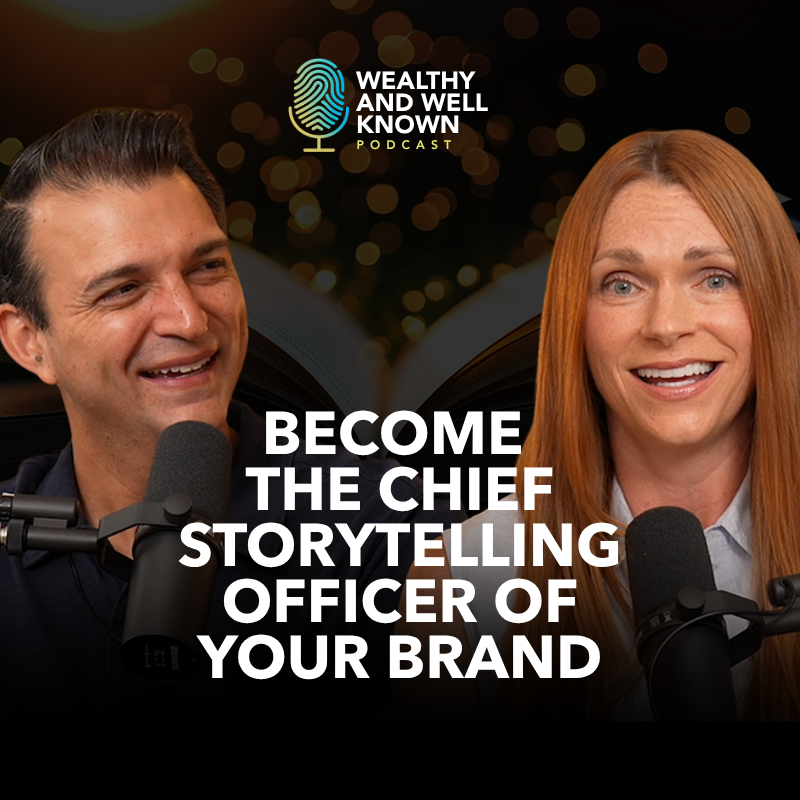
In this episode of the wealthy and well-known podcast, you’ll learn why your face is the greatest asset you have for creating trust and accelerating transactions in your business, and how sharing your story as the Chief storytelling Officer of your brand can build deep customer loyalty without gimmicks, hacks, or tricks.
00:01:09:13 – 00:01:11:20
Speaker 4
There is no fear when the mission to serve is clear.
00:01:11:22 – 00:01:16:06
Speaker 1
Ever wonder what it actually takes to build a reputation that generates revenue?
00:01:16:09 – 00:01:20:21
Speaker 1
Rory and AJ Vaden are the powerhouse duo behind Brand Builders Group,
00:01:20:23 – 00:01:22:18
Speaker 1
NYT bestselling authors
00:01:22:20 – 00:01:28:13
Speaker 1
the personal brand experts who have helped some of the world’s most influential leaders scale their personal brands.
00:01:28:16 – 00:01:29:05
Speaker 1
Now
00:01:29:08 – 00:01:30:13
Speaker 1
they’re pulling back the curtain
00:01:30:13 – 00:01:31:22
Speaker 1
on how to capture attention,
00:01:31:22 – 00:01:33:09
Speaker 1
build massive trust,
00:01:33:11 – 00:01:36:06
Speaker 1
turn your expertise into a lasting legacy.
00:01:36:07 – 00:01:43:03
Speaker 1
Get ready to elevate your influence and your income. This is wealthy and well known.
00:01:43:05 – 00:01:47:09
Speaker 4
Most personal brands and thought leaders think their camera is judging them.
00:01:47:10 – 00:01:49:18
Speaker 4
They’re afraid to be in front of the camera,
00:01:49:22 – 00:01:50:21
Speaker 4
even scared
00:01:50:23 – 00:01:57:09
Speaker 4
About what the camera is going to say about them. But today we’re going to talk about the power of your camera and why
00:01:57:09 – 00:02:01:19
Speaker 4
your face is the greatest asset you have towards creating trust
00:02:01:23 – 00:02:05:17
Speaker 4
and thus accelerating transactions in your business.
00:02:05:18 – 00:02:22:04
Speaker 5
Now, if you’re sitting there listening to Rory talk and going, well, I’m going to skip this episode. This one is not for me. If you’re saying I need to be for the face of the brand, if I need to be the face of my company, if I have to get on camera. Nope. No thank you. And I would actually encourage you.
00:02:22:04 – 00:02:40:14
Speaker 5
This episode is for you. This episode was perfectly designed to reach you exactly where you are today. Because the truth is, you are the brand, right? You are the person behind the company, but we don’t want you to be behind it. We want you to come out and be in front. And there’s a reason why.
00:02:40:16 – 00:02:41:07
Speaker 5
All right, Rory.
00:02:41:08 – 00:02:42:07
Speaker 4
Let’s get into it.
00:02:42:11 – 00:02:44:05
Speaker 5
Why? What’s the reason why?
00:02:44:10 – 00:02:51:05
Speaker 5
Why do we think that people should get out from hiding behind their logos and websites and actually be the front?
00:02:51:06 – 00:02:52:00
Speaker 4
Yeah.
00:02:52:02 – 00:02:54:00
Speaker 4
part of our premise is that
00:02:54:02 – 00:02:56:13
Speaker 4
trust must take place before there’s a transaction
00:02:56:13 – 00:03:08:03
Speaker 4
is simple, right? The reason that we don’t teach gimmicks and hacks and tricks on this show is because we’ve been around long enough to see that that stuff doesn’t work long term. It eventually burns out.
00:03:08:04 – 00:03:08:20
Speaker 5
And usually.
00:03:08:22 – 00:03:10:09
Speaker 3
To say, we’re old.
00:03:10:10 – 00:03:12:19
Speaker 4
No, we’re not that old. I mean older.
00:03:12:20 – 00:03:13:09
Speaker 5
Mature.
00:03:13:10 – 00:03:14:20
Speaker 4
We’re mature, we’re experienced.
00:03:14:21 – 00:03:15:13
Speaker 5
Experienced.
00:03:15:14 – 00:03:20:03
Speaker 4
I’ve been at this since I was. We’ve been 17. We’ve been at this since you were 20.
00:03:20:03 – 00:03:21:05
Speaker 5
Two in this.
00:03:21:05 – 00:03:23:21
Speaker 4
So we’ve been at it a hot minute. But I think it’s
00:03:23:23 – 00:03:49:04
Speaker 4
what we’ve done has worked, which has played the long game. The long game is trust. And so if you start the conversation there and you go, well where does trust come from? And I would just say if you made a list of the people that you trust the most in your life, there’s a good chance that the people on that list are going to be people that you see, that you you know, their face, you spend a lot of time with them.
00:03:49:05 – 00:03:54:02
Speaker 4
You trust your pastors. We trust the people we live with. We trust our family. We trust people in our neighborhood.
00:03:54:02 – 00:04:12:12
Speaker 4
And the only strangers that we trust are people that are like celebrities. And I would say, why do we trust celebrities? Why do we trust actors? Actors are liars for a living, like they literally are paid to pretend.
00:04:12:14 – 00:04:28:04
Speaker 4
Why do we trust them? We trust them because we see them. So I think that this this topic matters because I don’t think it has anything to do with how you look. I think it only has to do with familiarity
00:04:28:05 – 00:04:45:00
Speaker 5
I would love to give a quick case study example of this. One of the things that we do at Brand Builders Group is every single quarter. We collectively as a company, pick a book to read and everyone has to read it. And at the end of the quarter, we do a book club and we come and we share our takeaways and our thoughts.
00:04:45:00 – 00:05:10:14
Speaker 5
The reason we do that is because we believe in personal growth and development, but it’s also because we want to create shared common language amongst our team members. This year for Q2, this is in 2026. We read the book Excellence Wins by Horst Schulz, who is the founder of the Ritz-Carlton. And I just want to give this as a really great example.
00:05:10:14 – 00:05:13:11
Speaker 5
I have known of the Ritz-Carlton brand
00:05:13:13 – 00:05:18:06
Speaker 5
pretty much since I was in my 20s. It’s a pretty well known brand.
00:05:18:07 – 00:05:22:13
Speaker 4
We didn’t go for. We didn’t get to go to the Ritz-Carlton for a while, but we knew about it.
00:05:22:14 – 00:05:44:13
Speaker 5
But it’s one of those iconic brands around luxury and service, and I think a lot of people are like, I’d love to go to a rich one day just to experience what everyone talks about. But, you know, to be honest, up until a couple of years ago, I didn’t even know where it started or who started. Like, if you would have talked about Horst Schulz five years ago in a room, I’d have been like, who’s that?
00:05:44:13 – 00:05:51:04
Speaker 5
And by getting to know him, I have fallen in love with the brand
00:05:51:06 – 00:05:58:08
Speaker 5
I did not love. I did not have an affinity for the Ritz-Carlton. I mean, it’s a brand, it’s a logo, it’s a building
00:05:58:12 – 00:06:06:04
Speaker 5
But my appreciation, my affinity towards it, has compounded significantly since reading this book
00:06:06:06 – 00:06:09:14
Speaker 5
because I got to know the man behind it.
00:06:09:16 – 00:06:10:17
Speaker 5
I got to learn about
00:06:10:18 – 00:06:14:00
Speaker 5
why he wanted to get in this service business, and how he started
00:06:14:00 – 00:06:15:21
Speaker 5
and the culture he’s trying to instill.
00:06:15:21 – 00:06:21:01
Speaker 5
And honestly, his his love of Scripture and the Bible and his commitment to the Lord
00:06:21:03 – 00:06:36:23
Speaker 5
I could go on and on and on about all the things. But by getting to know him, I have completely fallen in love with the brand because I know the person behind it and I don’t know this person in real life.
00:06:37:00 – 00:06:56:03
Speaker 5
I’ve never heard him speak on a stage, but I can tell you right now if there is an option of staying at many other luxury brands versus a Ritz, I would go to the Ritz just to be reminded of how it started, to be reminded of the culture and the intention and the heart of service behind this brand, but
00:06:56:04 – 00:06:57:12
Speaker 5
because of a book.
00:06:57:16 – 00:06:58:09
Speaker 4
And a person.
00:06:58:09 – 00:07:23:01
Speaker 5
Because of a story, because of a person who is willing to go, this is what I believe, and this is why we started this company. So let that be just a nod of encouragement to every founder, to every business, over, to every solopreneur, every entrepreneur. If you think your story and you being the face of it, doesn’t have significance and customer loyalty and affinity, you are so mistaken,
00:07:23:02 – 00:07:44:15
Speaker 4
like, think about using that case study. How many millions of dollars does the Ritz-Carlton spend on advertising? How many billions of dollars do they spend to acquire the real estate that they have and build it? And to go out of all of that and people who have talked about it, and it’s been used as a brand in case studies and in business school.
00:07:44:15 – 00:07:49:01
Speaker 4
But what’s the thing that actually made you fell in love
00:07:49:01 – 00:07:50:21
Speaker 4
is the story of the founder.
00:07:50:22 – 00:08:16:01
Speaker 4
It’s also the most attractive. It’s it’s the most compelling. And I just I think people are missing out. And we saw this in our trends and personal branding National research study that that people are more likely to buy from you, work for you, recommend you spend spend more money with you. If they know the stories of the founders and and the executives.
00:08:16:01 – 00:08:18:04
Speaker 4
so then why do we hide AJ? Like
00:08:18:04 – 00:08:19:18
Speaker 4
why the fear of the camera?
00:08:19:19 – 00:08:36:13
Speaker 5
I don’t think it’s just a fear of the camera. I think it’s a fear of being in the public eye. I think that just as many people have a fear of speaking on stage. Right. It’s like public speaking is the number one fear of all humans even before death. Right? Which is so ironic.
00:08:36:13 – 00:08:45:12
Speaker 4
But Jerry Seinfeld says that. Great line. He says, for most of us, we would rather be in the casket than giving a eulogy at the funeral. It’s so.
00:08:45:12 – 00:09:01:14
Speaker 5
Great because I think it’s people are really afraid of as judgment. I don’t think this is a fear of a camera, a camera I’m looking at right now. It’s a piece of equipment. It’s a little tiny black box. I am not afraid of you. Tiny black box I got, is not it? That is not.
00:09:01:15 – 00:09:04:15
Speaker 4
I’m not afraid of you. Tiny black box.
00:09:04:17 – 00:09:17:16
Speaker 5
Like that is not what I’m afraid of. What I’m afraid of is what everyone else is going to think, say, share about me when I talk to this tiny black box. Right?
00:09:17:19 – 00:09:36:22
Speaker 4
But I don’t get that because and I go to me, this is very similar to the fear that people have about saying, no, this is in multiply your time. We talked about it’s like people are afraid to say no, they don’t want to say no. But what they don’t realize is you’re always saying no to something. You’re either saying yes to to one thing or you’re you’re you’re.
00:09:37:00 – 00:09:39:23
Speaker 4
Anytime you say yes to one thing, you’re simultaneously saying no.
00:09:40:01 – 00:09:44:10
Speaker 5
But I think it’s fair to make a general statement. No one likes to feel judged.
00:09:44:11 – 00:09:44:22
Speaker 4
Sure.
00:09:45:02 – 00:09:45:20
Speaker 5
Nobody likes.
00:09:45:21 – 00:09:46:05
Speaker 4
But that’s.
00:09:46:05 – 00:09:46:19
Speaker 5
Not my point.
00:09:46:23 – 00:10:10:20
Speaker 4
But that’s not my point. My point is you’re being judged. Anyways. That’s my whole point is to go. You’re being judged anyways. Your face is already associated with your brand in an offline environment. The only thing about online is it’s the multiplication of your reputation. It’s the digitization of your reputation, but it’s still your reputation, so you already have that judgment.
00:10:10:20 – 00:10:15:06
Speaker 4
People are already judging you, your brand, your face, how you look every day.
00:10:15:06 – 00:10:33:22
Speaker 5
I really do believe it is the difference of the ability for when you go online, like when you’re putting a video out there, podcast, YouTube, social media. But I just want to say this, I don’t think this is just about being on camera. I think the exact same thing happens on stage of like, what are they going to say in the evolution?
00:10:34:00 – 00:10:44:01
Speaker 5
What are they going to tell the meeting planner? What if everyone hates it? What if people leave in my presentation? What if no one claps? What if I get terrible reviews? I think the exact thing, exact same thing happens.
00:10:44:02 – 00:10:45:03
Speaker 4
I think it’s the same.
00:10:45:04 – 00:11:02:22
Speaker 5
Thing because when you post it, you’re putting it out there versus yes. Is it happening all around you? Sure. But are they coming to your face and going, that was terrible. I can’t believe you said that. You’re an awful person. No, people aren’t doing that. Not to your face.
00:11:02:22 – 00:11:03:11
Speaker 4
But online.
00:11:03:12 – 00:11:04:23
Speaker 5
They online they will.
00:11:04:23 – 00:11:06:19
Speaker 4
Because they’re hiding behind the camera.
00:11:06:20 – 00:11:16:19
Speaker 5
They’ll just be like, you know, thumbs down, like, don’t listen, unfollow this person. That’s crappy advice. And I think a lot of people, it’s like, they don’t like that.
00:11:16:20 – 00:11:17:07
Speaker 4
Yeah, I.
00:11:17:13 – 00:11:22:09
Speaker 5
Think that’s a reason not to do it. I’m just going I think that’s the reason most of us aren’t doing it.
00:11:22:09 – 00:11:31:15
Speaker 5
that should have zero impact on whether or not you do it. I’m just saying I do believe that’s why they don’t. So how do we get over that is the question.
00:11:31:16 – 00:11:49:00
Speaker 4
Yeah, I think you’re I think you’re right. And to that point, I think I guess what’s, what’s what’s really fair about that is the the criticizing is also hiding behind the camera. They don’t have to they don’t have to see you face to face. And so they’re much more likely to be nasty and mean. It’s like when someone writes a negative email, they will.
00:11:49:01 – 00:11:57:17
Speaker 4
They would never say those things. Almost never would that person say nasty things to your face. But when they do it through email, it’s like there’s that. That barrier.
00:11:57:18 – 00:12:08:10
Speaker 5
I have found to is that for an entrepreneur, a business owner doesn’t matter. Your company is like your child and nobody wants anyone to tell.
00:12:08:10 – 00:12:09:01
Speaker 3
You your baby’s.
00:12:09:01 – 00:12:30:09
Speaker 5
Ugly, right? So I believe that it doesn’t even have to be negative because I have had many conversations with friends or they’re like, I’m just getting ripped apart, I’m getting destroyed. And then I’ll go read the comments and I’m like, where? Like, what do you mean, like? And I even get this sometime, like every single time that a customer service emails, we do get them right.
00:12:30:10 – 00:12:36:19
Speaker 5
Like they come at me time I get one. I literally have to emotionally remind myself, this is not about you.
00:12:36:19 – 00:12:38:15
Speaker 5
The company is still good, we’re still doing good work.
00:12:38:16 – 00:12:54:00
Speaker 5
And it’s just one piece of feedback. I think so many of us are so attached to this company, whatever it is, that it’s like, it hurts when people don’t like it or have negative things to say. So it doesn’t even have to be a hater or a criticize. Or it could be.
00:12:54:01 – 00:12:55:03
Speaker 4
A constructive feedback.
00:12:55:03 – 00:13:03:19
Speaker 5
Or it could be a yeah, somebody who’s pretty neutral, who’s like, well, you know, I think you should. And then all of a sudden we take that as, oh, I’m terrible.
00:13:03:21 – 00:13:15:16
Speaker 5
So I think there are some of that where you have to detach yourself from the company, like there is. There has to be an identity shift. If I am not my company, I am the person behind the company.
00:13:15:16 – 00:13:30:22
Speaker 5
this is about why you started it, who you started it for, the ideals, the beliefs, the values, the lessons, the stories, the victories, the failures. Those are the things that help people separate you from the company. And I think that’s where a lot of people get it wrong.
00:13:30:23 – 00:13:35:14
Speaker 5
It’s like, oh, I am the face of the company. It’s like, no, the company has its own face,
00:13:35:14 – 00:13:48:15
Speaker 5
we’re just saying, hey, stop being behind it and actually bring the story to the forefront. We had this I told you about this a couple of weeks ago, how I met an organization called EO Entrepreneurs Organization here in Nashville.
00:13:48:15 – 00:14:08:00
Speaker 5
And there’s seven of us that we meet for half a day every month. We’ve done that for ten years. And five of the seven are the original five. So we’ve been together doing this for ten years, and it’s my favorite thing that I’m a part of. And we have this ongoing conversation for two years.
00:14:08:01 – 00:14:09:10
Speaker 4
Oh, this is good. Yeah, this is good.
00:14:09:14 – 00:14:24:23
Speaker 5
And I think it’s very reminiscent of this conversation. So maybe some of you will gleam something from this. But for two years we’ve had this conversation almost every month of like, what do we have to do to become the CEO of our company?
00:14:25:01 – 00:14:28:18
Speaker 4
Like, what does it mean to be a CEO? What should a CEO be doing? What should a CEO.
00:14:28:22 – 00:14:49:03
Speaker 5
Even had goals like this year is the year I become the CEO of a company, because as you guys know, I say this all the time. CEO just really means chief Everything officer. But in a small business and a growing enterprise, as an entrepreneur, it’s like you’re doing all the things right. You’re making sales, handling customer service issues, doing recruiting, checking bills, like there’s a lot of things.
00:14:49:03 – 00:15:01:20
Speaker 5
And so most of us have very established businesses. We’ve been doing this a long time, and we’ve all had this running conversation for two years. Like, how do we become the CEO of a company?
00:15:01:23 – 00:15:05:22
Speaker 5
And at our last meeting, a wise member.
00:15:06:00 – 00:15:08:09
Speaker 4
You had an epiphany. You all had a big epiphany.
00:15:08:10 – 00:15:15:23
Speaker 5
A wise member of our group who’s been in business the longest, said, I have had an epiphany.
00:15:16:00 – 00:15:16:10
Speaker 4
Oh.
00:15:16:10 – 00:15:33:15
Speaker 5
And I would like to share it with the rest of you to see if it clicks. And we were like, do tell Dennis. Like, tell us, tell us, tell us what you’ve learned. We need to know. And he goes, what I’ve realized is I don’t want to be the CEO. And we were like, what? And he goes, how do you guys define CEO?
00:15:33:16 – 00:15:55:02
Speaker 5
Right. And so I like led this conversation of like, what is a CEO to you? And as we’re all sitting there talking about what is a CEO, we all ended the conversation with, oh yeah, I don’t want I don’t want to do that. I don’t actually want to be the CEO. But oh, here was the big oh, shoot, I am the CEO, but that’s not what I want.
00:15:55:02 – 00:16:18:08
Speaker 5
And Dennis was like, this is the exact same epiphany I had. I don’t want to be the CEO. I want to be the founder. And we were like, what’s the founder do? Like, what do they do? He goes, I want to be the chief storytelling officer. He goes, I have finally realized I am not the best CEO for my company, but I am the only one who can tell the story of our company.
00:16:18:09 – 00:16:37:11
Speaker 5
I want to be the Chief Storytelling officer. I am ready, finally, to be the face of the company, to tell this origin story, to share its beliefs and values and lessons like I am ready to step out from behind the company. I don’t want to be the CEO. I want to be the founder chief storytelling officer of my company.
00:16:37:12 – 00:16:38:00
Speaker 4
That’s good.
00:16:38:01 – 00:16:38:12
Speaker 5
And I was.
00:16:38:12 – 00:16:39:10
Speaker 4
Like, that’s good.
00:16:39:15 – 00:17:13:09
Speaker 5
That’s what we want. That’s what I want. And so it was such an epiphany of going, we’ve been striving for this thing that once we finally just said, what is that like? What is that? None of us actually said this was our long term vision. But every single one of us said part of why we started this business, and a part of why we still run our business, is because we want to share what we’ve learned with other business owners, and we’re not doing it because we don’t see ourselves as being in front of the camera, the face, because we’re stuck behind it doing all the things that need to be done.
00:17:13:09 – 00:17:35:01
Speaker 5
So I just think that’s a really interesting thing of like, hey, what is the transition from being an executive of your own company to being the chief storytelling officer of the heartbeat behind all that you’re doing? And I think that’s what we’re talking about today. It’s are you willing to get on stages, to get on camera, to post content, to be the chief storytelling officer of your company?
00:17:35:03 – 00:17:36:20
Speaker 2
I love that, I love that.
00:17:36:20 – 00:17:51:20
Speaker 4
So on this topic of being front facing and doing doing video, I know the answer to this one. Okay, I don’t always know the answer to what. How do you how do you overcome this fear? This one I know the answer to.
00:17:51:21 – 00:17:52:03
Speaker 5
Hit.
00:17:52:03 – 00:18:19:03
Speaker 4
Us is simple. The reason that people are either afraid to get on camera or the reason that they go, I don’t want to get on camera because I don’t want to be perceived as vain. Both have one thing in common, and the thing they have in common is they are self-centered. The solution to this problem is to be service centered, not self-centered.
00:18:19:03 – 00:18:36:12
Speaker 4
So let me explain. When I have a fear of judgment, I am being self-centered. What are they going to say about me? Are they going to bash me? Are my ideas stupid? Do I look silly on camera? Is my hair out of place? Like, is the, you know, is my outfit whatever? Do I look, you know, everything is.
00:18:36:13 – 00:18:54:16
Speaker 4
Is this the imposter syndrome is totally self-centered. And then the other group is like, I think like a lot of legitimate CEOs and entrepreneurs think they’re like, oh, so vain to be on camera. People are going to think I’m vain. I don’t I don’t need that attention. I don’t I don’t need the limelight. I don’t need the whatever.
00:18:54:17 – 00:19:18:03
Speaker 4
Also self-centered. The answer to this. The solution is to realize you being on camera has nothing to do with you. It is not about whether you feel good enough to or whether you feel like it’s vain. It’s not about you. It’s about the person on the other side of the camera. When you are being service centered, you go, I’m not trying to gain attention.
00:19:18:03 – 00:19:34:23
Speaker 4
I’m not trying to get trust. I’m not trying to gain praise. I’m trying to be useful to the person on the other side. It’s the same thing that happens on stage. And that’s why I know this is because it was like as a speaker, I was always so scared of, like, am I going to be funny? Is the audience going to like me?
00:19:34:23 – 00:19:58:08
Speaker 4
Whatever. Whatever. Am I going to forget what I’m going to say? It’s all this I focused stuff. But when you let go of self-centeredness and you just focus on service centeredness, you go, what is that person in the audience struggling with? I wonder what that person’s life is like. How is what I’m about to say? How could I make what I’m about to do or say be useful to that person?
00:19:58:11 – 00:20:13:14
Speaker 4
And you only feel you don’t? There is no fear when the mission to serve is clear. And so I know that if someone is afraid of being on the camera, it’s because of self-centeredness, not not selfishness. It’s not that they’re trying to take advantage of people.
00:20:13:15 – 00:20:16:07
Speaker 5
I said, you’re just too focused on your team self and I.
00:20:16:08 – 00:20:34:04
Speaker 4
You’re too focused on me, myself and I and, you know, and a lot of entrepreneurs and executives and founders go like, well, I don’t need to be the face because they’re thinking about themselves as like, I don’t need this, but it’s not about what you need. It’s about what you can do for the audience. What lessons have you learned?
00:20:34:04 – 00:20:34:15
Speaker 4
just how can
00:20:34:15 – 00:20:34:20
Speaker 4
we.
00:20:35:00 – 00:20:56:17
Speaker 5
Have a genuine question then? Because I’m thinking through, like so many Uber successful entrepreneurs, entrepreneurs that I know who still say this and I’m like, but you have so much to I have so much to learn from you. Yes. And so for that person who’s still going, yeah, but no, I just, I don’t do you, I don’t have that calling in me.
00:20:56:17 – 00:21:04:08
Speaker 5
So for, for some of the people listening who’s like, well, I hear you, I just don’t relate to that. Like, do you think everyone should do this?
00:21:04:10 – 00:21:06:05
Speaker 2
I think that.
00:21:06:07 – 00:21:15:03
Speaker 4
Everyone who’s been successful at something has an obligation and a duty to share what they’ve learned
00:21:15:03 – 00:21:40:23
Speaker 4
with the person they once were. That’s why we say your most powerful position to serve the person you once were. I don’t think it’s necessarily a requirement that everybody has to build a personal brand and start a podcast. And but I will say this, I think there’s way too many people that have them that actually don’t have much to share with the world that haven’t been that successful, who are just trying to do it as a marketing tactic.
00:21:40:23 – 00:21:58:05
Speaker 4
Should be, and the people that should be or not, because they’re afraid of being vain and like, oh, I don’t want to be an influencer. I don’t need that attention. And going, it’s not about you. It’s going if you care to make the world a better place and you have lessons and expertise that you’ve learned, you have that duty to share it.
00:21:58:05 – 00:22:21:06
Speaker 4
I believe that because otherwise I go then all of your success was was just an accumulation for yourself. And that’s great. I mean, that’s fine. Like, okay, you sold your company, you’re successful, you have money. But like, how are you helping the person, the generation behind you? What are you doing to help them? So that’s why I think that if you have that you should share it doesn’t mean it has to be in the form of a podcast.
00:22:21:06 – 00:22:26:21
Speaker 4
But I go, but since the tools exist today. Why wouldn’t you do it?
00:22:26:21 – 00:22:28:06
Speaker 4
And and I will say
00:22:28:06 – 00:22:37:01
Speaker 4
The most dangerous creators are the ones that they go, I don’t need your likes. I don’t need your following. I don’t even need your money because I’ve made money from all this other stuff.
00:22:37:02 – 00:22:55:20
Speaker 4
And those are the ones that people flock to because they go they don’t, they’re not they’re not trying to get something. They’re just trying to give something. And they also could care less about the haters because again, they don’t need anything from it. They’ve they’ve got their validation, their success from other places. So I kind of I kind of think so.
00:22:55:20 – 00:22:57:00
Speaker 4
I kind of think they should.
00:22:57:02 – 00:23:09:20
Speaker 5
I mean honestly, I feel the same way. I was just curious. But it’s like I really do like in that to this book, excellence wins. Like there was nothing Horst Schulz was going to gain from writing this book other than serving his readers.
00:23:09:21 – 00:23:11:10
Speaker 4
Totally. Great example.
00:23:11:11 – 00:23:34:11
Speaker 5
I mean, there’s like there is like, this was not for some royalty or big advance like that would be pennies in the bucket. Yeah, but this was just about serving the readers of like, I have learned things that I think others should know. I’ve seen things that I care to share. I believe there’s a better way of loving your employees and loving your customers.
00:23:34:11 – 00:23:43:22
Speaker 5
And I’m going to tell you what it is. You don’t have to agree to it. You don’t have to subscribe to it. But I believe in it enough that if I don’t, it’s a disservice to who I am.
00:23:44:00 – 00:23:56:10
Speaker 4
And to me, that’s what a mission driven messenger is, right? That’s why we say, you know, for our clients, our community, our aspiration is that personal branding is not self-centered, not it should be service centered.
00:23:56:11 – 00:24:15:08
Speaker 5
Okay. So as we wrap up, I have some tactical questions for the person listening who we’re really saying, hey, your face is the best marketing tool that you have, so let’s get your face out there and it’s really not your face, it’s your story, right? Chief Storytelling Officer it’s going to be my new goal Chief Telling Officer.
00:24:15:09 – 00:24:22:03
Speaker 4
But, but there is a distinction between I think face is more powerful than just words on a page or voice.
00:24:22:05 – 00:24:22:14
Speaker 2
I do.
00:24:22:15 – 00:24:23:00
Speaker 4
Think that.
00:24:23:00 – 00:24:24:01
Speaker 5
Matters the story.
00:24:24:02 – 00:24:25:13
Speaker 4
But it is ultimately it’s the.
00:24:25:13 – 00:24:26:19
Speaker 5
Story story. So
00:24:26:21 – 00:24:39:15
Speaker 5
Tactically speaking though, what are some very tactical ideas that someone’s like, okay, I get all of that. But that red light goes on and I go blank, right? It’s like I am struggling to do this.
00:24:39:15 – 00:24:45:15
Speaker 5
what are some tips, some ideas that can help someone overcome that to get them comfortable on camera?
00:24:45:17 – 00:25:03:09
Speaker 4
Yeah, I’m going to give a shout out here to my friend Phil Jones. Phil Jones has a really great he’s got lots of great quotes, but one of his great quotes, as he says, the worst time to think about what you’re going to say is in the moment, you have to say it. The worst time to think about what you’re going to say is in the moment, you have to say it.
00:25:03:09 – 00:25:25:02
Speaker 4
So I think thinking about what you’re going to say before the camera goes on, I think is valuable. You. That doesn’t mean you should use a teleprompter, doesn’t mean you should memorize the script. You can do those things if they’re helpful. But what works for me is I literally keep every almost every day I update this. So I have a running Google doc that just says reels ideas.
00:25:25:03 – 00:25:44:03
Speaker 4
And every time I have a thought during the day where I go, man, I wish somebody would have told me that five years ago. Or like I wish I would have learned this much earlier. Or like, here’s a lesson that I’m learning and I’m being reminded of today going that would have been useful to me 20 years ago.
00:25:44:03 – 00:26:05:14
Speaker 4
I just write it down and I’ll just put like like I’ll give you an example. Right. So some of my recent ones here is inertia. I just wrote down the word inertia because I was reminded recently that all of success in business and life is just about inertia. It’s about getting if you’re if you’re not moving, it’s just about creating movement.
00:26:05:19 – 00:26:38:06
Speaker 4
And then it is about doing the right movements. Because once you’re doing the right movements, things do what they’re already doing. And so those two, those two things are both connected to the concept of inertia. And I’m like, I need to just make a real about inertia. So as you’re reminded of those lessons, I think that’s a tactical thing is, is don’t wait till the camera turns on to be like, okay, say something brilliant or it’s like, no, catalog it beforehand so that when you have time to record, you’re like, oh, I’ve got these three things I want to I want to say.
00:26:38:06 – 00:26:40:21
Speaker 4
So that’s one tip. What’s your what’s a tip from you?
00:26:40:22 – 00:26:57:14
Speaker 5
Yeah. So I’ll give you just a couple of quick tips that I think have been helpful and useful to me. The first one is that if you have a problem talking to the tiny black box, I would really encourage you to print out a picture of your favorite customer or your favorite team member and actually tape it below the camera.
00:26:57:14 – 00:27:20:02
Speaker 5
I know that seems like a weird kind of thing to do, but I think a lot of people have a struggle talking in monologue. They’re just looking at a camera, talking to nothing. But if you put a picture of like, oh, like this, this is the customer that I remember that we helped change their life, or we saved their house, or we got them out of debt or we, you know, saved them on the operating table.
00:27:20:02 – 00:27:40:02
Speaker 5
It’s like, put that person there to be reminded. Like, this is not a tiny black box you’re talking to. These are real human beings. So that’s just a little tip hanging up below, you know, or off to the side of your your laptop. That’s one. A second is I think a lot of people struggle with reading a question silently and then answering it aloud.
00:27:40:02 – 00:27:58:01
Speaker 5
So I actually have someone interview you. I think one of the best things you can do to get comfortable on camera is it to be more conversation and then let editors do what they do best and edit out the interviewer? But just, you know, this could be your spouse, it could be a kid. It could be someone in the office doesn’t have to be an expert.
00:27:58:01 – 00:28:21:18
Speaker 5
Just be like, I just need to have a conversation. So that would be my second tip is if you have a problem in the monologue of just like sharing content, have someone interview you and then let the editing do what editing does. Then my third idea for you is, and these are all things that I have done that helped me with all of this is the very first things that you can do on camera are not necessarily sharing content, it’s just sharing your story.
00:28:21:23 – 00:28:50:09
Speaker 5
Like have a list of like things that, you know, like the back of your hand, like what was your first job, what got you into your industry? What was the first year of your company like? What are your core values? What’s your mission statement? So just more talking about things that are innately your story that aren’t necessarily thought leadership or content, but it just gets you really acclimated to talking to the camera, talking about yourself, talking about things in general.
00:28:50:09 – 00:29:06:09
Speaker 5
So those are good ways to just warm you up so that when you go and talk about ideas like inertia, you already have some familiarity with talking to the tiny black box, sharing ideas because you’ve started with sharing your story first.
00:29:06:11 – 00:29:15:17
Speaker 4
Love it. All right. Last question. Tactical. Okay, I want to go super superficial. I do think.
00:29:15:19 – 00:29:17:00
Speaker 5
You want to go super.
00:29:17:00 – 00:29:33:06
Speaker 4
I want to go superficial. Okay? I want to go with superficial tips. I do think, genuinely, people have a fear of how they look on camera and just go like, you know, I’m okay in real life, but there’s something about on the camera. What tips do you have to look better on camera?
00:29:33:07 – 00:29:33:16
Speaker 5
Lifes and.
00:29:33:16 – 00:29:35:06
Speaker 4
Angles, what.
00:29:35:08 – 00:29:36:16
Speaker 5
The end likes and angles.
00:29:36:17 – 00:29:44:10
Speaker 4
Okay, what about the lighting and what about the angles? Makes someone look better on camera.
00:29:44:11 – 00:30:04:14
Speaker 5
I cannot speak to the males that are listening to this. I can only speak to the female listeners, but you give me angles that make me look ten years younger. I lighting that takes away, you know, the natural, beautiful lines of aging that makes me feel better. And you get.
00:30:04:18 – 00:30:06:22
Speaker 4
You don’t know how to do it. You just know what.
00:30:06:23 – 00:30:07:18
Speaker 5
I know how to do it.
00:30:07:19 – 00:30:11:13
Speaker 4
Oh, well, how do you do it? Like, how do you do the lighting? How do you do the angles?
00:30:11:14 – 00:30:18:13
Speaker 5
Never, ever, ever have your camera looking up at you because it just makes you look terrible.
00:30:18:14 – 00:30:21:23
Speaker 4
Meaning camera lower than your eyeline. Yes, is the worst.
00:30:22:00 – 00:30:24:18
Speaker 5
It just gives you a instant double chin no matter how.
00:30:24:19 – 00:30:27:12
Speaker 4
So camera always has to be above your eyeline.
00:30:27:13 – 00:30:28:21
Speaker 5
These are personal preferences.
00:30:28:22 – 00:30:29:06
Speaker 4
Yeah.
00:30:29:07 – 00:30:39:02
Speaker 5
That’s good. Yes. Looking down, it just gives you a more defined jawline, gives you more definition and like everything. But you know, again, I’m just you said superficial.
00:30:39:03 – 00:30:40:10
Speaker 4
It’s like that’s what I’m saying.
00:30:40:13 – 00:30:53:18
Speaker 5
You look better and the lighting matters. Right? Okay. What a dark lighting. Are there shadows on your face. Right. So it makes you look like you have dark circles under your eyes. It picks up, you know, certain imperfections and your skin or lines, and it’s.
00:30:53:18 – 00:30:55:08
Speaker 4
Like dark lighting does that.
00:30:55:09 – 00:30:59:20
Speaker 5
Well, it’s just if it’s casting a shadow. Right. So if you have lighting behind your off to the.
00:30:59:20 – 00:31:01:09
Speaker 4
Side where the light is coming.
00:31:01:09 – 00:31:03:04
Speaker 5
From, need the lighting in front of you.
00:31:03:05 – 00:31:05:11
Speaker 4
So behind the camera pointing at you.
00:31:05:12 – 00:31:23:19
Speaker 5
You can have too much lighting for sure. And then you looked washed out. But it’s a reason why I love natural lighting. It’s why photographers love natural lighting because it does something that artificial lighting can’t do. So the type of light, the tone, the hue of the light, the placement of the light, those are all things that really matter.
00:31:23:19 – 00:31:28:05
Speaker 5
It’s why I never let you take pictures of me, because you never have good angles.
00:31:28:05 – 00:31:32:09
Speaker 4
And part of why I’m asking this question, it’s very self-centered. I need to understand.
00:31:32:10 – 00:31:52:14
Speaker 5
That those would be my two things, like what I have found. And then it’s like, yes, can you use a filter or two? I don’t believe in using AI for enhancements, but a nice filter to it’s like, no problem if we’re going superficial here to go. You know what? I’m 42 and I love everything about being 42 and the fine lines, and I have no problem with that.
00:31:52:14 – 00:32:14:14
Speaker 5
But do I really want them highlighted on camera? Probably not. Like I love the smile lines because it shows that I’ve had a great life, but do I really want them, like featured in close Up? Probably. Probably not. So like let’s subtle subtle the suckers out. And I think a lot of it is just knowing like what makes you comfortable.
00:32:14:16 – 00:32:31:20
Speaker 5
So like for me it’s like I what I don’t really care about is hair, makeup or outfits. Ironically, I care more about lighting and angles. So that’s just me. I know plenty of people who are like, nope, gotta have full hair and makeup to be on camera. That’s not me. Like I don’t care, but I do care about lighting and angles.
00:32:31:20 – 00:32:47:20
Speaker 4
My encouragement to people on that category is look how you look in real life. Like don’t like be. You’re super casual in real life and then like wear a suit or a dress on camera, like, look how you look in real life. And then what I hear you saying is just like, we just want to get the best version of how we look in real life on camera.
00:32:47:21 – 00:33:09:19
Speaker 4
Best version I don’t have very many other tactical tips because I suck at this. One tip would be higher hire people who can make you beautiful on camera. My only tip that I’ve. I learned a while back that has truly stuck with me about cameras is called the tip and turtle. The tip and turtle. Okay, so when you’re taking pictures, this feels awkward.
00:33:09:19 – 00:33:13:15
Speaker 4
But and this is particularly more for stills than it is, I think for video.
00:33:13:16 – 00:33:14:19
Speaker 5
It would be very awkward.
00:33:14:20 – 00:33:33:05
Speaker 4
It’d be very awkward if you did this on video. So this is this is a camera taking thing, but is if you tip forward towards the camera and if you, you stick your neck out, you turtle you it’s called the turtle. You stick your neck out like this is you tip towards the camera and you stick your neck out.
00:33:33:06 – 00:33:53:06
Speaker 4
It feels awkward as heck, but the pictures come out way better so you can try the tip and turtle tip forward towards the camera. Turtle your neck out and you’ll be you’ll be happy with your picture. So there’s your there’s your total, superficial, not purpose driven, complete self-centered set of camera tips. I would just right.
00:33:53:06 – 00:34:18:08
Speaker 5
Here lighting and angles make a world of difference. And then again letting editors do what editors do best. So if you’re listening to this episode and you’re going, this is exactly what I needed to hear to be reminded that I need to be the chief storytelling officer of my company. Would you please do us a favor and one give us a review like this helps other people know if this is a podcast they should listen to.
00:34:18:09 – 00:34:39:12
Speaker 5
So if this was good for you today, will you please leave us a review? That would be so helpful. But then more importantly, if you think this was helpful for you. Do you know someone that you should share it with? Do you know someone who has an amazing story but they’re reluctant to share it and just give them a little nudge of encouragement of hey, I heard something today and it made me think of you.
00:34:39:13 – 00:34:51:18
Speaker 5
Check out this episode. Do yourself a favor by helping a friend and send this over to them. And then if you liked it, and if you haven’t already subscribed, right, subscribe so that you can tune in and hear more from us later.
00:34:51:22 – 00:35:12:11
Speaker 4
Yep. And if you’re looking for ideas for how to convert all of this into cash for your business, request a free call with our company Free Brand Call Podcast. You can talk with one of our strategists about how we work with mission driven messengers to become more well-known and more wealthy with ethics and integrity, and we’d love to hear your story and see if we can help you.
00:35:12:12 – 00:35:19:12
Speaker 4
That’s it for this edition of the Wealthy and Well-known podcast. Until next time, go out and serve the person you once were.