


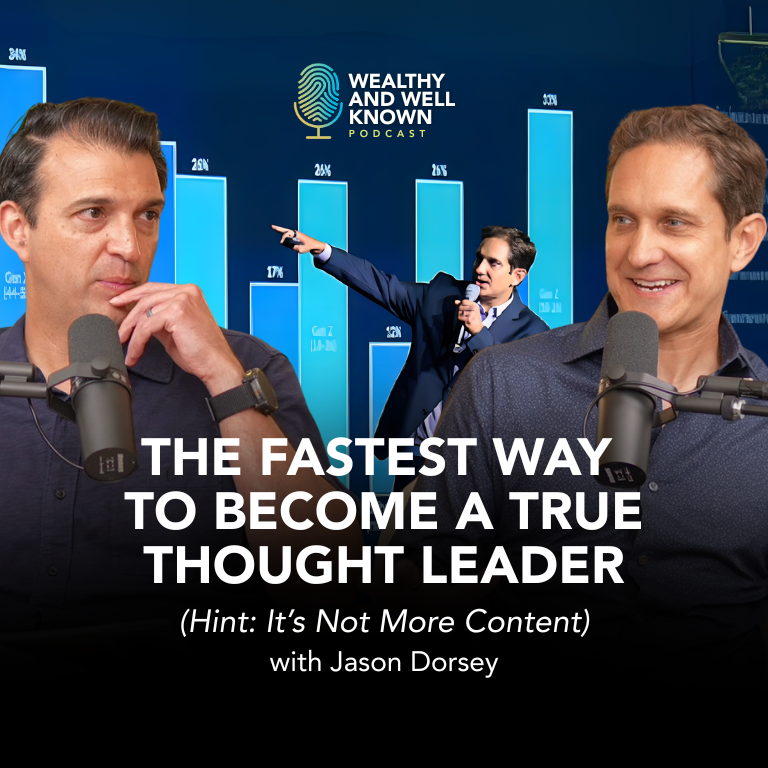
WWK Ep 021: The Fastest Way to Become a True Thought Leader (Hint: It’s Not More Content) with Jason Dorsey
021_WWK_AUDIO
===
Jason: [00:00:00] If you don’t have original research, you are just sharing opinions [00:00:05] and. If you look around these rooms, there’s a ton of people filled with opinions and even great [00:00:10] stories. But if you want people to invest and invest significant money [00:00:15] in you or in your business, you know what you’re trying to offer to them, the problem you’re trying to solve, you need data [00:00:20] to back it up.[00:00:25] [00:00:30] [00:00:35]
Rory: How do you truly stand out as a thought leader in a world of ai? How do you get [00:00:40] yourself featured in the media? How do you get booked to speak on the biggest [00:00:45] stages? Those are all topics that we’re gonna talk about today on this edition of the Wealthy and Well-Known [00:00:50] podcast. I’m being joined by one of my best friends, one of the smartest people [00:00:55] that I know, and also one of the most successful personal brands in the world.
You’re about to meet Jason [00:01:00] Dorsey, who is a bestselling author. His most recent book is Z Economy. He is one of [00:01:05] the highest paid, most booked speakers, particularly in the non-celebrity [00:01:10] category, but as a true thought leader and expert, uh, one of the busiest speakers in the [00:01:15] world today. Uh, he also runs with his wife, the Center for Generational Kinetics, which [00:01:20] is.
Perhaps, at least in my opinion, the most respectable research firm [00:01:25] in the world. We are clients of his and we’re gonna talk about how using [00:01:30] original research is a huge part of the future of building personal brands. Just in the last [00:01:35] week, he has had inbound media requests from, uh, media or. [00:01:40] From media outlets like CNBC, Bloomberg, [00:01:45] CNN.
He’s regularly been featured in the New York Times and several other places. The USA [00:01:50] today, their work appears all over and they work with some of the most respectable corporate clients in the world [00:01:55] to create. Proprietary research, and also, as I mentioned, we have been a client of [00:02:00] theirs and we referred several of our members at Brand Builders Group to do original research studies.[00:02:05]
It’s one of the things that we are inviting our authors at Mission-Driven Press to do, uh, as part of a [00:02:10] regular pub. Let’s just cut that part about MDP. So I’m excited to have [00:02:15] Jason, welcome to the show, buddy. Hey, thank you.
Jason: Thrilled to be here. Thrilled to be a [00:02:20] non-celebrity, busy speaker. I knew you were gonna say something about it.
Yes. Finally I did it. I’m just one tier [00:02:25] below those celebrities.
Rory: Well, I, I, you know, and, and it’s, you know, I say that tongue in cheek, but it’s, it is [00:02:30] true and it’s, and it’s a pride point because you get paid a lot of money [00:02:35] as a speaker and to be in boardrooms and to be on boards and to be an advisor [00:02:40] to companies.
It has nothing to do with your celebrity. I mean, it has something to do with [00:02:45] some of your celebrity, but it has mostly everything to do with your research.
Jason: Mm-hmm. [00:02:50]
Rory: And the original insights that you bring. So I wanna start right there. Tell [00:02:55] us why research
Jason: mm-hmm.
Rory: Is, has been a [00:03:00] critical part of your journey, and why do you think original research is [00:03:05] important for personal brands?
You know, in the future?
Jason: I have a, a [00:03:10] core belief that has driven my work and, and caused all the growth for our business and with our [00:03:15] clientele. And that is if you own the data, you own the conversation. [00:03:20] And it changed my life, changed my career, changed everything about our business, the [00:03:25] opportunities we got, the influence we had, the people we got to meet, the, the work we got to do.
Because [00:03:30] the world right now is full of opinions, tons of opinions, and it’s dominated by opinions and [00:03:35] observation. The problem now is executives and entrepreneurs and [00:03:40] business leaders and people making big bets. Don’t wanna make them based on [00:03:45] opinions and observations.
Rory: Mm.
Jason: They, they already have enough risk in their life and in their business.
[00:03:50] They are trying to ground their decisions, ground their strategy, base their [00:03:55] vision on tangible, real data that they can trust and believe in to [00:04:00] inform and really give them an advantage. And so what that means for us and for our clients [00:04:05] is we’re the people that our competitors cite. Which is amazing. I [00:04:10] have this, this, this core belief that if you are having to cite other people’s data to make your point, [00:04:15] you are not the expert somebody else is.
Now, you may be adding your own perspective to it and [00:04:20] stories and all that. I got it, I got it. But the reality is you want to be the one who cited. And [00:04:25] so for us, when we lead statistically accurate studies, whether that’s nationally or globally, [00:04:30] all of a sudden we’re the source of truth. And I think that’s so important right now in the age of ai.
[00:04:35] It’s easier than ever before to create content on any platform in any way you want. But what you can’t create is [00:04:40] statistically valid research that leaders are looking for to separate myth from [00:04:45] truth. And I mean, you’ve heard me speak a bunch of times at these big events like. I believe it’s [00:04:50] never been more important, like truly a calling to separate myth from truth.
It is so [00:04:55] hard these days to know what’s real and what’s just made up. And when you give people real [00:05:00] data that they can bank on, that they can truly make tough decisions. ’cause remember, [00:05:05] decisions today are high risk. When you think about executives, they’re trying to not only [00:05:10] grow their business, they’re trying to keep their people employed, right?
They’re, they’re trying to deliver sure for customers and shareholders, [00:05:15] but they’re feeling the pressure. Entrepreneurs today, more competition than ever before. Put out a new [00:05:20] book, more books published this year than ever before. So how do you not just stand out? I [00:05:25] think that’s too low of a bar. How are you truly unique and own a space where [00:05:30] you are recognized as the one that’s leading the field, maybe even [00:05:35] inventing a field.
And, and the way I think about that is you wanna have the data. You wanna own the data [00:05:40] that fills in the gaps. It’s not that like, you know, I speak on generations. It’s not [00:05:45] that millennials are entitled, okay, that’s interesting, but not new. Why? What shaped that? [00:05:50] What caused it? Is it actually true? Why are millennials two generations, not one?
Why do [00:05:55] millennials most dislike other millennials in the workforce? Right? These are things that if you can get to the root cause, we’re [00:06:00] like, oh, I never thought about that. I always wondered that. That’s the emotional response [00:06:05] that drives people to wanna work with you because you’re hitting them logically.
Like, okay, that makes total sense. And emotionally [00:06:10] I’ve seen that, or that answers a core question of mine versus here’s another story or [00:06:15] a poem, or, you know, three points for my life. I think people, particularly executives and leaders, [00:06:20] and those in positions of responsibility, they like all that sort of stuff.
There’s a place for it. [00:06:25] But when it comes to big decisions. Challenging times, uncertain economies, more [00:06:30] competition than before. AI’s emergence. They’re looking for research and data they can count on [00:06:35] and it’s, it’s why clients like you and others. Come to us over and over and over again and [00:06:40] all these big fancy bestselling authors who we love working with and celebrities, but so many [00:06:45] corporations use us to do their thought leadership research
Rory: well, and, and that’s [00:06:50] interesting nuance to me that never, I never fully understood.
I mean, it, it took a while [00:06:55] for me to really understand how you use research and I was like, why [00:07:00] would companies. Pay all of this money for you to do research and then they don’t [00:07:05] share the research with other people. Like as a thought leader, I’m going, the whole reason I wanna do a research study is to put it [00:07:10] out to like Yeah.
You know, establish our thought leadership and, and all that. And what you just said is [00:07:15] going, there’s, there’s kind of two ways to use the data. One is that these companies invest a lot of [00:07:20] money for actual. Research and data to make their own internal [00:07:25] strategic decisions.
Jason: Mm-hmm.
Rory: And that’s why it’s like they’re not sharing it, it’s a competitive advantage.
Jason: Mm-hmm.
Rory: But [00:07:30] that also ties into why personal brands need to have data, because that’s [00:07:35] what the big companies, and that’s what, you know, very intellectual, sophisticated [00:07:40] types of, you know, buyers. That’s what they’re looking for and that’s what they’re gonna respond to. [00:07:45] Mm-hmm. Not just, oh, you had a, you had a video.
Go vi, you had a TikTok.
Jason: Mm-hmm.
Rory: Video go [00:07:50] viral.
Jason: Yeah. And, and the way I think about it is in the corporate world, you know, our clients [00:07:55] are banks and healthcare systems and huge tech companies and, you know, you can just go through the [00:08:00] whole long list. And I like to say they, it’s not even 80 20, they probably keep [00:08:05] 90, 95% of the discoveries that we, um.
You know, gain for them [00:08:10] internal and use it to inform their strategy. You know, I speak at all these corporate boards and no recording, like [00:08:15] all this sort of stuff, right? Like this is their competitive advantage. Their competitive intelligence is gonna shape their [00:08:20] strategy for the next five, 10 plus years.
And they’ll share maybe five, max, 10% of the [00:08:25] discoveries because they then want to put out, Hey, we found all these things. This is informing our product [00:08:30] roadmap. This is informing, uh, the way we’re delivering services or pr developing new products or serving our [00:08:35] employees. So they still wanna be known for it.
But they’re gonna keep most of it internal. On the personal brand [00:08:40] side, it’s completely flipped,
Rory: which has also become a, a huge [00:08:45] new pool of people for you. And I wanna understand why has that happen? You know, you used to do. More [00:08:50] corporate where it’s like, it’s more internal. Yeah. Decision making. But now there is, uh, you [00:08:55] know, a rising tide of, of entrepreneurs and personal brands who are coming to you.
So,
Jason: [00:09:00] mm-hmm.
Rory: Why? And and how is that work?
Jason: Well, what happened originally is a lot of people [00:09:05] coming to me going, Jason, how are you in the media all the time?
Rory: Right?
Jason: How are you keynoting these huge conferences? ’cause [00:09:10] it’ll be like me. Some Hall of Fame football player, a former president, you know, and maybe somebody [00:09:15] from McKinsey or some Harvard economist, and they’re like, how are you featured on the main stage and have more time [00:09:20] than any of them.
Yeah. Which happens all the time. And I’m like, ’cause people want insights they can use, they [00:09:25] want data they can’t get anywhere else, so they go. Oh, I got it. I could totally use that. Or that [00:09:30] solves that problem or I never thought about it that way. Or you know, you wanna really fill in these gaps for them.
[00:09:35] And so once I started being on all those stages all around the world, and the beautiful thing about data [00:09:40] is it translates and it travels, it has handles, people take it all over the place. I mean, we do so much [00:09:45] international work, it really opens up markets. So, so that happened. And then all these personal brands who [00:09:50] you and I know are like Jason.
Love you, man, but you’re not huge on Instagram. [00:09:55] You don’t have a big LinkedIn following,
Rory: right?
Jason: You know, you’re not all these things like, how is this happening? I’m like, well, we [00:10:00] have what they can’t get anywhere else, right? And, and because of that, once you’re the [00:10:05] source of truth, everybody wants you. And, and so it started like that.
So then we started working with a few personal [00:10:10] brands and it was like, Hey, you know, we’ll do for you what we’ve done for us. Um, but we need your help. And I think this is a, a [00:10:15] real key. Personal brand research strategy and thought leadership strategy is different than [00:10:20] corporate, right? When it comes to personal brands, we wanna really understand what is the position you’re [00:10:25] seeking to own.
Mm. You want to be the source of truth, you wanna be the one who cited. So [00:10:30] we think about it as like, what are your dream headlines that will come out of your research study? Or [00:10:35] what are the questions that if you knew the answer to everybody would cite you or come to you or hire [00:10:40] you? When you think about like the core markets for the people that, for example, that, that you know, uh, so [00:10:45] many who learned from you.
Entrepreneurs, they love that dramatically grows their business. They make so much money off our [00:10:50] studies, all these personal brands. When you have coaches and consultants and people that are selling professional [00:10:55] services or parts of membership, they love it. ’cause now they have something that’s tangible.
They can turn into all these things, [00:11:00] it’s evergreen, and they’re now the source of truth in something that’s very intangible. So all of a [00:11:05] sudden those sorts of groups released it. Then with authors, what happened is they’re like, oh, well. I went [00:11:10] to go sell the book, Jason, and when I put in there that we were gonna do a national research study, we got all this interest.
We’ve [00:11:15] had so many friends get huge book deals or choose to do their own because they were able to generate so much [00:11:20] business from it. So it’s when you do a study, you get something tangible out of it. That then [00:11:25] drives something tangible. And I think so much today doesn’t do that for people, particularly personal brands.
Rory: Mm-hmm. [00:11:30]
Jason: You know, there’s a lot of hype out there.
Rory: It’s a lot of hype and there’s a lot of, there’s a lot of people [00:11:35] with fancy demo reels ’cause there’s good video editors that can make you look better on stage. There’s a lot of people [00:11:40] with big social media followings. ’cause you can fake that. There’s no shortage of books that are [00:11:45] coming out and, you know, some legitimate bestsellers, some not so legitimate, but get to say [00:11:50] they’re bestseller, whatever.
Yeah. Um, but. It’s interesting because you do, [00:11:55] you do these research, this is what a research report looks like, right.
Jason: For state of Gen [00:12:00] Z.
Rory: This is, this is your internal one. So a lot of times when you put these together for clients, [00:12:05] they, um, you know, this is what a, like a deliverable would be. You would give them data and then they [00:12:10] would turn it into maybe something like this.
Mm-hmm. Is to go one, one thing that’s been [00:12:15] fascinating to me is it took us seven years to write the Wealthy Well-Known book. [00:12:20] Great book. Like to make it a New York Times bestseller.
Jason: Mm-hmm. [00:12:25]
Rory: It took us a few months to work with you to create the trends in personal branding, [00:12:30] national research study.
Jason: Mm-hmm.
Rory: The thought leadership that came from that was [00:12:35] equal to, if not far, greater than having a New York Times bestselling book.
Jason: Mm-hmm. Because. [00:12:40]
Rory: It was fast, it was relevant, like timely. Mm-hmm. And it was [00:12:45] practical. Mm-hmm. Right. And even this is our experience and our frameworks and things, but the numbers are, it’s like the, [00:12:50] it’s like the numbers never lie kind of a thing.
Jason: Mm-hmm.
Rory: So this is something that I [00:12:55] think there’s not enough personal brands thinking about.
Jason: Mm-hmm.
Rory: And going, especially in a world of [00:13:00] artificial. This is a way to stand out big time.
Jason: Yeah. And, and you know, I speak at a [00:13:05] lot of events now for personal brands, which I never did before. I’m having a blast doing it.
And my, [00:13:10] my mission or my calling, and I’m very direct, uh, which is if you don’t have [00:13:15] original research, you are just sharing opinions. And [00:13:20] if you look around these rooms, there’s a ton of people filled with opinions and even great stories. But [00:13:25] if you want people to invest and invest significant money. In you [00:13:30] or in your business or in, in, you know, what you’re trying to offer to them.
The problem you’re trying to solve, like you [00:13:35] need data to back it up. Mm. And people get hung up a lot of times. Like, oh, well Jason, I’m not a [00:13:40] researcher. I’m like, Hey, I got a lot of researchers. I got that part covered. What we need is people [00:13:45] that have a vision of a space they want to own questions that they feel are not [00:13:50] solved, that if we’re solved would, would really drive change.
And they have. And [00:13:55] this is something that, you know, we turn out a lot of people that, that come to us now because I’m like, look, if you don’t really know [00:14:00] your space, doing a study is not gonna change anything for you. If anything, you’re [00:14:05] gonna have an amazing study, but you’re still not gonna have the depth.
But if you’ve been doing this for [00:14:10] several years or many years, and you really have a, a point of view in a position [00:14:15] like a study is, is game changing for you? And you know, for us, like most of the studies we do now are [00:14:20] 60 days or 90 days.
Rory: And as an entrepreneur, you know, approach. You [00:14:25] know, this is a problem we can solve by writing you a check.
Like, I can’t, I can’t solve, I can’t [00:14:30] get someone to write a book for me by writing a check. Like I have to put the sweat equity into the whole, whole thing. [00:14:35] But like, we pretty much just write you a check, have a few conversations, you guys go do all the [00:14:40] work here of like the grunt work of making sure it’s statistically valid, fielding the samples, you know, and then [00:14:45] even analyzing the data and giving back to us like what you found.
Um, by the way, if, if [00:14:50] anyone is listening, if you go to free brand [00:14:55] training.com/research, so free brand training.com/research, [00:15:00] we will connect you directly to Jason and his team if you wanna explore and kind of [00:15:05] think about, okay, does, could a study fit for you? Um, and you do different types of studies that, you know, kind of [00:15:10] meet different budgets and, and different scopes and magnitudes and, and things like that.
Um,
Jason: yeah, [00:15:15] our typical client, the way we think about it today is. They, they’re gonna invest [00:15:20] in this study, the whole study beginning to end about four hours over the [00:15:25] project. And the most important thing is they need a vision, right? What is the space you wanna own? [00:15:30] I would say most people have it, some don’t.
And when they don’t, we’re like, Hey, go figure out these questions. Like [00:15:35] take some time, talk to your advisors, your friends, your family. Mm-hmm. Once you know those come back, we’ll do all the work back. Yeah. And then come [00:15:40] back. But a lot of times people come to us say, Hey, I got a book idea. Can you do a study to inform the book?
[00:15:45] Absolutely. We do that all the time, or I’ve written the book.
Rory: You’re doing that right now for one of our mission driven press [00:15:50] authors, Eric Thomas, et the hip hop preacher, which is interesting because.
Jason: He’s fantastic.
Rory: He’s [00:15:55] fantastic. I
Jason: mean,
Rory: so inspiring. One of the best speakers in the history of the world.
Jason: Yeah.
Rory: One of the biggest social media [00:16:00] followings. AJ and I grew up watching his videos, but like also classically known as a [00:16:05] motivational speaker, even though he’s a PhD.
Jason: Mm-hmm.
Rory: But now this is the first time [00:16:10] ever. Mm-hmm. Where he is. Releasing original [00:16:15] research.
Jason: Mm-hmm.
Rory: Right. Which will be true thought leadership, not just insights and inspiration, which [00:16:20] he’s always done.
Mm-hmm. Very, very well. Yeah. But now even at his level going, yeah, I want, [00:16:25] I want to have that academic substantiation, I want to have that objectivity, I want [00:16:30] that data driven, um, backing to what I’m saying. And that’s, that’s another, another [00:16:35] powerful part of this for personal brands watching is that. [00:16:40] You feel much more like a professional when you’ve done a study.
Mm-hmm. There’s an element just like [00:16:45] when you publish your first book. Yeah. Or just like, you know, you first launched your first website, you’re like, oh, you know, it [00:16:50] starts with a business card. It’s like, oh, I’m official. I have a business card. Oh, now I have a website. And then it’s like, oh, I have a book.
Oh, I have a [00:16:55] bestselling book. This is one of those things where you go like, whoa, even though you [00:17:00] guys did the work, it’s like, this is my research. Yeah. It’s my space, it’s my [00:17:05] questions, it’s my vision. And now I am truly like [00:17:10] the preeminent thought leader. And when AJ and I did the trends in personal branding, national research study, we [00:17:15] included in the book.
Jason: Mm-hmm.
Rory: Uh.
Jason: Well, and y’all got on Good Morning America right away. That’s
Rory: right. Yeah. It was
Jason: [00:17:20] incredible
Rory: At first, the day after we released our research study. Mm-hmm. I mean, we got on Good Morning America. This [00:17:25] is no lie. We put it out there for free and they literally were like, Hey, we [00:17:30] saw your study, can you come on tomorrow?
Um, now we didn’t know it was Good Morning America. It was actually like [00:17:35] some other affiliate and then the interview went so well. Good Morning America picked it up and aired [00:17:40] it. We didn’t even know. And it was just like. Wait, what? Like how many years of doing [00:17:45] 10,000 other things would we try to do and not ever get that?
Jason: Yeah. And people are always like, uh, you know, [00:17:50] ’cause I’ve been on the Today Show, I don’t know how many times, right? All these 60 minutes, 20, like all of these TV [00:17:55] shows, tons of ’em. We were in the cover store in the New York Times and people like, how do you do that? I’m like, look, if, if you [00:18:00] bring journalist data.
They are ecstatic. Like it makes [00:18:05] their job so easy. It’s something they can cite and then they want your perspective. And I think that’s [00:18:10] really, that’s the part that’s hard for people sometimes to conceptually understand. I, I just did a media interview, I guess [00:18:15] maybe two days ago now, and I was on this journalist, really well known journalist and she said, Jason, I’m so [00:18:20] happy to talk with you because you are bringing data and actual research and every other person that we’ve [00:18:25] interviewed just had opinions and it is such a difference.
And I saw the story ’cause it just came out and [00:18:30] I included. All through the story. Hmm. And, and I, and I just think like if, when [00:18:35] people realize how straightforward it is to get this done and like, Hey, you have your own study, you own all the [00:18:40] data, we own nothing. Yeah, we do the work, but it’s your vision.
You’re approving everything and [00:18:45] then you determine of all the data and insights that you found. ’cause it’s packed with discoveries. You get [00:18:50] to share them with the world, not us. This is all you. We are just here as a resource and a [00:18:55] partner and we will take the mystery away. Like we’ll do all the hard work, but, but you have to know enough about your [00:19:00] space where when we give it to you, you can just run with it and let the world know, because that’s our mission, right?
Yeah. Our, our, our mission [00:19:05] is, is to elevate thought leaders through research. And, and if we do that, [00:19:10] uh, it. It. Like that’s my legacy, right? That’s the thing I get fired up about. That’s why I [00:19:15] speak at all these events and I’m like, look, if nothing else in this room changed except y’all went out and all did studies [00:19:20] and were able to then elevate the expertise of the world because of that, like, cool, I’m done.
Like [00:19:25] that is the greatest thing ever because all the millions and millions and millions of people that are gonna be helped that way, [00:19:30] sometimes people come to us to, which is interesting, and they’ll say, well, you know, um, what if we find things we don’t like? [00:19:35] I’m like, you will find things you don’t like.
That’s research. But [00:19:40] you share what you’re gonna share, right? And, and oftentimes,
Rory: but also you should wanna know, like [00:19:45] you, you should want to know, like if, if you’re truly trying to help people and you’re truly trying to be a thought [00:19:50] leader, you should want to know if something you’re saying is wrong.
Like if you have a point of view that [00:19:55] is inaccurate or incorrect and you’re out there advancing it, it’s like you wanna know that [00:20:00] and it becomes a fascinating thing to talk about. Your own misconception about, [00:20:05] like, I had this misconception coming into the research study. Mm-hmm. Um, like I couldn’t believe in our [00:20:10] study as an example.
I never thought doctors would. Be an [00:20:15] important market for us, that, that people cared, that their, that, that, you know, we asked this [00:20:20] question about which profession does it matter? Mm-hmm. Uh, to a consumer that they have a personal brand. [00:20:25] Doctors was the number one profession. Mm-hmm. 61% of Americans said they want their [00:20:30] doctor to have an established personal brand.
Doctors weren’t even on our radar as [00:20:35] prospects for what we do at Brand Builders Group. And now we work with Dr. Josh Ax and we work with Dr. Gabrielle [00:20:40] Lyon, and we work with all of these really incredible, you know, chiropractors and, and, and, and [00:20:45] wellness people because it’s like, oh, in the health space, it matters to be able to like build a [00:20:50] personal brand that you can trust.
Jason: Mm-hmm.
Rory: So those, you wanna know when you’re wrong. [00:20:55] If you, you should want to know.
Jason: Yeah. And, and you know, the way I like to think about it is like, [00:21:00] it’s, it’s new information that can inform whatever it is you’re sharing. And sometimes you find that, that, Hey, I’ve been [00:21:05] saying something and it doesn’t land anymore in the way people think, right?
Like Wolf will go out and, I mean, I’ll, I’ll [00:21:10] give you example. We were just doing studies on employee benefits, uh, for one of our corporate clients. And [00:21:15] free mental health services was at the top. And the company goes, we don’t offer that at [00:21:20] all. I’m like, well that’s not a mistake. It’s an opportunity. ’cause clearly this is the number [00:21:25] one thing that this whole group wants, that if you offer it shows it’s gonna [00:21:30] drive recruiting and retention and long-term commitment.
Or on the flip side, we just did. ’cause you know, I [00:21:35] speak on generations. Uh, we just did a study and what Gen Z most wants more than anything else [00:21:40] is stability. Stability is one of the things that we can actually offer for [00:21:45] many in Gen Z. We just don’t emphasize it. And then we look at, well, what actually messages stability [00:21:50] for them to, right.
It think
Rory: they want ping pong tables and like
Jason: Yeah. Scheduling, flexibility and all this other stuff. Yeah. [00:21:55] Yeah. And it’s, but it makes sense. You go through years of instability, of course you want stability on the other side. [00:22:00] And every time that I can present that with our research and the leaders, [00:22:05] whether they’re in person or at some, you know, big virtual event, they’re like.
Rory: Wow,
Jason: I never thought about that. That [00:22:10] makes so much sense. Like as soon as you do, the more you do that, the more they’re ready to hear [00:22:15] everything else. Right. And, and, and I think that’s the key point. Great research advances a [00:22:20] conversation. Mm. And I tell people like, just advance the conversation and [00:22:25] it doesn’t even have to matter.
Like, are you right or wrong or this or that? It’s like you’re just trying to advance the [00:22:30] conversation. And that’s the part that drives so much media for us because. I don’t have an [00:22:35] agenda. I’m just like, Hey, this is what we found. We were shocked, we were surprised. We were [00:22:40] thrilled. We were all these things.
I, I just did an interview. I was like, we did not wanna discover this [00:22:45] at all.
Rory: Mm.
Jason: This is super concerning, but it’s [00:22:50] real and it’s the truth and we need to be talking about this.
Rory: Yeah.
Jason: And it changed all the energy.
Rory: [00:22:55] So again. As a business owner, part of what’s amazing is just like this is a problem [00:23:00] we can solve by writing a check and partnering with you.
If you’re, if you’re curious about that, go to free brand [00:23:05] training.com/research. We’ll connect you to Jason and their team. Um, [00:23:10] I wanna talk about what to do with the study once you have it. Right? So you invest this money. Mm-hmm. [00:23:15] Your team goes out, does your thing. We collaborate together. We come up with this amazing, brilliant, like, [00:23:20] these are the insights.
Jason: Mm-hmm.
Rory: Um. This, sitting in a room on a table [00:23:25] is not gonna do anything. Mm-hmm. So what do you do with your, [00:23:30] your most successful clients? What do they do with this to, to turn it into driving [00:23:35] business?
Jason: Yeah. Our, our belief is you should be able to make at least a 10 x [00:23:40] return on your money. But that 10 x return is not gonna come from doing the great study.
We’re gonna crush it. [00:23:45] Like we, we crush our studies. People love it. Like we know they’re gonna be amazing. [00:23:50] All of the return is gonna be putting the studies discoveries into action.
Rory: Hmm.
Jason: And [00:23:55] so what does that mean? We, we have something called our finding findings activation framework, but it’s how do you take [00:24:00] the data and discoveries and message ’em to the world?
In such a way that it drives your key business [00:24:05] outcomes. As you can probably guess, I’m into data and we should be able to measure everything. We should [00:24:10] be able to measure all the results from the study. And I don’t mean putting the insights into action. That’s absolutely true. If [00:24:15] it’s an internal study, meaning a company is leading the study to drive a a, a business strategy, but from an [00:24:20] external revenue generation standpoint, which is how personal brands should think about it.
Mm-hmm. This should be able [00:24:25] to drive leads. It should make, uh, should get you paid a lot more Money should drive media, should drive [00:24:30] longer term relationships and should help you to, um, offer to be able to solve bigger and different [00:24:35] challenges. So the way we do that is we’re like, okay, great. You get this beautiful data set, you get your [00:24:40] PowerPoint and let’s pretend that your findings deck is, um, 60 slides, right.
I’ve already pulled out all [00:24:45] the stories. Here’s all the great stories. Here’s the charts, here’s all the headlines, here’s [00:24:50] everything. Served it up to you. What do you do? So the first thing we tell them to do is you’re gonna go through there and you’re [00:24:55] gonna find the 10 or 20 that just give you tingles.
They get you fired up, you’re gonna [00:25:00] go circle ’em, right all over. Star, do whatever. But you need to start to figure out what are the stories you want to tell? ’cause [00:25:05] there’s not just one story in a study. There’s 10, 20, 30 study, uh, stories and you wanna be able [00:25:10] to tell them sometimes together, and a lot of times individually ’cause different stories resonate with different audiences.[00:25:15]
So we’re gonna go from that and say, okay, what is the best way to reach those that you want [00:25:20] to reach? So I speak to corporate executives and leaders and so forth. So for me, they [00:25:25] want white paper and they want that because it shows sort of depth around the discoveries. So [00:25:30] that means we find those 10 or 20 insights and we go in and we have a framework which is basically like, what did you [00:25:35] find?
What does it mean? Why is it urgent or important? What do I do with it? So then we fill that [00:25:40] out and that’s how we begin to develop these white papers. But for other clients of ours, like entrepreneurs [00:25:45] and some these personal, they are not interested in white papers. They’re like, what am I gonna do with white paper?
Mm-hmm. They instead want a video [00:25:50] series where we’re gonna take each insight and turn it into evergreen videos so they can go and share for a year, two [00:25:55] years. Maybe we turn into a course where all of a sudden now you have a research ba, a research backed course, [00:26:00] you know, for so many of our clients use it for books.
Some are for books they wanna do in the future, some are for books they’re [00:26:05] working on now. My favorite, we have people that release their study to go promote books they’ve already done.
Rory: Mm [00:26:10]
Jason: Right. They’ll just add bonus material or say they’ve updated it or they’ll just release the study [00:26:15] and then use that to get media again, to be able to then talk about the book.
Studies give you permission to [00:26:20] talk with people. Gives permission for people to wanna listen to you ’cause you have something they can’t get anywhere else. We [00:26:25] also, like, we use it a lot to, um, for all kinds of demand gen. So while people turn into [00:26:30] infographics, while people turn into short form videos, animated videos, um, people turn it [00:26:35] into, uh, op-eds.
Like I was, uh, I was on one of the big media outlets for an oped I wrote, [00:26:40] um, which was amazing on, on marketplace. So like a lot of these things are just. [00:26:45] You should have at least a year, if not two years of content in a single [00:26:50] study. People always ask me, well, do I have to do another study? Or I’m like, I’m like, you can, but it’s better to max out [00:26:55] the value from this.
And so we show you. Here’s how you use it in your speeches. Like for me, I. I [00:27:00] know like you do, we use our study in our speech. It’s also the lead gen. So for us, all the people in the [00:27:05] audience, whether it’s a thousand or 5,000 or 50, what do they do? They take out their phone, they scan the QR codes, [00:27:10] and then they can get the study.
But what’s really wild, it’s, and I never ever thought this would happen. [00:27:15] You would not believe how many people want the hard copy versions of it. Hmm. So the hard copy version [00:27:20] you have, like, we have so many clients and they will pay to get the versions so that everybody, in [00:27:25] fact a lot of ’em want it instead of the books or they’ll take it in addition to the books ’cause it feels very current and of the moment [00:27:30] and we could keep updating it.
So we see that, um, we use it in our consulting process. So for [00:27:35] anybody who’s doing professional services, you can then say, Hey, I have a research backed process, which is [00:27:40] huge in all of that. Same for communities. I mean, the whole idea is. What are [00:27:45] the problems you’re trying to solve with the study? How can you turn that into the right thing to [00:27:50] educate and inform that audience?
And it looks different for everybody. We do live webinars, we do prerecorded. [00:27:55] Our clients use this in so many different ways. I know my favorites is creating indexes [00:28:00] or creating now, then create their own quizzes. You know, that’s top lead gen for so many people right [00:28:05] now. And now you have one that’s research backed and once people get the vision and go, oh, I got it.
[00:28:10] So I could take what I already do, you’ll come in and make this research backed, and then I could turn into all these [00:28:15] marketing tools and PR tools and communication tools. I just get to level up every single thing [00:28:20] I do.
Rory: Talk about research backed real, real quick, and then we’ll, we’ll land the plane ’cause this.
This has [00:28:25] been amazing, but I think. So you’ve really made a strong case [00:28:30] for the, the power of research, the reasons to do it, both for just getting [00:28:35] actual answers and insights, also for branding and positioning. Uh, and then also, [00:28:40] you know, for perception and like price increases. Why can’t I just do this myself with [00:28:45] SurveyMonkey?
Like, why do I need, why do I need you? Why, why, what, [00:28:50] what makes something count as like real research versus like, why can’t I just email my [00:28:55] email list? Mm-hmm. And come up with some questions and, and ask them, can you talk about the [00:29:00] difference between, you know, a true academic methodology [00:29:05] and statistically valid sample sizes versus just like.
People do this, right? They’ll put [00:29:10] something on their Instagram stories, they’ll ask a question, and then they’ll present it as like, [00:29:15] research. Why is that? Why does that not count as, as real [00:29:20] research?
Jason: Yeah, that’s a great question. The, um, we actually, in our, um, proposals, [00:29:25] the, we have a whole page just on why you could do that and why it won’t actually deliver all the things that [00:29:30] you want.
But basically. When you think about the difference between a [00:29:35] study and a survey, just in a traditional sentence, if I’m gonna survey my list, you’re not [00:29:40] getting anything representative except of your list, and except of the people who decided they like you [00:29:45] enough or you offered some free thing for them to complete it, it doesn’t actually represent.
Anything [00:29:50] other than the people on your list who had nothing better to do at that moment? Same with Facebook. It’s whoever you [00:29:55] reached or any of these. So in our model, uh, generally our studies are a thousand people [00:30:00] and it’s always weighted to something. So usually, for example, it’s weighted to the US census for age, gender, [00:30:05] geography, and ethnicity.
Um, and we have a thousand people. ’cause that gives us a margin there. Plus or minus [00:30:10] 3.1, uh, 19.
Rory: What very a margin. Yeah.
Jason: [00:30:15] 19 out 20 times, uh, 20 times, which is sort of the, what they call the 95th confidence interval. [00:30:20] All of that to say, uh,
Rory: meaning that when you ask a thousand people at that level, [00:30:25] it’s like that’s going to be a statistically valid representative sample of the entire [00:30:30] nation.
Jason: Mm-hmm.
Rory: And that’s what makes it valid. It’s, it’s not just a thousand people took it, it’s [00:30:35] that the demographics of the thousand people who took it. Represent the [00:30:40] demographics, weighted and equivalent sort of to the nation, the national demographics.
Jason: Yeah, [00:30:45] so we’re gonna match the US census, and so we’re gonna have all the different states represented and [00:30:50] genders and, and anything else.
So like age, gender, geography, and ethnicity. That gives us a really low [00:30:55] margin error. This is very important because we always publish methodologies, so [00:31:00] that’s why all these media outlets wanna use it because they know, oh, this is [00:31:05] statistically accurate. Otherwise, you’re just doing a survey. If you wanna own a space, [00:31:10] you have to be statistically accurate.
You want a very low margin of error because that [00:31:15] means it’s real and valid. And once you do that, then people will cite you. The media will cite you. [00:31:20] Academics will cite you. Business leaders will cite you. Boards of directors, investor groups. [00:31:25] All of these places will cite you because you have a statistically accurate national study.
[00:31:30] That’s what I always tell people. You have to name your study and give it a credible name, not some cheeky name, because [00:31:35] you wanna be the source of truth. So own that space. Be the source of truth. ’cause your [00:31:40] data, your study is valid. It’s, it’s statistically rigorous [00:31:45] and that’s why so many big companies use us.
That’s why all kinds of different groups partner with us, so many personal [00:31:50] brands is because. If you’re going to invest the time to do it, you want to do it right. So I think [00:31:55] for us, the big, at least what I hear from our clients, ’cause you know most of them are repeat or direct referrals. What I hear from [00:32:00] our clients is we do study design differently than anybody else because we do study design specifically [00:32:05] for thought leadership.
Mm-hmm. That is what we do. Then we manage the process. So the thousand or 2000, [00:32:10] however many participants go through it and they’ll meet whatever the criteria are. Maybe they’re all people that have over a [00:32:15] million dollars. Maybe they all are business owners, maybe they’re all moms. Like we, you know, we do all [00:32:20] kinds of studies and then the analysis where we pull out the stories for them.
[00:32:25] That’s like magic and they get so excited and the response at the app,
Rory: right? Or even if I’m not like a numbers [00:32:30] person, I don’t really understand. Yeah, no, no. You’re, you’re doing that extrapolation for me.
Jason: We do the whole thing
Rory: and then I just [00:32:35] can go be the storyteller.
Jason: You can present your study the same day.
We teach you how to present it. We give you [00:32:40] our framework. We record presenting it as if we’re you. We give you everything you need so that you can take whatever your [00:32:45] strengths are and your passion. And immediately integrate the, the study and the discoveries so that you can [00:32:50] start telling the world. And you know, for us, we always believe you should create a research hub, which is something on your [00:32:55] website that everybody’s wanting goes back to, that’ll have your key findings and your perspective on it.
And you know, white [00:33:00] papers, infographics, videos, those sorts of things. So you have this sort of center of truth that’s now a part [00:33:05] of what you do. And I, I just, again, if you own the data, you own the space. If you’re [00:33:10] constantly citing other people to make your point, you’re missing an opportunity to really step up to that next level.[00:33:15]
Or as you said earlier, you know, one step below a celebrity.
Rory: [00:33:20] Uh, well, there you have it again, free brand training.com/research if you’re interested in this. And [00:33:25] share this episode with someone you know, who is a personal brand or an entrepreneur who [00:33:30] is ready to go to that next level to like true authority, right?
This is, this is, you know, this [00:33:35] idea of statistically valid, academically accurate and sound. Uh, this is [00:33:40] a, a level of legitimizing your expertise and your own confidence in what you’re teaching. [00:33:45] And that’s what this is really about. So. Make sure you, if you know someone like that who should be [00:33:50] doing this at that level and owning a conversation, share this episode with them.
Uh, make sure you hit [00:33:55] subscribe, tell us your thoughts down below, and we’ll catch you next time on the Wealthy and Well-Known [00:34:00] [00:34:05] [00:34:10] podcast.
Ep 108: Why Research is Your Competitive Advantage with Jason Dorsey

Speaker 1: (00:05) [Inaudible] RV: (00:07) Hey, brand builder, Rory Vaden here. Thank you so much for tuning in to listen to this interview, we are so excited to bring you this information and wanted to let you know that, Hey, there’s no sales pitch coming from anything that we do with this is all our value add to you and the community. However, if you are somebody who is looking for specific strategies on how to build and monetize your personal brand, we would love to talk to you and we offer a free call to everyone that’s interested in getting to know us and is willing to give us a chance to get to know them and share a little bit about what we do. So if you’re interested in taking us up on a free strategy call, you can do that at brand builders, group.com/summit. Call brand builders, group.com/summit. Call. Hope to talk to you soon on with the show. RV: (01:02) You’re about to meet one of the smartest people that I know, one of my best personal friends, someone that I learn a ton from, and I admire tremendously. Jason Dorsey is truly one of the, I think, most respected, true thought leaders in the world. Somebody who’s work defines our world and helps us redefine our world. So he is the leading generational researcher. I think in the world he’s been on 60 minutes. He’s been on the today show. He’s been on the early show. He’s been on over 200 shows. I mean, he’s on national TV on almost a weekly basis and him and his wife. Okay. So Denise via is the CEO of gen HQ and they are a research firm that helps huge companies conduct data driven, you know, empirical analysis on the trends of how generations are buying, selling, working. And they have a brand new book that’s coming out called Z economy. RV: (02:09) How gen Z is going to change the future of business and what to do about it. So this affects you as a personal brand. We’re going to talk a little bit about how Jason and Denise have built their careers up to where they are at now. And Jason was recently inducted into the professional speaking hall of fame. He’s had over 1000 standing ovations and there’s also one of the most dynamic onstage presenters that I have ever, ever seen. So Jason, welcome to the show, buddy. Thank you. Just thrilled and honored to be with you. And I just want to say thank you for all that I’ve learned from you about brand building and developing a platform and really being able to leverage ideas and to influence. So thank you so much for having me on and for your friendship. It’s truly an honor to be with you today. JD: (03:00) Of course, brother. So I think hopefully don’t mind me sharing this. You’re one of the highest paid speakers in the world and specifically among speakers who are paid a lot of money who are no offense I would put in the non-celebrity Speaker 4: (03:16) Non-Celebrity yes, definitely a non-celebrity over here reminded about that, JD: (03:20) But my nine year old daughter every day that I’m not a celebrity. And when I think about why, okay, we talked about a lot of the reasons why, you know, being amazing on stage, you have been in this industry a long time, but I think that your super power is probably research. And of course, Jen HQ you, you the center for generational kinetics is actually the name of the firm, right? So you guys do real research and so can you just talk about like, what do you, what do you do there as a research firm and how do you think that that shapes, you know, or has shaped your speaking career in terms of what separates you from other speakers, authors, thought leaders, you know, et cetera. Yeah, it’s a great question. And so I think maybe to go back a little bit, I got into this when I was 18 years old and I didn’t have a resource like you or, or other groups that could sort of help me to figure out what my path would be to become an author and speaker and a consultant and eventually a board member and so forth. JD: (04:22) So I had to sort of stumble my way through as many of us do. I ended up sleeping on the floor of a garage apartment when I was 18. I was $50,000 in debt. I had 5,000 books that I had self printed and no idea what I was doing, which is probably a good thing. Cause I may not have gotten that if I do what I was doing, but, but out of that, I sort of took the traditional path of in order to be an expert, I should write a book, which I still believe is one of the absolute best ways to get out there. It’s not the only way, but it’s a great way to do it. It shows depth of understanding and, and sort of a body of work or around a question or strategy or topic or something. So I wrote this first book and then eventually I started speaking for free. JD: (04:58) And then eventually I started getting paid a few hundred dollars and then more, and then I guess it was two or three years later, I was keynoting event. It was me and Barbara Bush, 5,000 people in arena, fireworks, going off. And, and to some degree I sort of thought I’d made it, you know, my mom was there. So that was really helpful. So that was my mini celebrity moment. And then after that, I realized that people would pay me to speak and that there was actually a business here to be a brand at that particular time talking about my generation, which we eventually called the millennials. But back then we did, and it was just young adults. And so I would go when I would speak and write and do all that. And I did that for many years, wrote a bunch more books. And then I ended up on 60 minutes and it was sort of one of those watershed moments, certainly for me in my career, but also around the topic of generations. JD: (05:46) Because until then it wasn’t nearly as hot of a topic, but that 60 minute episode really got the attention, particularly of executives, entrepreneurs, baby boomers, frankly, people that had money and influence and were makers. They then called me up and said, you know, we’ve hired your generation, Jason, they’re terrible. Their pants are falling off. You know, their moms here, they won’t work on their birthday. Like, you know, what’s wrong with you. And so I sort of became the flak jacket if you will, for my generation. And in doing that, I’m speaking at all these corporate board events and just, you know, doing what I do. And I’ll remember distinctly, I was at this one boardroom and I was, I was meeting with the board and the CEO of this public company. So it’s publicly held company trades on the New York stock exchange at the time basically said that millennials were terrible and head and they just had all these problems with it. JD: (06:34) So I not knowing any better when afterwards. And I asked their head of HR, I said, would you mind sending me the data so I could understand the problem that we just heard about because I want to make sure I can contextualize it. Cause then maybe I can try to, to solve for, to come up with some ideas. So they sent me the data and I looked at the data. I’ll never forget it. And the data didn’t match what the CEO had just said. And that was a huge deal because I, you know, I’ve served on the board of a public company. I serve on lots of private company boards right now it’s unusual that a CEO would make such a bold claim that isn’t grounded in their own data. Right? And so I went through the niece, my wife, who has a PhD, and I said, Denise, this is the strangest thing. JD: (07:16) You know, it just was with this company. They’re amazing. The CEO said this, I got the data set. And then the data does not match what the CEO just said. I said, what do you think we should do? And she said, we should start a research company. She said, because then we can give people great data, accurate data, and then they can make better decisions. And if we control the data, if we, if it’s our data, then we’re the people that they’re going to keep coming back to in order to help them grow their business or whatever the problem is you’re trying to solve. So that was how we created the center for generational kinetics. And Diddy’s being a professional researcher, became the CEO, ran up all of our research. And then we started doing more and more research. And we started doing research in the U S and then we started doing research outside the U S multiple languages and what ultimately happens. JD: (08:00) And I think this is so important for people who want to build their brand is the more data that we collected that was our own. The more people came to us for that information, for that context, for that insight. And so when you want to separate yourself in a market, one of the things I’ve learned to do is to be unique or different from everybody else that now I may not be better. I happen to think in most cases, our solutions are better, but I’m certainly different because we’ve now done more than 65 generational studies around the world. We’ve worked with over 700 clients, including many of the biggest brands in the world. And every time we work with clients, we get their data. And you can imagine now when somebody comes to me from, I don’t know, pick an industry life insurance and says, Jason, you know, can you help us think about the generational impact on the life insurance category and what our sales professionals need to know? JD: (08:46) I can say absolutely. In fact, I know exactly what works to sell life insurance, to millennials, gen X and boomers, and why one generation tries one technique to sell and that work with this generation of customers and vice versa. But then I can take that and apply it to automotive. I can apply it to physicians and healthcare. I can apply that to technology B2B enterprise company. So all of a sudden what we did, and it was not intentional. What we did is the more data that we created, the more research we did, the more we stood out in the market and you asked, you know, how do we charge the fees that we get that we receive? It’s because people are hiring me because we bring this data. This research has insights to everything that we do. So even if I don’t do a study for someone, the fact is I’ve already done 15 studies in automotive. JD: (09:28) I don’t have to do that. So they already know what it was, and I’m still getting data from all these different sources. And so for me, like when we wrote this economy book, what I think makes it so powerful. So we have all this data about gen Z. Who’s now 24 years old, as they relate to, let’s say millennials and gen X and baby boomers. And so for people out there, let’s just use the book as an example that wanted to let’s say, recruit or motivate or retain gen Z. They don’t have time managers out there to go try a whole bunch of stuff and see what works. They want to know what works. So we’re able to give them that, cause we’ve already proven it same with marketing or sales or building trust or driving influence. And that’s what people pay us for. They pay us to bring context and data driven insights and help them solve a specific problem. Right? I’m not a raw speaker. I’m not, you know, I, wasn’t a coach of a professional football team. I don’t do that. I help people understand how to solve tough generational challenges. And right now, like in our case, gen Z and millennials are upending. Every major industry, huge issues being created and they need to be solved so that leaders can move forward, grow their own personal brand, but also move their business forward. And so that’s how we got into this. And what was left RV: (10:33) You think for you that they’re all causing ruckus. Cause that’s key that keeps you in high demand, screwing everything up JD: (10:40) For everybody. Well, and that, so let’s take that comment. Cause I think it’s a really good one. So, so the perception we hear from executives all the time is, you know, Jen’s Dean, they’re driving all this change or just all of this change. They’re creating all this problems. And argument is no, they’re not. They’re just doing what they’ve always done. It’s all they’ve ever known for them. This isn’t changed. This isn’t new. This is indifferent. This is purely all they’ve ever known in terms of how to communicate what their work styles are, what their motivations are. What’s important to them. And they’re bringing that into an environment. The environment sees it as change, but gen Z and even millennials, they don’t see it as change. It’s all they’ve ever known. Why are you calling me, send me a text. You want me to do bring a checkbook? JD: (11:23) I don’t have one. You know, like these sorts of things are real deal. And so in the book in particular, we try to humanize with a bunch of Jensey stories, but also have managers who are sharing their personal stories, working with Genti marketers, talking about how they’re using social media and why certain things work and certain things don’t. And I think that’s the biggest issue for me. So we’ve sort of built our brain on the idea that we separate generational myth from truth. That’s really the key, right? We separate myths from truth and that’s what most people want are smart. If they can just get the truth, they’ll make a great decision, but they don’t know who to trust, where to go for the information so forth. And so we can bring that to them. So as a brand, you know, my brand evolved originally. JD: (12:04) I was a writer, writer wrote my first book and then I became a speaker. I didn’t become a speaker out of strategy. I became a speaker cause nobody bought the book, but I could eventually I got offered a free lunch to speak. And then I got offered dinner to speak. And then I got paid on a hundred dollars, whatever. And so, so all of that. So I went from author, really being passionate about a subject to being a speaker and then trying to figure out how to communicate well, right? 3000 talks around the world to all kinds of audiences. I mean the same kind of big stages you speak on. And then from that going into research and every time I’ve done that our fees have gone up, demand has gone up, influence has gone up the media, calls us all the time because we have the data. And so for me, when I think about building a brand, for example, this economy book is the way we’re going to base our brand for the next 10 years, gen Z is not going away. So do this and put it out and build on it. RV: (12:53) I want to talk about gen Z specifically in a second, because I think it’s, it’s you know, they are a massive force in the world, which is going to affect all of our businesses before we do that though, in terms of research. Okay. So, so let’s say that I’m, you know, I’m not a generational speaker, but I speak on something marriages or health or money or something. JD: (13:20) What, what does research, what does research mean? RV: (13:23) Like really mean and how can I, how can I do something semi substantive at lease and semi, you know, like I think there’s gotta be different levels of research, right? Like one thing is like, Hey, I did an Instagram poll to my followers. Another might be, Hey, I actually conducted a survey and I found some audience, another level might be, I hired some research from, and then maybe the next level is I hired an actual researcher that was on my team. Like, can you just walk us through like the varying levels of like what counts as research? And, and, and to what extent we really need to be able to do it in order to kind of cite it as fact and truth and not just like, you know, my Instagram poll. JD: (14:07) Yeah, absolutely. So I think there’s a, a pretty big difference between data and research. And so a lot of people confuse the two. And so for let’s take your Instagram poll. I actually think social media polls are great way to drive engagement, but they don’t represent really anything other than the people who happen to follow you more than likely or you’re advertising to, and then sub some subgroup of those that happen to be so entice that without being paid any money and they have nothing else to do that they’re actually going to complete the poll. Right. And so if you think about who it represents, I would argue probably doesn’t even represent your followers. It represents some subgroup that at that moment was interested enough and didn’t have something else going on that they wanted to participate and receive nothing in return for it. JD: (14:47) Right. So it’s helpful. It’s interesting. You want to share it and it’s a great data point, right? It’s, it’s really interesting. And you’ll probably find a lot of things that will help to inform future things. We wouldn’t consider that research, but we will consider it interesting. And I wouldn’t say that it’s wrong or bad. It’s just one source of data. But I think the problem is people do an Instagram poll or a Facebook poll, or they email their list and then they put it out as infantry search. And that I think is where you, you can, it’s a very slippery slope for us, generally speaking quantitative research, which is primarily what we do. We’re always looking to have a very low margin of error usually plus, or minus 3.1 19 out of 20 times. And so if somebody comes to me and says, Jason, I want to know your methodology. JD: (15:29) I want to know your sample. Then I absolutely want to be able to share that with them, help them to understand it. And I always say in my talks, if people are citing data, but they don’t tell you where they got it from, or they don’t tell you the methodology and sample be very leery because they could have just pulled their friends. They could have just asked their family. They could have asked a group that they knew was going to answer in a very specific way. So sort of on your, your hierarchy, if you will, of what you provided. So, you know, polls and things to your friends, which by the way, that’s a great way to understand your list and a great way to understand your followers. There’s probably even, Speaker 5: (16:00) Yeah. There’s other uses there’s other uses for that data point. JD: (16:04) Absolutely. And if it’s for internal insights in particular, I think that’s fabulous. What you don’t want to do is go start publishing that as if it’s research because anybody who’s an actual researcher, we’ll, we’ll fight, we’ll poke holes in it and that’s it like somebody like us, we have to be careful. We have PhD researchers because other PhD researchers are looking at our research. Right. And so we know that that’s sort of the, just the way it works. So you have the poles like you talked about, and then you could say go up. Like, here’s what I would do. If somebody came to me, cause we work with lots of big name celebrities and we do this for lots of companies that the easiest way to understand what’s going on in an industry that you want to be an expert in is to go and aggregate third party research. JD: (16:43) What I mean by that is you go from find research from all different sources where they did actual studies and then you put it together. And now you sort of have your one page five page, 10 page, 50 page source document of all this great research that other people have paid for, but they’ve released it publicly. Like for us, most of our research, we never released publicly because our clients want to use it as a competitive advantage in the marketplace. And then we have some that want to be really positioned as thought leaders. And so they want to release the research and bring something different to that conversation. And we help them get tons of media and get on TV shows and all this kind of jazz. But, but if we’re going back to the personal brand side, then what I would say is you want to start with this sort of landscape research where you take whatever you can find out there. JD: (17:27) And if you have no budget, you just find all the free stuff and you sort of synthesize it together, you cite it correctly. And now you’ve got this foundational piece of information, right? That you can then refer to going like a step up from that. You could join, let’s say a syndicated study or some other study where there’s a whole bunch of people chipping in, in order to do a really great study. That’s pretty common. And then you can jump up if a mortar, which is to what we do, which is customer. And we do quantitative research, qualitative research, we do mixed method, all kinds of things. But the key there is I like on the quant side, we’re doing pretty large studies, a thousand completes 2000 completes 5,000 complaints. We’re doing it around the world. We’re waiting it to something like the, let’s say the us census for age, gender, geography, and ethnicity or whatever it is. JD: (18:07) And then we’ll do like maybe I just want to find out about people who I don’t know started college, but didn’t finish or people who are small business owners that are millennials and female, right? Whatever those are, I would do studies built around those. And so, as you want to, frankly, as yet to spend more money, you can do much more complex studies. You can do more complex analytics with the data and so forth. But fundamentally what I would say to somebody can mean said, look, Jason, I got no money. Where would I start? I would say, great. What I would do is I go find all the publicly available research. You can put it together in some source documents, cite everything correctly, which is really the key. And then you can start to talk about it, cause it doesn’t have to be your data as long as it’s released publicly and you cite them appropriately. JD: (18:48) I mean, our research gets quoted all the time and that’s how we get so much media. It’s shocking how many other people use our research and their work. I mean, part of the reason we even did this economy book is because we do this study called the state of gen Z. We do it every year and have done it for many years. And that’s really sort of the source study for people trying to understand gen Z. And it was getting so much publicity that we ended up doing this economy book in many ways, because we wanted to go really deep around those core questions and strategy. So I personally believe that research is one of the best ways to separate yourself, particularly in a crowded market. And like there’s, there’s competition everywhere. It doesn’t matter what your topic is, motivation, strategy, generations, leadership, whatever. Right. And so anything you can do to distinguish yourself in a credible way, particularly through research, I think is very valuable. And I believe that if you want to work with executives and entrepreneurs and people that are making big bets, the more data and research that you can bring, the more you’re going to have trust with them because they will know that you know what you’re talking about. And I think that’s really important, even more so where do you RV: (19:50) Nine? I mean, that’s really a powerful, that’s so practical and powerful is just to like, even for your own confidence that you’re not just sharing random thoughts off your head, but it’s like, Hey, this is based. Okay. JD: (20:02) Some, some statistically valid RV: (20:05) Work, even if I, if, even if it’s not my original work, where do you find third party research? You just go to like Google and type it in or is there JD: (20:14) Yeah, absolutely. Yeah. What I always suggest to people. So we do customer research. We do custom research for brands who do it for companies who do it for lots of big institutional investment groups. We do it for tons of people. So that’s our core business, but if somebody wanted to not use us, so let’s say, I, you know, they say, I don’t want to work for the center for generational kinetics. I’m not interested in, you know, whatever the topics are, where we specialize. I want to go hire somebody else. I would just go on Google and would always tell people is get three bids. You’ll be stunned, how different the pricing will be for the same exact thing, dramatically different pricing. If you’ve got five, you have five. And so then you sort of got to work through and say, okay, what’s going to get me what I want. JD: (20:56) What would I have confidence in the deliverables they’re going to provide? Are they going to help me to understand it? Or do they just write a survey and send me the answers? Then I got to go figure it out. Like our specialty is we write really great questions, but that’s what, that’s what we have so much business. And then we turn it into really powerful deliverables. And so what happens is you can do a great study, but if you can’t tell a good story based on the data, then it doesn’t matter how great the study is because people won’t be engaged to it. So you really got to be able to write great questions, have the right sample do all the things that you do and sort of good research hygiene. And then from there, the next step is turning it into that story based in the data that connects with the people you’re trying to reach. JD: (21:36) Maybe those are executives. Maybe those are entrepreneurs. Maybe they’re meeting planners, whoever it is they are, but they need to be able to understand why that, that research is important to them. Why do they need to take action on it? Why should they engage with you? And that I think is where it starts to get very powerful. I think people very often go cheap on research because they think, Oh, I just need to do a study. And I’m going to throw a few thousand dollars at it or something. And then they’re frequently disappointed. They say research doesn’t work, but it’s sorta like you. And I joke about, well, if you pay for, you know, an inexpensive speaker and you’re not happy with them, you probably got what you paid for. You know, that there’s not always a direct correlation, but oftentimes there’s enough, particularly if they’ve been around for a long time, but then RV: (22:15) Aggregating third party stuff. Like you’re saying that you can just search like the state of gen Z. You guys make that available just on your website and stuff like, so you’re saying you can find credible third party research just to help you understand your own space just by basically searching around and then looking for in their citation. What’s their margin of error and their sample size and that kind of stuff to make sure you’re looking at a valid JD: (22:40) Peace. Yeah. All great research will share their methodology. So if you go on our website, which is gen hq.com, GE and hq.com, you can click on state of gen Z. You’ll see our state of gen Z research studies there for those who are still sort of unsure what this looks like. You can see lots of research done for other clients. And so anytime something’s publicly available on the web, it usually says, you know, here’s our methodology, but also says, here’s how this can be used. If you want to use it, make sure you cite us. You know, if you’re going to publish it, make sure you link back that kind of thing. And by the way, you want to do that because that’s the right way to do it. And so yeah, I would go with the third party research first. I think that that’s statistically valid, put it together and provide it to people in a way that’s very helpful for them to understand something. JD: (23:20) A lot of times people think that research is about solving problems. Like we happen to use it for solving problems, but it may just be understanding a situation. Sure. If you don’t have understanding, you can’t drive towards that resolution, you can’t innovate. And so it brings a different perspective. You know, I’ll use millennials or gen Z as an example, lots of our clients say they know gen Z or millennials, and then they start to describe them. I’m like, well, that’s your kid or your grandkid, but that’s not the 80 other millennials, you know, in the U S or RV: (23:51) That’s not a statistically valid sample. It’s not, JD: (23:54) It’s a sample of one that, you know, you happen to have a lot of emotional tie to. And so we always joke that, that a lot of our clients have a proxy for the generation and that representative of the generation is their child or grandchildren. And usually the one that’s most frustrating for them. And so they’re stunned when we say, you know, gen Z is the fastest growing generation in the workforce. Millennials are the largest generation in the workforce, millennials outspend every other generation last year, millennials were the number one generation to refer their friends, gen Z or the key group of trendsetters right now for the first time, the youngest, which is gen Z. RV: (24:29) So let me, let me stop there. Cause I wanna, I want to officially transition here to the, to the, to the Z economy book and to gen Z, because I, I think that, you know, this expertise and the data you’re talking about. So if you put your hat on, so let’s just steal a little bit of free consulting from Jason Dorsey as personal brands that are, you know, communicating about a variety of topics, but we’re kind of like establishing thought leadership and things. What are, what are the things that we need to know about gen Z, that the data is telling you that you go okay, if you’re trying to reach this audience and why we either should or should not care about reaching the audience, but just like, what are some of the macro trends? I mean, obviously that’s what Z economy book is all about is like in the state of gen Z report. But I think if, as you apply that to personal brands, what are some of the things you think we could be on the lookout for? JD: (25:25) Yeah, absolutely. So I’ll show you, I’ll share with you some things that you should do and what to avoid. So in terms of things to absolutely do, like for us, we know a gen Z, they’re very values driven in terms of how they engage with brands and they don’t just engage. They join a brand. And so if you’re going to go out and you’re going to promote whatever it is that you’re, you know, is your personal brand or your larger brand, it’s very important. You share the why behind what you do. And I don’t mean like the Simon Sinek, why, I mean the, you know, how are you going to make the world a better place? How are you helping your local community? How are you working to combat some of these social challenges that gen Z is very much connected to this and we’ve seen it over and over and over in our research around the world. JD: (26:04) So it’s very important to have that mission, that thing that you’re owning, that you’re saying you’re tied to, it’s not just about making money. In fact, gen Z is more frugal than millennials. Gen Z has a higher savings rate. They’re looking for coupons and discounts are entering the workforce later than ever before. They’re going to graduate college there than ever before. 12% of them were already saving for retirement at age 22. Like, I mean some pretty staggering numbers for a generation so young. So if you want to message to them, and again, this is 24 and under you want to be very thoughtful that you’re in alignment with their values, whichever ones, you know, obviously they gotta be your values, but you want to make sure that they’re in alignment and you’re talking about things that are going to resonate with them. And then you to walk the talk on that, you can’t just say it. We saw so many brands over the last 12 months get completely blown up on social media because they said one thing and then they didn’t do it, or, you know, and so that lack of alignment gen Z will call you out so fast for that. So I think that’s really important. The second is RV: (26:59) They socially aware, is that like you would say, they’re kind of like socially aware, JD: (27:04) Well, they’re, they’re aware of social causes, right? They want, they want to know that you’re about more than just making money. And so much of personal branding unfortunately, is like, here’s how to make money or get rich or do this. And then people turn around and try to sell that. Like that’s interesting for gen Z. In fact, we would argue that gen Z would prefer to a side hustle versus trying to Steven start their own business. There’s a bunch of reasons for that tied around risk and money. But, but the idea here is you want to be really clear what you stand for so they can understand and decide if they, if it resonates with them. The second we know is they are very much into video and not into reading. That doesn’t mean they don’t read because they do read. But in terms of them taking the effort to engage with the brand videos where they start, that’s where we see things like ticktock doing so incredibly well or Snapchat and even Instagram. And obviously you’re the expert on videos. So that the video is what pulls them in and drives that sense of engagement reading for many young people is work doesn’t mean they don’t like to do it. It’s just work. And they’re used to just getting so much content through video that if you’re not providing a video, you’re missing them, all the posts with photos and all this stuff. Interesting. But you really want to pull them in. RV: (28:08) Oh, so not even phone, not even photos, you’re saying like donate, don’t think of photo and video is the same video is different. JD: (28:16) Definitely. Yeah, absolutely great distinction video. We find much more effective than photo or an image. They don’t like Photoshop things that are fake things that are perfected. That’s why you see brands like Arie who’s in this economy book doing so well with gen Z, where they’re showing like real images of real women, these kinds of things. So that a real desire for sort of rawness, I think is very strong with them. But we also see when we look at gen Z is if you are trying to sell them something, they need to know they’re getting a good deal. Now that’s important because they are very fiscally conservative or practical with their money. We see that they use coupons, they have this high savings rate, they get money for their birthday. They put it away and then ask their parents for money to go buy stuff. JD: (28:54) They really there’s a lot of that in the book. Does that mean that it reflects all gen Z? No, because our belief is generations or clues and not a box, but they’re powerful clues that do three things. They allow you to connect with build trust and drive influence. And if you can do that at a high level, you can grow your brand faster, but we also see what gen Z, if you want to engage with them, you have to understand their life stage. Remember they’re doing everything later than previous generations. That’s getting their driver’s license later in any other generation and into the workforce later RV: (29:22) Boggles my mind, my, my niece, like she waited like a year to get her driver’s license. And I’m like, everyone I know. Was there the day JD: (29:33) That you were eligible for a driver’s life RV: (29:35) That blew my mind? JD: (29:37) Yeah. Well, th that the concept of freedom, which is underlying that the, that for other generations, your driver’s license was your passport to freedom. Lose your ability to leave your home. Well, gen Z, we find don’t need that for a variety of reasons. We could go into all those take the rest of the time, but, but fundamentally they don’t attach the same thing to a driver’s license. And so if you have a different view of it, then you’re engaging with is different. Even owning a car, sounds like work and expense, but you don’t have to do it in a lot of places. So all of that, that’s why I say, you know what? Work with millennials. Tell brands this all the time, but we’re moving millennials. Doesn’t work with gen Z because they’re not millennials 2.0, I mean, they are completely different. They don’t remember a time before social media. JD: (30:16) They’ve always been able to do everything through, by sliding a finger on a screen. I mean, it’s fascinating. They’ll never write a check. They’ll never have a landline at home. All this stuff that’s sort of millennials started and was new and different gen Z doesn’t remember anything, but that in fact, gen Z does not remember nine 11. And that was one of our biggest discoveries. And that’s when he got here. So yeah, I mean, this generation is so different, more diverse than millennials. So in the book, a NC economy, we talk about this because if you can bring this accurate context, then you can figure out what to do. But the problem is so often we start with our own and then we apply it to them. And that’s where we misspeak. RV: (30:55) That is fascinating. I mean, yeah, just some of those things that you just said, like nine 11 and driver’s license. I mean, those are, you know, these like capstone moments in our life that don’t even, they’re not even on their register. So the way that we live and think is completely different from how they live and think, and it’s not that they have changed. I love what you said early on about they’re stepping into our environment. They’re not changing. It’s who they is, who they have been. Awesome. So Jason, this was like, man, I have to have been listened to this, like several times, just to pull out the part about how to do research and think about that. And then also gen Z, where do you want people to go to connect with? You obviously does economy book is coming out, you know, about this time. And so you can go find that and learn more about how we can take our personal brand and connect it to the trends that are coming with gen Z. But where should people go if they want to connect with you personally? JD: (31:56) Yeah, sure. Definitely. If you want to go check out the book, if you buy it on Amazon and you email us at [inaudible] dot com, we’ll send you all the free video courses that we put together. Denise, neither really, really good in terms of connecting with us personally, you could find me easiest way to find me is on Twitter. You can also just join our newsletter. That’s when we share all of our best research every month, you can sign up for [email protected]. And if you want to read more about the book and different things, you can go to Z economy, Z C O N O M y.com. I really look forward to connecting with everybody. You know, if people are part of your tribe, Rory you know, I I’d love to connect with them. So please feel free to reach out. RV: (32:36) Yeah, well there you have it friends. That, that is what it sounds like. And looks like when you have real data backed insights as research. Jason, thank you so much for, for this. And Kurt, you all go follow Jason, check him and Denise’s books, economy. We’ll link up to that in the show notes. Jason, we wish you the best. Thanks for being here. My man. Thank you, Rory. Congrats.